
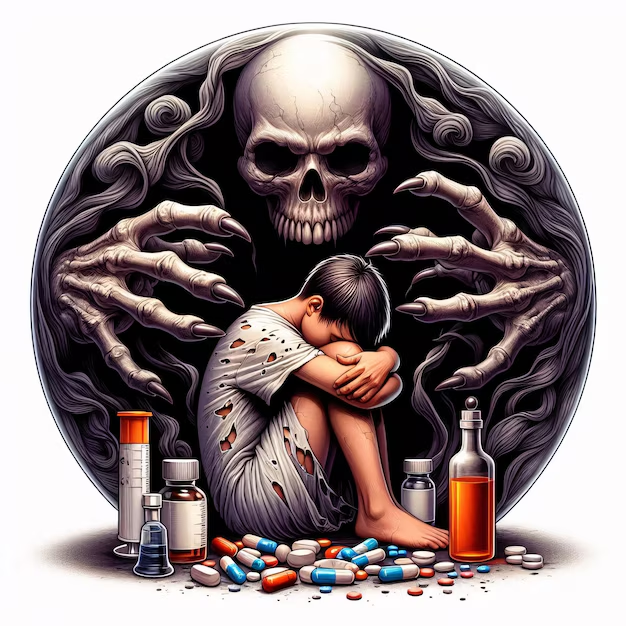
Brothers and sisters, over the past few years we have watched a crisis grow in our society. It is destroying lives, breaking families and corrupting our young people, and for many it has ended in an early death. That crisis is drugs: the taking of them, and the buying and selling of them.
These are not numbers we hear on the news and then forget. Behind every statistic is a son or a daughter, a brother or a sister, a mother or a father, and behind every death is a family left to carry the grief.
It often begins with something small. Curiosity, perhaps, or wanting to fit in. Perhaps someone is struggling at home, lonely or under pressure, and looking for an escape. But curiosity can become addiction, addiction can become debt, and debt can become the kind of desperation that leads a person into crime and into places they never imagined.
Nor can we ignore how the drug trade is bound up with gangs, exploitation and violence.We must be responsible with our words. Not every knife crime is caused by drugs, and to claim so would be neither accurate nor fair. But the world around illegal drugs exposes vulnerable people to gangs, debt and violence.
I am not repeating something I read in a newspaper. We have seen young brothers drawn into the drug trade through manipulation, false promises and what looked like kindness. Someone says, “Akhi, come, let me buy you some chicken and chips.” Then there is a new pair of Air Forces. To a young man who has never owned expensive trainers, and may not have money for a simple meal, it feels like real care. He thinks he has met a good brother who is looking out for him.
Later the same person comes back: “Akhi, remember those trainers? Remember that food? There is plenty more where that came from. I just need one small favour. Take this bag to this address.”
Then comes another favour, and another. Kindness turns into obligation and friendship into manipulation, and before he understands what has happened he is trapped in something he never meant to enter. The person who seemed to be helping him was grooming him to be exploited. Not every danger announces itself. Sometimes it arrives dressed as generosity and belonging.
What hurts most is that the people caught up in this are not strangers to us. They attend our masajid, sit in our classrooms and walk our streets, and some of them are in our own homes.
I say this pointing the finger at myself first. Are we speaking to our young people before they fall into these environments, or only after something has gone terribly wrong? Can a young person who is struggling go to his parents, his imam or his teacher and say, ‘I need help’, without being met at once with shame and anger? Or do we only realise how serious it was when the police arrive, when the hospital calls, or when we stand together to pray the janazah of someone who had their whole life ahead of them?
Islam does not teach us to wait for tragedy before we act. Allah says:
And do not throw [yourselves] with your [own] hands into destruction.
Qur’an, 2:195
And He says:
And do not kill yourselves [or one another]. Indeed, Allah is to you ever Merciful.
Qur’an, 4:29
Ours is a religion of protection. The Shari‘ah came to safeguard a person’s faith, life, intellect, family, wealth and dignity.
You already know that drugs are haram. Our children know it too; many have been taught it since their earliest years at maktab. So I do not want to ask whether drugs are haram. I want us to reflect on why Allah has forbidden them, and what He is protecting us from.
The Shari‘ah places great weight on the preservation of life and of the intellect, hifz al-nafs and hifz al-‘aql. Allah has given every human being ‘aql: the ability to think, to reason, to tell right from wrong and to choose. It is through the intellect that we understand His commands, recognise the truth and restrain our desires. The Shari‘ah treats anything that deliberately clouds or destroys it with great seriousness.
Consider what an intoxicant does. Judgement weakens. A person may harm himself or someone else, or spend money meant for his family. In time the next dose matters more than his family, his work, his health and even his relationship with Allah. What he believed he controlled begins to control him. The prohibition guards far more than the body against a substance. It guards the mind, the family and a person’s relationship with his Creator.
Someone may say, “It is my body and my choice. I am not hurting anyone.” That is not how Islam teaches us to think. You are a son or a daughter, a husband or a wife, a father or a mother, a neighbour and a member of this Ummah. The Messenger of Allah ﷺ said:
There should be neither harming nor countering harm.
[Ibn Majah]
Think of the young man who starts taking drugs. Who lies awake when he does not come home, wondering whether he has been arrested, whether he has overdosed, whether he is lying unconscious somewhere? His mother. Who watches a loving son slowly become someone else? His father, his brothers and his sisters. If he is married, who suffers when the money for rent and food goes on drugs? His wife. And when a father’s mind, money and life revolve around an addiction, his children lose him even while he is in the house. The harm travels from the person to the family, from the family to the community, and sometimes on through generations.
So when we speak to our children, it is not enough to say, “Don’t take drugs, they are haram”, and think our duty is done. We must teach them the commands of Allah, and the wisdom behind them too: that Allah has given them a mind, a body, a life, a family and an iman worth protecting, and that each of us will stand before Him and answer for how we treated what He entrusted to us.
There is another side to this that we cannot ignore. What of the person who has already fallen? Do we tell him he is a disgrace and should keep away from the masjid? No. We must hate the sin without forgetting the human being.
Ibn al-Jawzi records in al-Tabsirah that Abu al-Darda passed by a man who had committed a sin while people were insulting him. He asked them, “If he had fallen into a well, would you not pull him out?” They said they would. He said, “Then do not insult your brother, and praise Allah who spared you what he fell ” They asked, “Do you not hate him?” He replied, “I hate what he did. If he leaves it, he is my brother.”
Allah says:
Say, “O My servants who have transgressed against themselves [by sinning], do not despair of the mercy of Allah. Indeed, Allah forgives all sins. Indeed, it is He who is the Forgiving, the Merciful.
Qur’an, 39:53
A person may have spent years destroying himself and running from Allah, yet if he turns back sincerely, the door of tawbah is open. Who are we to make him despair? Often the person who needs the masjid most is the one too ashamed to walk through its doors. We need to be a community that opens that door, listens, advises and supports people towards the right help. We remind them of Allah’s mercy, and we help them take the practical steps to recover.
There is one more group I must address, and I know it may upset some. To those selling drugs: fear Allah. Do not think He is unaware of what you do. He sees the money made from drugs and then washed through so-called halal businesses. He sees the tinted cars going from street to street to check that customers have been served and workers are doing their job. He sees the Islamic reminders on the branding, and what goes on behind closed doors.
Leave that life now, before it is too late. Perhaps you feel you are winning: the car, the designer clothes, the holidays, the big house. But ask yourself honestly whether any of it is worth your eternity. Will you trade Jannah for a few years of luxury that can vanish overnight? That life does not bring the peace it promises. You are always looking over your shoulder, afraid of the police or of someone you have crossed. If you cannot sleep at night, what have you gained? And what will you say to Allah when you stand before Him?
The Prophet ﷺ said:
A wise man is the one who calls himself to account and does noble deeds to benefit him after death; and the foolish person is the one who subdues himself to his temptations and desires and seeks from Allah the fulfilment of his vain desires.
[Tirmidhi]
O Allah, relieve those among the Muslims who are weighed down by worry. Heal our sick and the sick of the Muslims, forgive our dead and the dead of the Muslims, and do not deprive us of Your mercy on the day we meet You.
Ameen.
The main reasons why drugs are prohibited in Islam:
Preservation of the Intellect (Aql):
The intellect is one of Allah’s greatest gifts to human beings, distinguishing them from other creatures and enabling them to understand accountability, morality, and faith. Drugs impair cognitive function, cloud judgment, and alter the state of the mind, preventing a person from thinking clearly and remembering Allah.
Protection of Physical and Mental Health:
Islam strictly forbids self-harm. Allah says in the Quran: “And do not throw yourselves into destruction” (Surah Al-Baqarah, 2:195) and “Do not kill yourselves. Indeed, Allah is to you ever Merciful” (Surah An-Nisa, 4:29). Modern science confirms that drugs—both illegal substances and prescription drug abuse—cause severe physical, psychological, and neurological damage, often leading to fatal consequences.
Prevention of Harm to Family and Society:
Drug addiction frequently leads to the breakdown of families, domestic abuse, child neglect, and financial ruin. On a societal level, the drug trade fuels crime, violence, corruption, and instability. By banning intoxicants, Islam aims to foster a healthy, safe, and productive society.
Financial Responsibility:
Wealth is viewed as a trust from Allah, and it should be spent on necessities, charity, and the well-being of one’s family. Wasting money on harmful substances is considered israf (extravagance) and tabdheer (squandering), which the Quran explicitly condemns: “Indeed, the squanderers are brothers of the devils” (Surah Al-Isra, 17:27).
Obstruction of Spiritual Duties:
Islam requires Muslims to remain conscious and focused during daily prayers (Salah) and other acts of worship. Intoxicants make a person neglectful of their spiritual obligations and remembrance of Allah. The Quran states: “O you who have believed, indeed, intoxicants, gambling, [sacrificing on] stone altars [to other than Allah], and divining arrows are but defilement from the work of Satan, so avoid it that you may be successful” (Surah Al-Ma’idah, 5:90).
Ultimately, prohibitions in Islam are not meant to restrict human freedom arbitrarily, but rather to protect individuals and communities from harm, ensuring physical, mental, social, and spiritual well-being.