
Whenever a Muslim family comes together to enjoy a halal meal, it is very likely—almost without a doubt—that the food laid out on their table has been produced, processed, and exported by a country where the majority of the population may not be Muslim. This means that the ingredients and products they consume often originate from nations that do not follow Islamic dietary laws themselves.
Take a moment to pause and reflect on that.
Halal goes beyond mere food choices; it is an act of worship and a religious duty. It holds deep personal significance and is closely connected to a Muslim’s faith. However, in today’s global economy, the provision of this religious requirement is largely managed by external parties.
This is a fact backed by concrete data.
Who Truly Supplies the Halal Market?
Based on widely referenced and extensively cited statistics from the comprehensive State of the Global Islamic Economy Report, along with further detailed academic studies and research analyses, the top halal exporters worldwide are identified as follows:
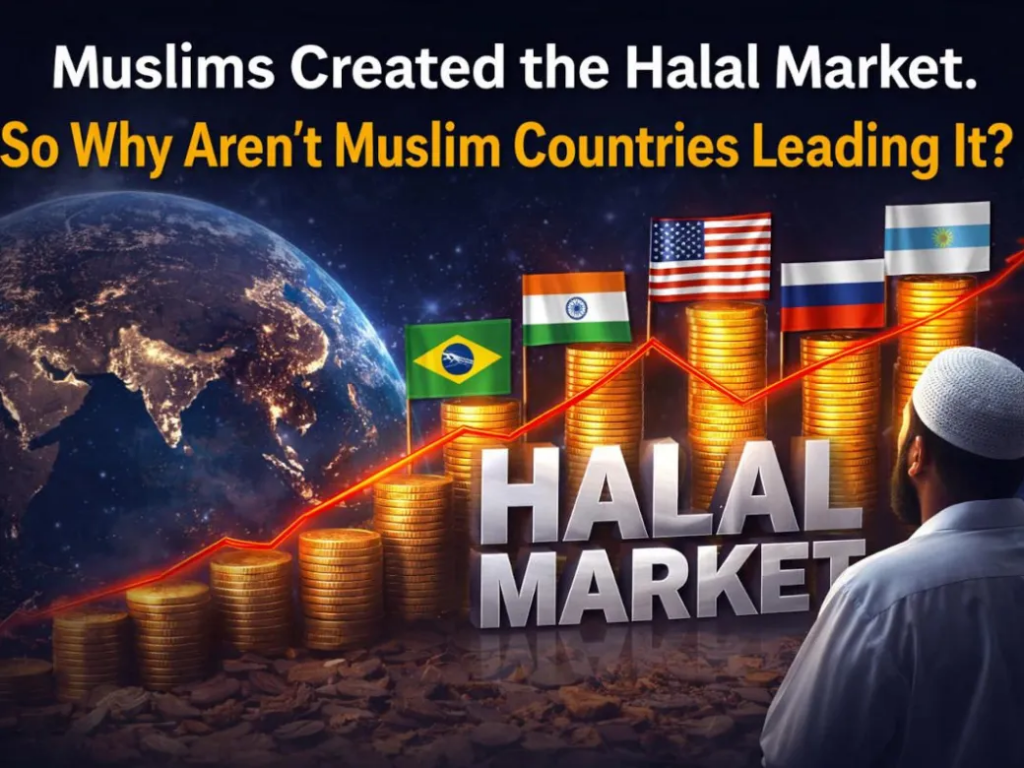
Brazil — $16.2 billion
India — $14.4 billion
United States — $13.8 billion
Russia — $11.9 billion
Argentina — $10.2 billion
Together, these five countries export over $66 billion worth of halal products annually.
Remarkably, none of them are Muslim-majority nations.
To Be Clear: This Is Not a Criticism of Anyone
Before proceeding, it’s important to state clearly and unambiguously: this is not a critique of non-Muslims—whether they are Christian, Hindu, Jewish, Buddhist, or follow any other religion or none at all.
In fact, countries such as Brazil, India, and the United States deserve commendation.
They are the individuals or groups who play a significant role in the situation or context being discussed. These people can influence outcomes, contribute to decisions, or be directly affected by the events taking place. Understanding who they are and what their perspectives might be is essential for gaining a comprehensive view of the matter at hand.
Respected halal requirements
Invested in infrastructure
Built reliable systems
Delivered consistency
Earned the trust of global halal markets
Their success is the result of vision, discipline, and execution.
The problem is not that they succeeded.
The problem is that we were largely absent.
The Halal Paradox: We Created the Demand, Others Mastered the Supply
The global halal economy is not a niche market. It is one of the fastest-growing segments of the world economy:
It is already worth over $7 trillion globally
It is projected to approach $10 trillion within a few years
The Muslim population now exceeds 2 billion people worldwide
One would naturally expect Muslim countries to be leading the charge in this rapidly growing market—taking the initiative in designing the industry standards, owning and managing the prominent brands, and playing a dominant role in controlling and directing the entire supply chain process from start to finish.
Instead, the reality is starkly different.
We are primarily consumers, not controllers.
We drive the demand, while others dominate the supply.
This paradox should alarm every serious Muslim entrepreneur, policymaker, and investor.
A Deeper Challenge: Structural Weakness, Not a Temporary Gap
This issue goes beyond rankings or short-term imbalances. Institutional data exposes a deep-rooted, long-term structural problem:
OIC (Organisation of Islamic Cooperation) countries face a significant halal trade deficit.
Halal imports far surpass exports.
Intra-OIC trade in halal products remains limited.
Only a handful of Muslim-majority countries rank among the top 20 halal exporters worldwide.
Simply put: the Muslim world is consuming more halal products than it produces.
This is no temporary oversight—it represents a systemic failure.
Why Are Non-Muslim Countries Leading the Halal Industry?
The reasons are not theological but industrial, strategic, and economic.
- They Built Scale
Brazil’s rise as a global halal leader is no accident.
They developed:
- Large-scale poultry and meat processing plants
- Integrated supply chains from farms to ports
- Production systems tailored for export to halal markets
They produce at scale and export at scale.
Scale drives lower costs, consistent quality, and global market dominance.
- They Mastered Logistics
Logistics determines success in global trade.
Cold chains, shipping routes, storage, customs efficiency, and port infrastructure matter far more than political rhetoric.
In many cases, these countries can transport halal meat across continents more efficiently than some Muslim countries move goods within their own borders.
Whoever controls logistics controls market access.
3. They Treated Halal as a Serious Business, Not Just a Symbol
For many of these exporters, halal is not just a religious label; it is a global quality standard.
To them, halal certification signals:
Cleanliness
Safety
Traceability
Ethical processing and handling
This makes halal products appealing not only to Muslims, but also to non-Muslims who want higher standards of quality and safety.
They expanded the market.
We, on the other hand, often restricted it—treating halal as a narrow religious label rather than a competitive advantage or a comprehensive standard of excellence.
4. Capital Went Into Consumption, Not Production
This is perhaps the most uncomfortable truth.
For decades, large portions of Muslim wealth have flowed into:
Real estate in foreign markets
Luxury assets and lifestyles
Passive financial investments
Meanwhile, others were investing in:
Food production
Processing industries
Agricultural technology
Export infrastructure and logistics
They invested in supply chains.
We invested in consumption.
The result? They now own the factories, distribution networks, and brands that feed us.
The Hidden Cost of This Failure
This is not just about pride, identity, or symbolism. It is about lost economic power and strategic vulnerability.
Every halal product passes through a chain:
Farm → Processing → Certification → Logistics → Distribution → Retail
The real value is not only at the retail shelf.
The real power lies in owning the chain.
When Muslim countries do not control that chain, they lose:
Jobs that could employ millions of young people
Industrial capacity that could build broader economies
Export revenue that could strengthen currencies and national budgets
Strategic leverage in global trade and food security
In other words, we are not just importing food.
We are importing dependence.
Where Do We Go From Here?
If the global halal economy is already worth trillions and still growing, then this is not merely a missed opportunity—it is an urgent call to action.
For Muslim entrepreneurs, investors, and policymakers, the questions are now unavoidable:
Will we continue to be passive consumers in an economy built around our religious obligations?
Or will we finally invest in the farms, factories, technologies, and systems that allow us to lead this sector?
The halal economy is booming. The only remaining question is whether Muslims will remain on the sidelines—or decide, with intention and strategy, to own the future of halal.