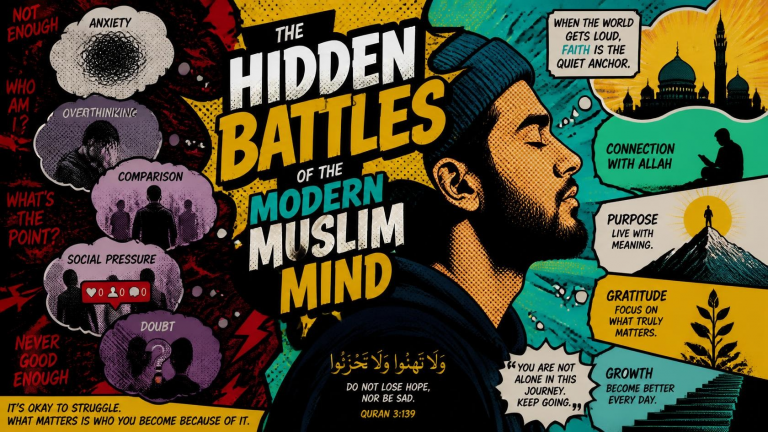
In recent years, there has been growing interest in the relationship between Islam and mental health. Many people assume that mental health care is a purely modern, Western development. In reality, the Muslim world has a deep and rich history of psychological insight, compassionate treatment, and even early forms of psychiatric hospitals. This legacy is now inspiring a new wave of “Islamic psychology” that integrates faith and mental well‑being.
1. How Islam Views the Human Being
At the heart of Islam is a holistic view of the human being. The Qur’an and Sunnah describe the person as a unified whole composed of:
Qalb (heart) – the spiritual and emotional center, where faith, sincerity, and intentions reside.
ʿAql (intellect/mind) – the faculty of reasoning, reflection, and decision‑making.
Nafs (self/ego) – the inner self that struggles between desires and discipline.
Rūḥ (spirit) – the divine breath and source of life given by Allah.
This multi‑dimensional view avoids reducing a person to just their body or just their thoughts. It recognizes that emotional and psychological suffering can be linked to physical, spiritual, social, and moral factors. This integrated perspective lies at the core of the Islamic approach to mental health.
2. Mental Health in the Qur’an and Sunnah
The Qur’an acknowledges human vulnerability to fear, sadness, grief, and anxiety. The stories of the Prophets show that even the most righteous experienced emotional pain:
Prophet Yaʿqub (Jacob) عليه السلام grieved deeply over the loss of Yusuf, to the point that “his eyes turned white from sorrow, and he was suppressing his grief.”
Prophet Musa (Moses) عليه السلام expressed fear and asked Allah for support when facing Pharaoh.
Prophet Muhammad ﷺ endured emotional hardship during the Year of Sorrow, losing both his beloved wife Khadijah رضي الله عنها and his uncle Abu Talib in a short time.
At the same time, the Qur’an offers powerful tools for emotional resilience:
Tawakkul (reliance on Allah)
Sabr (patience, steadfastness)
Dhikr (remembrance of Allah)
Tawbah (repentance and spiritual renewal)
Duʿa (supplication, intimate conversation with Allah)
These are not meant to dismiss pain, but to give it meaning, direction, and hope. They strengthen the heart while recognizing that human beings will struggle.
3. Early Muslim Scholars and the Science of the Mind
As the early Muslim community expanded, scholars didn’t only preserve revelation—they also engaged deeply with medicine, philosophy, and the nature of the mind. Several key figures contributed to what we would now call psychology and psychiatry.
Al‑Rāzī (Rhazes) (d. 925 CE)
A prominent physician who wrote extensively on diseases of the body and mind.
Emphasized observation, clinical notes, and individualized treatment.
Acknowledged the impact of emotions, lifestyle, and environment on mental well‑being.
Ibn Sīnā (Avicenna) (d. 1037 CE)
Author of Al‑Qānūn fi’l‑Tibb (The Canon of Medicine), a standard medical text in Europe for centuries.
Described mental and emotional disorders such as melancholia, mania, and obsession.
Recognized the connection between thoughts, beliefs, physical symptoms, and emotions, anticipating modern psychosomatic medicine and cognitive approaches.
Al‑Ghazālī (d. 1111 CE)
A theologian, jurist, and spiritual master whose works are central to Islamic spirituality.
Wrote about purification of the heart, diseases of the soul (envy, arrogance, despair), and methods for spiritual and emotional healing.
His approach combines beliefs, inner dialogue, habits, and spiritual practices, very similar to modern integrative psychotherapy.
Ibn al‑Qayyim (d. 1350 CE)
Student of Ibn Taymiyyah, wrote about the relationship between the heart, body, and soul.
Emphasized that emotional illnesses can be treated with a mix of sincere faith, repentance, gratitude, and practical action.
These scholars didn’t see a conflict between religious knowledge and scientific observation. Instead, they saw mental health as an area where both must come together.
4. Bimaristans: The World’s First Psychiatric Hospitals
One of the clearest historical breakthroughs of the Muslim world in mental health is the development of bimaristans – hospitals that included dedicated wards for mental illnesses.
Key Features of Bimaristans
Compassionate care: Patients with mental illness were not chained in dungeons or treated as possessed outcasts. They were treated as sick people deserving care and dignity.
Holistic treatment:
Medication and herbal remedies
Water therapy and baths
Light, air, and pleasant surroundings
Listening to Qur’an and calming sounds
Counseling and compassionate conversation
Institutional support: These hospitals were funded by waqf (charitable endowments), making treatment free or affordable.
Cities such as Baghdad, Damascus, and Cairo became known for their advanced hospitals where mental health was taken seriously centuries before modern Western psychiatry developed.
5. The Spiritual Psychology of the Nafs
Islamic scholars developed a nuanced understanding of the nafs (self/ego), which overlaps with what we might call personality, motivation, and inner conflicts.
They commonly described three states of the nafs:
An‑Nafs al‑Ammārah bi’s‑Sū’ – the commanding self that calls towards evil and desires.
An‑Nafs al‑Lawwāmah – the self‑reproaching soul that feels guilt, struggles, and self‑reflection.
An‑Nafs al‑Muṭma’innah – the tranquil soul at peace with Allah’s decree.
This framework is deeply psychological:
It recognizes inner struggle and self‑sabotage.
It acknowledges guilt and self‑criticism as part of growth (if used constructively).
It offers a vision of inner peace as the highest state, reached through faith, moral growth, and remembrance of Allah.
Today, many Muslim therapists draw on this classical model to help clients understand their inner conflicts in a spiritually meaningful way.
6. Colonialism, Modernity, and the Decline of Islamic Mental Health Institutions
Despite this rich tradition, much of the Muslim world experienced a decline in its scientific and institutional leadership due to political fragmentation, colonization, and intellectual disruption.
Many traditional bimaristans fell into neglect or were replaced by Western‑style institutions that often ignored the spiritual dimension of the person.
Some Muslims began to see mental illness either only as jinn, sihr (magic), or weak faith, or only as a Western medical issue, losing the integrated balance that earlier scholars had.
The language and heritage of Islamic psychology were marginalized in favor of imported models that didn’t always fit Muslim cultural and religious realities.
The result was a gap: people suffering mentally were either over‑spiritualized (told just to read ruqyah) or over‑medicalized (treated as brain chemistry only), with little room for a truly holistic approach.
7. The Modern Islamic Psychology Revival
In recent decades, Muslim scholars, clinicians, and researchers have begun reviving and rebuilding Islamic psychology as a professional field.
This revival includes:
Academic research into classical texts on the self, heart, and soul, and how they relate to mental health today.
Clinicians integrating faith and therapy, using evidence‑based treatments (like CBT, trauma therapy, etc.) while respecting Islamic values and spiritual needs.
Training programs and institutes that specialize in Islamic psychology, teaching therapists how to work competently with Muslim clients.
Imams and community leaders partnering with mental health professionals to address stigma, educate communities, and encourage people to seek help.
Where earlier eras built hospitals and wrote medical texts, the modern era is building counseling centers, online platforms, training courses, and community awareness campaigns.
8. How Islamic Teachings Support Mental Well‑Being
Islam doesn’t only recognize mental suffering—it offers tools to cope, heal, and grow. Some key concepts include:
1. Tawakkul (Trust in Allah)
Trusting Allah’s plan does not mean doing nothing. It means taking the means—therapy, medication, lifestyle changes—while believing the ultimate outcome is in His hands. This can relieve the pressure of feeling fully responsible for everything.
2. Sabr (Patience and Steadfastness)
Sabr is not passive suffering. It’s active endurance, staying committed to prayer, treatment, and positive action even when it’s hard—knowing that every moment of struggle can raise your rank with Allah.
3. Dhikr and Duʿa
Regular remembrance of Allah, recitation of Qur’an, and personal supplication calm the heart and provide a sense of connection and safety that many people with anxiety and depression deeply need.
4. Community and Ummah
Islam strongly emphasizes brotherhood and sisterhood. Friday prayer, family ties, visiting the sick, and supporting the vulnerable are all forms of social connection that protect mental health and fight isolation.
5. Hope and Mercy
Islam constantly calls believers to hope in Allah’s mercy, no matter how dark things feel:
“Do not despair of the mercy of Allah.”
This message is crucial for those drowning in guilt, shame, or despair. It says: You are never too broken to be loved by your Creator.
9. Moving Forward: Integrating Faith and Professional Care
The true Islamic legacy in mental health is not choosing between religion and science, but uniting them in service of human well‑being.
For Muslims today, that means:
Seeking qualified mental health professionals, and when possible, those who understand or respect Islamic values.
Using duʿa, dhikr, and spiritual practices as sources of strength—not as replacements for necessary treatment, but as partners.
Educating communities to reduce stigma, so that seeking help is seen as responsible and courageous, not shameful.
Reviving the rich intellectual and spiritual heritage of Islamic psychology, so future generations understand that caring for the mind and heart is part of our deen.
Conclusion
Islam has a long, profound, and often forgotten history of engagement with mental health. From early bimaristans and pioneering scholars to today’s growing field of Islamic psychology, the message is clear:
The mind matters.
The heart matters.
The soul matters.
And caring for all three is an act of worship.
By rediscovering this legacy and applying it in our modern context, Muslims can build mental health systems that are not only clinically effective, but also spiritually nourishing and true to the values of Islam.