The Battle of Tabuk marked the Prophet’s final military expedition. The Muslims set out in Rajab during the ninth year after the Hijrah and travelled to the region of Tabuk. The area took its name from a tall, fortified structure that stood beside a spring on the road from Hijr to Damascus, near the Syrian border. For the Muslims, the expedition became one of their most difficult trials.
The Roman Threat
At that time, Rome stood as Iran’s only powerful rival and possessed immense political and military strength. The Romans took great pride in their victories over Iran and the defeats they had inflicted on the Iranian army.
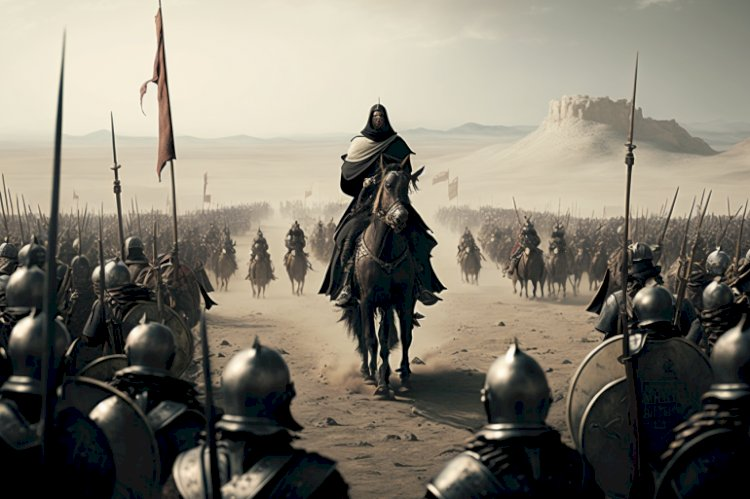
The Roman army included 4,000 cavalrymen and infantry soldiers. It carried the most advanced armour available at the time and established its camp along the Syrian frontier. Several tribes from the border regions, including Lakham, ‘Amilah, Ghassan, and Jazam, joined the Romans. Their vanguard advanced as far as Balqa’.[1]
Trade caravans travelling between the Hijaz and Syria brought the Prophet news of the Roman encampment. He saw no alternative but to confront the aggressors with a large army. He also needed to protect Islam from surprise attacks after the Muslims had established the religion through the sacrifices and lives of their loved ones. Islam had taken root and now stood ready to spread throughout the world.
The news reached the Prophet at a difficult time. The people of Medina had not yet gathered their harvest, the dates were about to ripen, and Medina and its surrounding areas faced severe food shortages. Nevertheless, devoted believers placed spiritual life, the protection of noble ideals, and striving in the path of Allah above worldly comfort.
Invitation to Join the Army
The Prophet understood the Romans’ strength and military experience. He knew that victory would require more than spiritual commitment, including faith in Allah and the willingness to fight for His sake. The Muslims would also need a large army.
For this reason, the Prophet sent representatives to Makkah and the areas surrounding Medina. They invited Muslims to fight in the path of Allah and asked wealthy Muslims to fund the expedition by paying zakat.
Soon after the Prophet made the announcement, 30,000 people volunteered to join the army. They gathered at Medina’s military camp, Thaniyya tul Wida’. The Muslims funded the expedition by collecting zakat. The army included 10,000 mounted soldiers and 20,000 infantrymen. The Prophet later instructed each tribe to select its own standard.[2]
Those Who Refused to Participate
The Battle of Tabuk exposed the difference between sincere believers, pretenders, and hypocrites. The Prophet called for general mobilisation during an extremely hot season, while Medina’s business community prepared to harvest the dates. Some people refused to join the army and offered various excuses. Their actions revealed their true character, and the Qur’an condemned their behaviour.
Some people declined to take part in this sacred jihad for the following reasons:
- When the Prophet invited Jadd ibn Qays, an influential man, to join the army against the Romans, he replied:
“I have a fanatical attachment with women. I am, therefore, afraid that I may chance to see Roman women and may not be able to control myself.”
The Prophet heard this childish excuse and left Jadd alone while he invited others. Allah condemned Jadd in verse 49 of Qur’an 9.
- The hypocrites had outwardly accepted Islam but had no genuine interest in the faith. They discouraged people from joining the expedition and used different excuses, including the intense heat. Divine revelation answered their objection in verse 81 of Qur’an 9.
Some hypocrites also frightened the Muslims by saying:
“The Arabs are not competent to fight with the Romans and consequently all the participants in the battle will be tied with ropes and sold in the free markets.”[3]
- Another group included Ka’b, Hilal, and Mararah. They sincerely believed in Islam and wanted to join the jihad, but they had not yet gathered their harvest. They decided to collect it first and join the Muslim army afterwards.
The Holy Qur’an identifies these three men in Surah al-Tawbah 9:118. When the Prophet returned from Tabuk, he reprimanded them severely. Their experience became an important lesson for others.
Why Imam Ali Did Not Participate in the Battle
Imam Ali accompanied the Prophet and carried his standard in every major Islamic battle except Tabuk. On this occasion, the Prophet ordered him to remain in Medina instead of joining the army.
The Prophet knew that the hypocrites and certain members of Quraysh might try to create disorder and overthrow the newly established Islamic government while he remained away. He therefore needed someone trustworthy to protect Medina.
Tabuk marked the farthest point the Prophet travelled during his military expeditions. He understood that anti-Islamic groups might use his absence to cause trouble and call their supporters from different regions to help them.
Although the Prophet appointed Muhammad ibn Maslamah to represent him in Medina, he also entrusted Ali with protecting the Ahl al-Bayt, his relatives, and the Muhajirun. He told Ali:
“You are the guardian of the Ahl al-Bayt, my kinsfolk, and the group of the Muhajirs. None except myself and you are suited for this task.”
Ali’s presence greatly disturbed the conspirators. They realised that they could not carry out their plans while he remained alert and watchful.
The conspirators therefore created another rumour. They claimed that the Prophet had repeatedly asked Ali to join the jihad but that Ali had refused because of the long journey and the intense heat.
Ali went to the Prophet and explained what the conspirators were saying. The Prophet then declared:
“O my brother! Return to Madina, because none is more suited to preserve the dignity and position of Madina than myself and you. You are my representative amongst the Ahl al-Bayt and my kinsfolk. Don’t you feel happy when I say that your relationship with me is similar to the one which existed between Harun and Musa except that no prophet will come after me. Just as Harun was the immediate successor of Prophet Musa, you are my successor and Caliph after me.”[4]
The Muslim Army Advances Towards Tabuk
The Prophet usually kept the destination of his military expeditions secret. When he travelled to confront people who obstructed the spread of Islam, planned to attack the Muslims, or held hostile intentions, he often avoided the main routes. This strategy prevented the enemy from discovering his plans and allowed the Muslim army to approach unexpectedly.[5]
However, the Prophet openly announced the destination of the Tabuk expedition. The Roman forces had gathered along the Syrian frontier to attack Muslim territory, so the Muslims needed to understand the journey’s purpose and prepare for its difficulties. They also needed to carry enough food, water, and other provisions.
The Prophet also sought support from the tribes of Tamim, Ghatfan, and Tayyi’. These tribes lived far from Medina, so he wrote to their chiefs. He also wrote to ‘Atab ibn Usayd, the young governor of Makkah, and invited the tribes and the people of Makkah to join this sacred jihad.
Because the Prophet needed widespread support, he could not organise the expedition secretly. He therefore explained its purpose and importance to the tribal chiefs. This allowed them to prepare sufficient provisions and riding animals for their warriors.