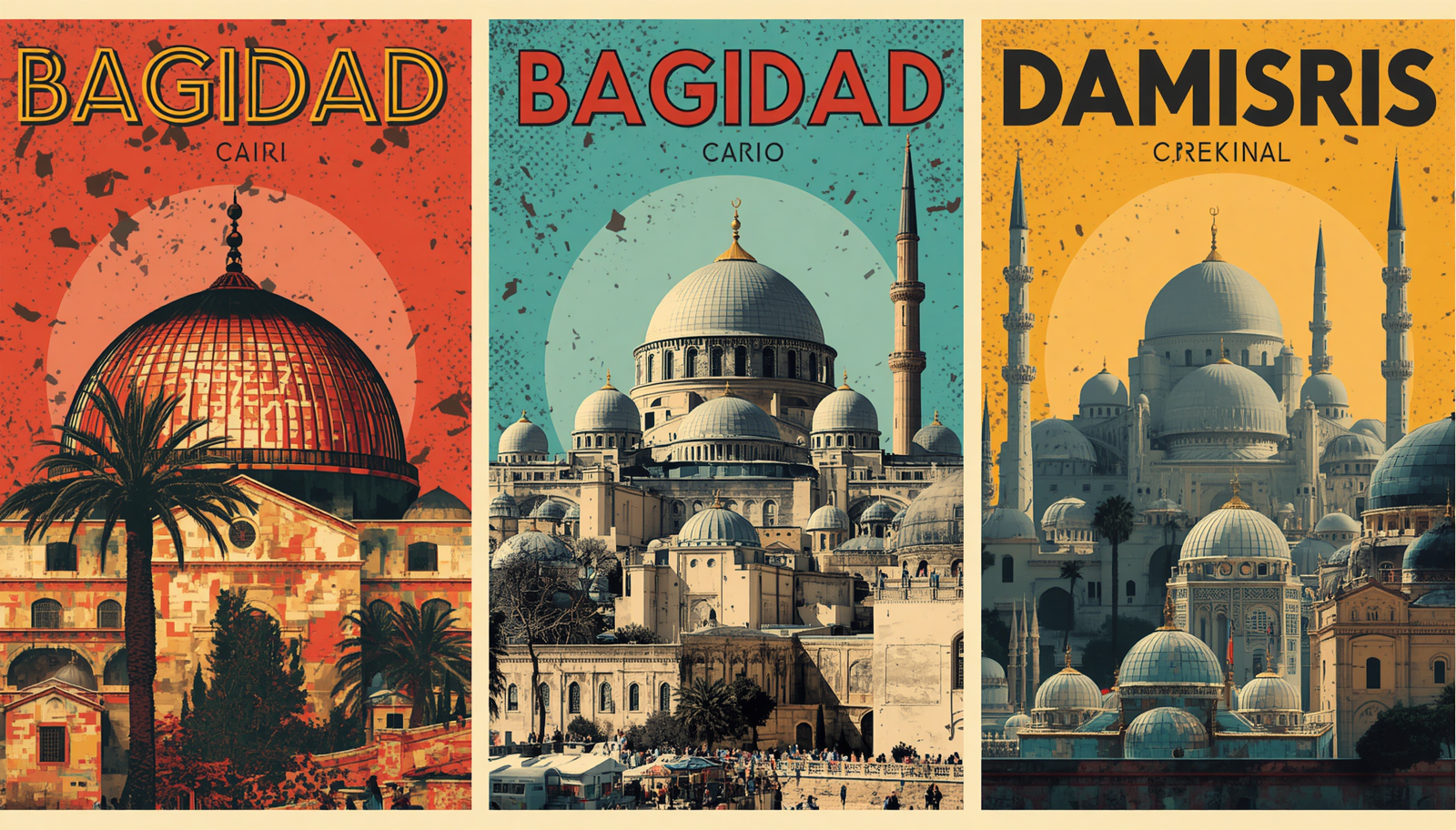
When we think about the cities that shaped our world, a few familiar names usually come to mind: Athens, Rome, London, Paris. But there is another story we often overlook — a story of Muslim cities whose names many people forget, even though their ideas still shape our science, architecture, trade, and daily lives. These are some of the Muslim cities that quietly helped build the modern world.
Baghdad was founded in 762 CE by the Abbasid caliph al-Mansur. For a time, it was the intellectual capital of the world. The city was designed as a perfect circle, symbolizing order in the universe. At its heart stood Bayt al-Hikmah, the House of Wisdom. There, Muslims, Christians, Jews, Persians, and others worked together to translate and expand the knowledge of Greece, Persia, India, and more. From Baghdad came algebra and algorithms through the work of al-Khwarizmi, important medical texts by scholars like al-Razi, and major advances in astronomy and geography, including better measurements of the Earth. Every time we solve equations or rely on algorithms, we are still using Baghdad’s intellectual legacy.
In 10th-century Europe, many cities were dark and muddy after sunset. Córdoba, in Muslim Spain (al-Andalus), was very different. It had lit streets, public baths, paved roads, and libraries filled with books. Under rulers like ʿAbd al-Raḥmān III and al-Ḥakam II, Córdoba became a great center of learning, with big libraries and universities. It was also a medical hub, where doctors carefully recorded clinical observations. The city was a cultural crossroads where Muslims, Christians, and Jews met and sometimes thrived together. Its Great Mosque, with its famous red-and-white arches, influenced Islamic architecture for centuries. Translation movements in al-Andalus helped carry knowledge into Christian Europe and supported the early beginnings of the Renaissance.
Farther east, in Central Asia, Samarkand flourished at the crossroads of the Silk Road. Under the Timurids, especially Ulugh Beg in the 15th century, Samarkand became a leading center for astronomy. Ulugh Beg’s observatory created very accurate star catalogs, listing more than a thousand stars, along with precise calculations of the length of the year and advanced trigonometric tables used by navigators and astronomers. In its markets and schools, Persian, Turkic, Arab, Indian, and Chinese influences came together. Samarkand shows us that scientific progress often grows where different cultures meet and interact.
Today, many people use “Timbuktu” as a symbol of a faraway, forgotten place. In the 15th and 16th centuries, it was the opposite: a lively center of learning and trade at the edge of the Sahara. Connected to the trans-Saharan trade routes, Timbuktu grew rich through the exchange of gold, salt, and manuscripts. Its mosques — such as Sankore and Djinguereber — also served as universities. Scholars there studied law, theology, mathematics, astronomy, medicine, trade, and politics. The surrounding region is believed to have held hundreds of thousands of manuscripts. Their survival challenges narrow ideas about where high-level scholarship and culture existed in the past, especially in West Africa.
Before modern Cairo became a huge city, there was Fustat, the first Muslim capital of Egypt, founded in the 7th century. Together, Fustat and later Cairo became powerful centers of trade, learning, and government. From these cities, glass, textiles, and paper were traded across the Mediterranean. Scholars there developed legal and religious ideas that shaped Sunni traditions, and administrators created financial and bureaucratic systems that helped run large empires. Cairo’s al-Azhar, founded in the 10th century, grew into one of the world’s oldest universities and remains an important center of Islamic learning today.
Persian poets used to say, “Isfahan is half the world.” Under the Safavids, Isfahan became a model of urban design. Naqsh-e Jahan Square brought mosque, palace, and bazaar together in one grand space, reflecting a balance between faith, politics, and daily life. Isfahan became famous for its beautiful buildings with turquoise domes and detailed tilework, for engineering achievements such as bridges and water systems, and for deep philosophical and mystical thought, especially in Shiʿi and Sufi traditions.
In North Africa, Fez quietly built and maintained a long-lasting educational tradition. At its center is al-Qarawiyyin, founded in 859 CE by Fatima al-Fihri, often described as one of the world’s oldest continually operating universities. From Fez, Maliki legal traditions spread across North and West Africa. The city also supported networks of scholars linking al-Andalus, the Maghreb, and the wider Muslim world. It became known for high-quality leatherwork, textiles, and metal crafts. These cities helped shape what we now understand as the university: a place where knowledge is kept, discussed, and passed down from one generation to the next.
So how did such bright centers of culture and knowledge fade from our usual historical stories? Colonial histories placed European cities at the center and pushed others to the side. New trade routes, after Atlantic sea powers rose, weakened Silk Road and trans-Saharan cities. Wars and political decline damaged institutions, libraries, and infrastructure. School textbooks often simplified the past, jumping quickly from Greece and Rome to modern Europe and skipping the rich centuries in the middle. Yet the ideas born in these Muslim cities did not vanish. They were translated into Latin and European languages and woven into global science, law, and culture.
Even if these cities’ names rarely appear in textbooks, their influence is all around us. In science and math, algebra, algorithms, star tables, and medical encyclopedias laid foundations for many modern subjects. In urban life, public lighting, hospitals, libraries, universities, and thoughtful city planning were developed and improved in many Muslim cities. In trade and finance, contracts, credit tools, and commercial law helped shape how we still do business today. In culture and spirituality, the poetry, philosophy, and theology that grew in these cities continue to inspire people around the world.
Remembering these cities is not only about fixing gaps in history. It is about telling a fuller, richer story of human civilization — one in which Muslims were not only guardians of old knowledge but also creators, inventors, and visionaries. Their streets may now be quieter, their libraries scattered, and their buildings worn by time. But in our equations, our maps, our universities, and our shared ideas of what a city can be, these once-forgotten Muslim cities are still speaking.