

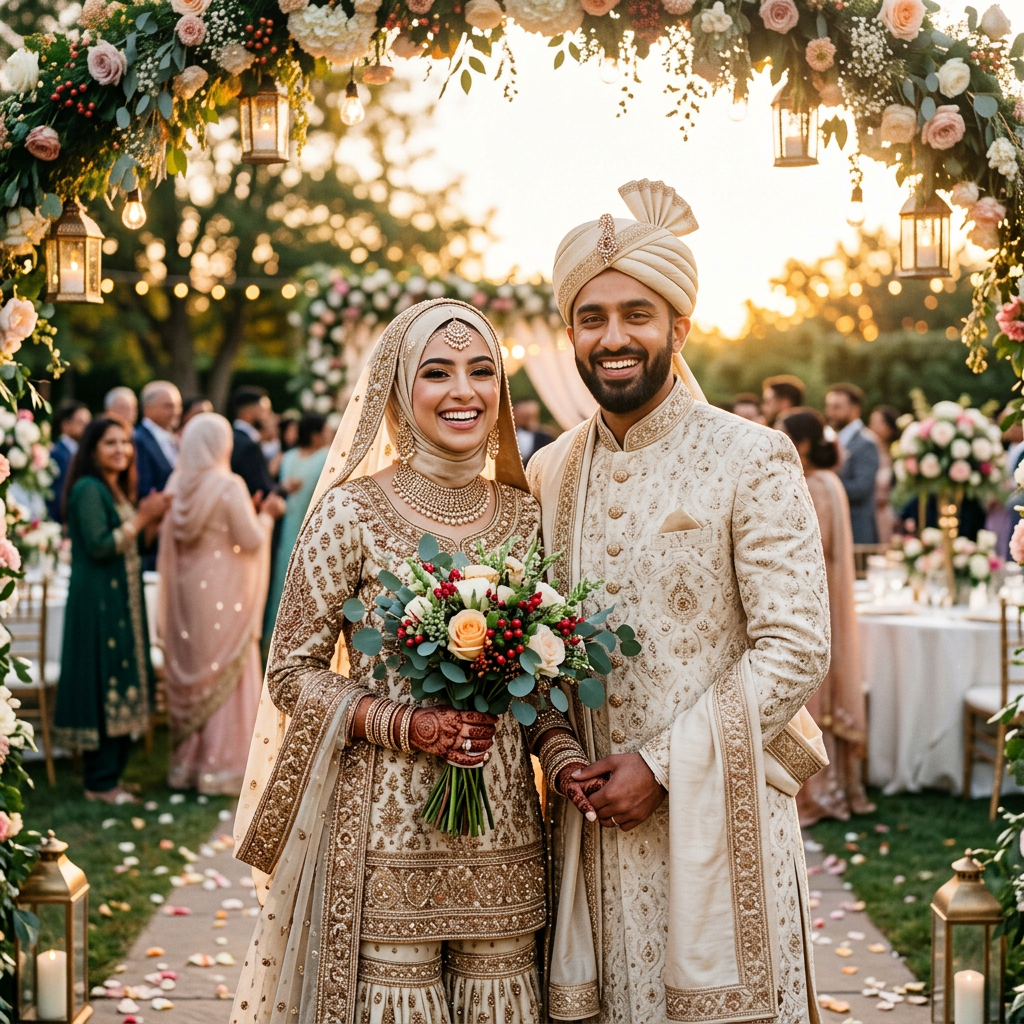
In Islam, marriage is much more than a social arrangement. It is considered an act of worship and a means for a person to complete and safeguard a major part of their faith. Through marriage, a man and a woman build a family based on love, mercy, and mutual rights and responsibilities.
This guide explains, in simple language, how Islam views marriage, the rights of husbands and wives, the conditions for a valid Islamic marriage, and when marriage is encouraged, allowed, or required.
What Is Marriage In Islam?
In Islam, marriage is a contract between a man and a woman. Through this contract, each of them gains specific rights and takes on certain duties. However, it is not a cold or purely legal agreement. Marriage is meant to be a deep bond that connects two people in love, mercy, and respect; becomes the foundation for a healthy family; and helps each spouse grow spiritually and morally.
The Qur’an emphasizes the importance of fulfilling contracts: “O you who have believed, fulfill [all] contracts.” (Qur’an 5:1)
So, in Islam, marriage is both a legal contract with clear terms and rights, and a spiritual bond that brings two souls together under the guidance of God.
Rights Of Men And Women In An Islamic Marriage
Islam places great importance on protecting the rights of both spouses. Each has specific rights over the other, and they also share rights in common.
2.1. A Wife’s Rights Over Her Husband
In Islam, a wife has several guaranteed rights. Among the most important are:
Dowry (Mahr)
The husband must give his wife a dowry at the time of marriage. This is something of monetary value (such as money, gold, or property) agreed upon by both sides. It belongs only to the wife, and the husband has no right to take it back unless she willingly gives it to him.
Financial Support (Maintenance)
The husband is responsible for covering his wife’s basic needs, according to his ability. This includes food and drink, clothing, a suitable place to live, and other everyday needs. This duty remains even if the wife is wealthy. Financial responsibility is part of his role as a husband.
Time, Care, and Non-Neglect
A husband must not abandon or neglect his wife. Classical Islamic scholars mention that he should not leave her for long periods without a valid reason, and when not traveling, he should spend regular nights in the same home and not disappear from her life. The wife has a right to companionship, emotional support, and physical closeness.
2.2. A Husband’s Rights Over His Wife
A husband also has certain rights in marriage. These are meant to help the family function smoothly and protect the marriage.
Leadership of the Family
In Islam, overall leadership of the household is given to the husband, but this leadership is a responsibility, not a privilege for oppression. He must make decisions with wisdom and fairness. His role is to protect, provide, and take care of his family, and the wife is encouraged to cooperate with him in what is good and lawful.
Obedience in What Is Lawful
The wife is expected to obey her husband in matters that are not sinful and do not harm her rights. If he asks her to do something that goes against God’s commandments, she must not obey in that matter. At the same time, he is forbidden from abusing his authority or mistreating her.
Safekeeping of Honour and Property
While the husband is away, the wife is expected to protect her dignity and his honor, and to take care of his home and his property as agreed between them. This mutual trust is a key part of a strong Islamic marriage.
Rights Shared By Both Husband And Wife
Islam also gives shared rights to both spouses.
Mutual Enjoyment and Intimacy
After marriage, sexual relations between husband and wife become lawful. Islam encourages each spouse to fulfill the other’s needs in a loving and respectful way. The wife should not refuse her husband without a valid and justifiable reason. It is important for both partners to communicate openly and understand each other’s feelings, but refusal without a proper cause can harm the relationship. Respecting one another’s needs and maintaining a supportive connection is essential for a healthy and loving marriage.
Healthy intimacy is widely recognized as an important protection for both partners, offering emotional security and mutual support. When experienced within the context of marriage, it serves as a profound source of reward, fostering deeper connection, trust, and lasting fulfillment for both individuals.
Kind Treatment and Respect
Both spouses must treat each other with kindness. This includes speaking respectfully, avoiding oppression, insults, or abuse, and being patient with each other’s shortcomings. Marriage is meant to be a relationship of friendship, not rivalry.
Covering and Protecting One Another
Each spouse is expected to protect the other’s honor and privacy. They should respect and keep each other’s personal and sensitive information confidential, honoring the trust placed in them. Maintaining this discretion helps build and strengthen a relationship based on mutual respect and trust.
In this sense, they not only “cover” each other’s faults but also actively support and encourage one another to grow and improve in various aspects. This mutual assistance creates a cooperative environment where each person benefits from the strengths of the other while working together to overcome weaknesses.
Inheritance
If one spouse dies, the other has a right to inherit a share of their wealth. The exact shares are detailed in Islamic law, but the key principle is that husband and wife are heirs to each other.
Shared Responsibility for Children
If God blesses the couple with children, both parents share the duty of caring for their physical needs, educating them, and raising them with good morals and faith. A righteous wife is described as a source of joy and light in the home, while a righteous husband is like a protective shield, guarding and supporting the family.
The Qur’an beautifully summarizes the balance: “And women have rights similar to what is expected of them, according to what is reasonable. But men have a degree [of responsibility] over them. And Allah is Almighty, All-Wise.” (Qur’an 2:228)
Conditions For A Valid Marriage In Islam
For a marriage to be valid in Islamic law, certain conditions must be met.
Clear Identification of Both Spouses
The bride and groom must be clearly identified, either by name or by a clear description (for example, “my eldest daughter”).
Mutual Consent
Both the man and the woman must agree to the marriage. Forced marriage is not allowed in Islam.
Guardian (Wali) for the Bride
The bride must have a legal guardian (wali). Usually this is her father, or her closest male relative. If she has no suitable relatives, a judge or Islamic authority may act as her guardian. The Prophet Muhammad (peace be upon him) said that there is no marriage without a wali.
Two Reliable Witnesses
At least two adult, trustworthy Muslim men must witness the marriage contract.
The Couple Must Be Lawful for Each Other (Not Mahram)
The man and woman must not be closely related in a way that Islam forbids for marriage (such as mother, sister, aunt, etc.). For example, cousins are allowed to marry in Islam.
If any of these essential conditions are missing, the marriage is not valid according to Islamic law.
Main Steps Of An Islamic Marriage
A simple way to understand the basic steps of an Islamic marriage is as follows.
Offer from the Guardian (Ijab)
The bride’s guardian says something like: “I marry you to my daughter,” or, “I marry you to my eldest daughter.”
Acceptance from the Groom (Qabul)
The groom responds: “I accept her marriage.” With the proper conditions and witnesses, these words complete the contract.
Public Announcement
It is strongly encouraged that the marriage be announced publicly and not kept a secret. At least two witnesses must be present. Families and the community are usually informed, often through a celebration.
Marriage is completed through words, just as divorce is declared through words. Islam gives great weight to a person’s spoken promises. Fulfilling contracts and keeping one’s word is a central value in the faith, and marriage is built on this principle.
Why Is Marriage So Important In Islam?
Marriage is vital in Islam because it protects the rights of men, women, and children; organizes the natural desire between men and women in a responsible way; and builds families, which in turn build healthy communities.
The Qur’an says: “O mankind, indeed We have created you from male and female and made you peoples and tribes that you may know one another. Indeed, the most noble of you in the sight of Allah is the most righteous of you. Indeed, Allah is Knowing and Aware.” (Qur’an 49:13)
Islam acknowledges that men and women naturally seek each other. But instead of leaving this purely to instinct, as with animals, God gave humans intellect, free will, and a moral system. Marriage is the system that channels our natural desires toward a higher purpose: building families, raising children, and strengthening society.
Another verse says: “O mankind, fear your Lord, who created you from one soul and created from it its mate and dispersed from both of them many men and women…” (Qur’an 4:1)
Islam does not deny human desires. Instead, it provides a framework—marriage—to protect people from harm, injustice, and broken homes.
The Purpose Of Marriage In Islam
The main purpose of marriage in Islam is to establish a stable, loving family that protects the rights of all its members. Physical pleasure and sexual satisfaction are recognized and respected, but they are considered secondary goals—a blessing and reward that comes with fulfilling the higher purpose of building a family.
In many non-marital relationships, the situation is reversed: the main goal becomes satisfying desire, while commitment, responsibility, and children’s rights are often neglected. Islam sees this as harmful to individuals and society. A healthy society begins with healthy families, and healthy families begin with a clear, committed marriage.
The Qur’an beautifully describes the emotional side of marriage: “And of His signs is that He created for you from yourselves mates that you may find tranquility in them; and He placed between you affection and mercy. Indeed in that are signs for a people who give thought.” (Qur’an 30:21)
So, marriage is meant to give tranquility (inner peace), affection (love and closeness), and mercy (kindness, forgiveness, and care).
Types Of Marriage In Islam
Broadly speaking, there are two categories: lawful (valid) marriages and unlawful (invalid or forbidden) marriages.
8.1. Lawful Marriages
Because marriage is a contract, there can be some variation in how it is arranged, as long as the basic conditions are met and no condition goes against God’s commands or the main purpose of marriage.
Some examples include:
a) Misyar Marriage
In this form, one of the spouses may give up certain rights by mutual agreement. For example, the wife may waive her right to regular financial support, or she may set conditions such as not being taken to live far from her family. This type of marriage is controversial in some communities but, in principle, can be lawful if all essential Islamic conditions are fulfilled and both parties consent.
b) ‘Urfi Marriage (Community-Recognized Marriage)
In one form of ‘Urfi marriage, all Islamic conditions are met (guardian, witnesses, consent, etc.), but the marriage is not registered with the state or court. It is known by the families and community, and not kept secret. In this case, the marriage can be valid in Islamic law, but the couple may face practical problems—for example, in matters of legal rights, disputes, or inheritance—because it is not documented by the state.
However, there is another kind of so-called ‘Urfi marriage that is not lawful: it is done in secret, without a proper guardian or real witnesses, and sometimes only written on a piece of paper and hidden from families. This secretive version goes against Islamic conditions and is considered invalid.
8.2. Unlawful Marriages
Throughout history, many different marriage customs have existed. Some of them clearly contradict the aims and rules of Islamic law. These are considered invalid or forbidden. Examples include:
Secret marriage (kept completely hidden without proper witnesses or guardian)
Polyandry (one woman married to several men at the same time)
Temporary marriage for a fixed time (marriage agreed for a short period only)
Forced marriage (no real consent from the bride or groom)
Most interfaith marriages (in classical Islamic law, a Muslim man may marry a chaste Jewish or Christian woman; other forms of interfaith marriage are generally not allowed)
Same Sex Marriage is haram and absolutely, completely forbidden In Islam
Marriage with an intention to divorce (marrying while secretly planning to end it after a short time)
Ritual marriages involving non-Islamic practices, such as those based on unusual blood rituals or ceremonies that clearly conflict with Islamic teachings.
Most of these are forbidden because they destroy the true purpose of marriage: building a stable, responsible family.
Is Marriage Always Required In Islam?
Marriage in Islam is not exactly the same for every person. Depending on someone’s situation, it can take different legal rulings.
Forbidden (Haram)
Marriage is forbidden if the form of marriage itself is unlawful, or if one of the spouses is unable to fulfill the basic rights of the other (for example, certain serious physical or mental conditions, without the other spouse’s informed consent).
Disliked but Not Sinful (Makruh)
Marriage may be disliked if a person has no real need or desire for marriage and fears they will not be able to fulfill its responsibilities well.
Permissible (Halal)
Marriage is simply allowed if a person can fulfill its responsibilities, but does not feel a strong need or pressure to marry.
Recommended (Mustahab / Mandub)
Marriage is recommended when a person has a desire to marry and could live without it, but marriage would help them spiritually, emotionally, and socially.
Obligatory (Wajib / Fard)
Marriage becomes required if a person strongly fears falling into forbidden sexual relationships if they stay single, and they have the means to marry emotionally, physically, and financially.
In short, if someone can remain chaste without marriage, it may be recommended or simply allowed. If someone is likely to commit sin without marriage, then marriage becomes a duty for them.
Final Thoughts
In Islam, marriage is a balanced system built on clear rights and responsibilities for both husband and wife, love, mercy, and mutual respect, and the goal of building strong families and, through them, strong communities.
For non-Muslims, it may help to see Islamic marriage not just as a set of rules, but as a comprehensive framework for protecting individual dignity, family stability, children’s rights, and moral and social order. From the Islamic point of view, when marriage is practiced correctly—with consent, kindness, justice, and faith—it becomes one of the most beautiful and rewarding parts of a believer’s life.