
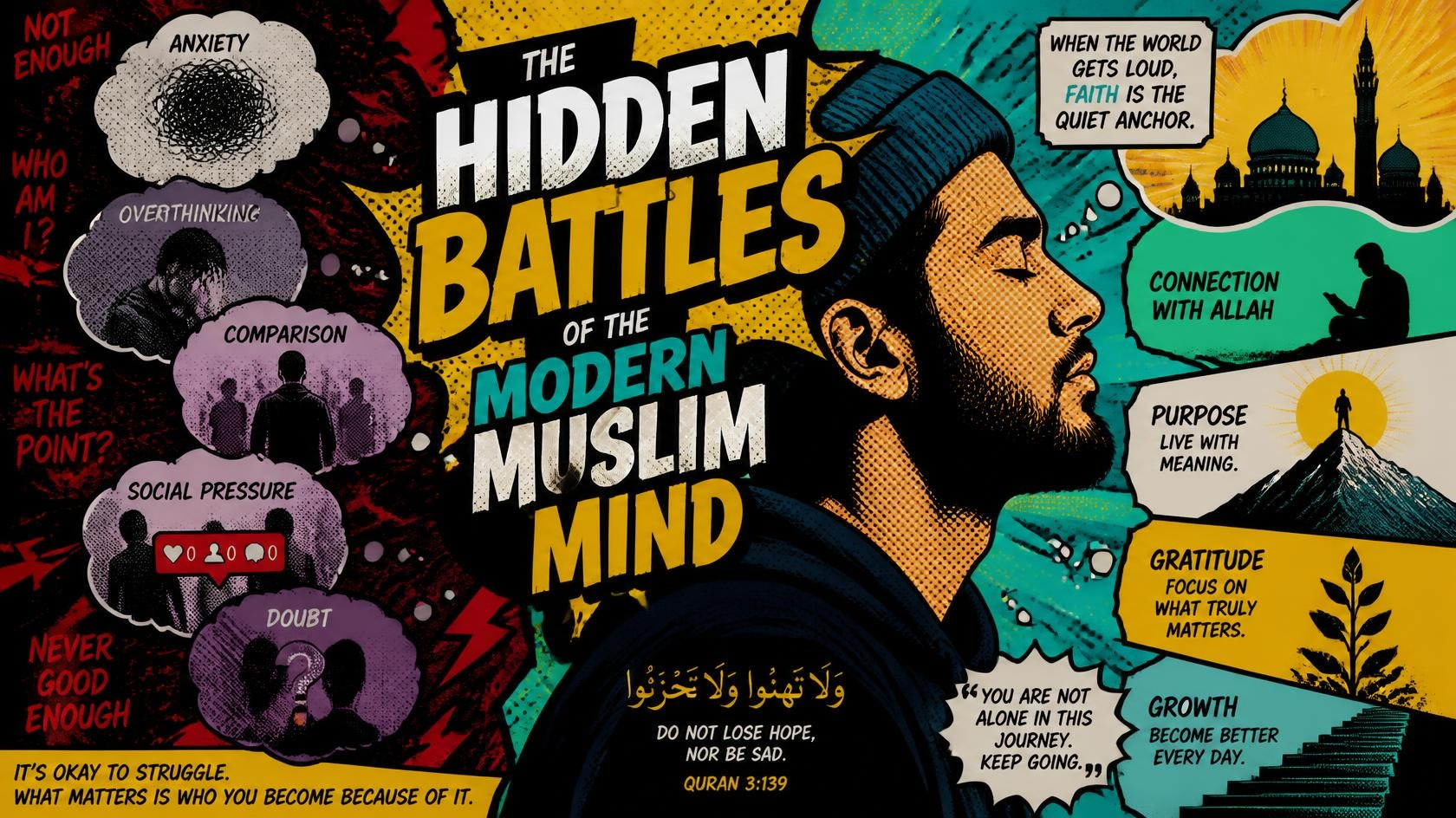
The modern Muslim mind is often fighting battles that are invisible from the outside. A person may look steady in prayer, composed in conversation, and active in the community, yet inside they are carrying a restless mind, a distracted heart, and a growing sense of spiritual exhaustion. We live in a time of endless noise — notifications, opinions, comparisons, and constant stimulation — and without realising it, these pressures begin to shape how we think, feel, and worship. The struggle is not only external. It is deeply internal, and for many Muslims today, that is where the real battle is being fought.
One of the most exhausting pressures of our age is over stimulation. The mind is rarely left alone long enough to settle, reflect, or recover. We scroll, switch, consume, and react until even silence feels unfamiliar. In such a state, it becomes difficult to enter ṣalāh with presence, to read the Qur’an with reflection, or to sit with one’s own thoughts without distraction. What was once meant to calm the soul now often becomes a rushed duty performed with a scattered heart. The result is not always open rebellion; more often, it is quiet numbness — the slow loss of inward sensitivity.
Comparison culture adds another layer to this struggle. Muslims today are constantly exposed to curated images of other people’s lives: their knowledge, their worship, their family, their success, and even their spirituality. This creates an unseen pressure to measure oneself against everyone else, which often leads to envy, shame, or despair. Instead of asking, “Am I growing closer to Allah?” the mind starts asking, “Am I better than them?” or “Why am I not further along?” This kind of thinking weakens sincerity and turns the heart outward when it should be turning inward.
Classical Islamic concepts speak directly to these wounds. Khushūʿ, for example, is not just a quality found in prayer, but a state of inward humility and attentiveness before Allah. It teaches the heart how to become still again, how to stop resisting presence, and how to worship with awareness rather than habit. In a distracted age, khushūʿ is not a luxury; it is a remedy. It brings the soul back from fragmentation to focus, from performance to sincerity, and from noise to reverence.
Likewise, tadabbur offers a cure for a mind that has become too hurried to reflect. The Qur’an was never meant to be recited mechanically alone; it was meant to be pondered, absorbed, and allowed to reshape the heart. Tadabbur slows the mind down long enough for meaning to enter. It asks the believer not only to read, but to pause, to think, and to let divine speech correct human confusion. In a world flooded with shallow content and instant opinions, tadabbur restores depth.
Then there is tazkiyah, the process of purification and growth, which reminds us that the struggle of the modern Muslim mind is not solved by motivation alone. It requires cleansing what corrupts the heart and nurturing what strengthens it. Tazkiyah is about learning to detach from what hardens the soul and attaching oneself to what softens it: dhikr, Qur’an, repentance, consistency, and honest self-examination. It is not a quick fix, but a lifelong work of returning the heart to its proper state.
The modern Muslim does not need to become more distracted, more consumed, or more polished for the gaze of others. What is needed is a return to depth. A return to inner discipline. A return to worship that is felt, not merely performed. The hidden battles of the mind are real, but Islam has never been silent about them. Its language is older, deeper, and more healing than the slogans of our age. In khushūʿ, tadabbur, and tazkiyah, Muslims are not given abstract ideals — they are given a roadmap back to clarity, steadiness, and peace.