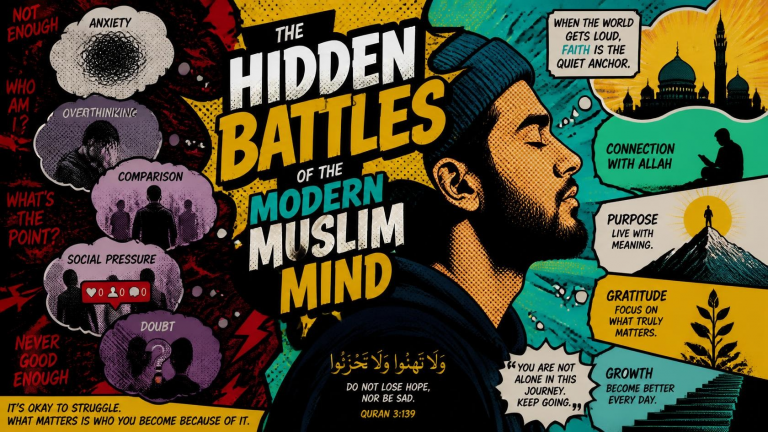

The Muslim ummah today numbers over a billion people worldwide. Yet despite this size, we face deep challenges: weak faith, internal division, moral corruption, political weakness, and global injustice. Islam does not leave us without guidance. The Qur’an and Sunnah diagnose our problems and provide the cure.
Below are major challenges facing the ummah today, with solutions grounded in revelation and supported by multiple pieces of evidence.
1. Weakness of Faith and Identity (Iman and Islamic Identity)
Many Muslims struggle with doubts, secular ideologies, and a loss of pride in Islam. This weakens the heart and opens the door to sin and confusion.
Qur’anic guidance
- Turning away from Allah’s remembrance
“Whoever turns away from My remembrance – indeed, he will have a depressed life, and We will gather him on the Day of Resurrection blind.”
(Qur’an 20:124)
- The truth of Islam
“Indeed, the religion in the sight of Allah is Islam.”
(Qur’an 3:19)
- Faith as the source of tranquillity
“Those who have believed and whose hearts are assured by the remembrance of Allah. Unquestionably, by the remembrance of Allah hearts find rest.”
(Qur’an 13:28)
- Warning against imitating false ways
“Then We put you, [O Muhammad], on a straight way of the religion; so follow it and do not follow the inclinations of those who do not know.”
(Qur’an 45:18)
Prophetic guidance
- Iman increases and decreases
“Iman wears out in your heart just as clothes wear out, so ask Allah to renew faith in your hearts.”
(Al‑Hakim; authenticated by al‑Albani)
- Best of people: people of Qur’an
“The best of you are those who learn the Qur’an and teach it.”
(Bukhari)
- Faith, modesty, and identity
“Iman has over seventy branches… and modesty is a branch of faith.”
(Muslim)
Solutions from Qur’an and Sunnah
- Reviving connection with the Qur’an
“This is the Book about which there is no doubt, a guidance for the muttaqeen (those conscious of Allah).”
(Qur’an 2:2)
- The Prophet ﷺ said:
“Recite the Qur’an, for it will come on the Day of Resurrection as an intercessor for its companions.”
(Muslim)
- Seeking sound knowledge (‘ilm)
“So know that there is no deity except Allah and ask forgiveness for your sin…”
(Qur’an 47:19)
- And:
“Say, ‘Are those who know equal to those who do not know?’ Only they will remember [who are] people of understanding.”
(Qur’an 39:9)
- The Prophet ﷺ said:
“When Allah intends good for a person, He grants him understanding of the religion.”
(Bukhari, Muslim)
- Strong companionship (suhbah)
“O you who have believed, fear Allah and be with those who are truthful.”
(Qur’an 9:119)
- The Prophet ﷺ said:
“A man is upon the religion of his close friend, so let one of you look at whom he befriends.”
(Abu Dawud, Tirmidhi)
- Pride and confidence in being Muslim
“This day I have perfected for you your religion and completed My favour upon you and have approved for you Islam as religion.”
(Qur’an 5:3)
- And:
“And who is better in speech than one who invites to Allah and does righteousness and says, ‘Indeed, I am of the Muslims.’”
(Qur’an 41:33)
2. Disunity and Internal Conflict
The ummah suffers from sectarianism, nationalism, and political conflict. This weakens us and makes us vulnerable.
Qur’anic warnings about division
“And hold firmly to the rope of Allah all together and do not become divided…”
(Qur’an 3:103)
“And obey Allah and His Messenger and do not dispute and [thus] lose courage and your strength depart; and be patient. Indeed, Allah is with the patient.”
(Qur’an 8:46)
“And do not be like those who became divided and differed after the clear proofs had come to them.”
(Qur’an 3:105)
“Indeed, this, your religion, is one religion, and I am your Lord, so worship Me.”
(Qur’an 21:92)
Sunnah on unity and brotherhood
“The believer to the believer is like a building, each part supporting the other.”
(Bukhari, Muslim)
“The Muslims are like a single body; when one limb hurts, the rest of the body responds with sleeplessness and fever.”
(Bukhari, Muslim)
“Do not envy one another, do not inflate prices over one another, do not hate one another, do not turn away from one another, and do not undercut one another in trade, but be, O servants of Allah, brothers.”
(Muslim)
Solutions
- Returning to Qur’an and Sunnah as the common reference
“But no, by your Lord, they will not [truly] believe until they make you, [O Muhammad], judge concerning that over which they dispute among themselves…”
(Qur’an 4:65)
- And:
“And whatever the Messenger has given you – take; and what he has forbidden you – refrain from.”
(Qur’an 59:7)
- Avoiding unjust partisanship and sectarian hatred
“Indeed, those who have divided their religion and become sects – you, [O Muhammad], are not [associated] with them in anything.”
(Qur’an 6:159)
- The Prophet ﷺ said:
“It is enough evil for a person to despise his Muslim brother.”
(Muslim)
- Promoting justice and shura in leadership
“And those who have responded to their Lord and established prayer and whose affair is [determined by] consultation among themselves…”
(Qur’an 42:38)
- And regarding justice:
“Indeed, Allah commands you to render trusts to whom they are due and when you judge between people to judge with justice.”
(Qur’an 4:58)
- Building bridges between Muslim groups
“The believers are but brothers, so make settlement between your brothers. And fear Allah that you may receive mercy.”
(Qur’an 49:10)
- The Prophet ﷺ said:
“Shall I not tell you what is better in degree than fasting, prayer, and charity?” They said, “Yes, O Messenger of Allah.” He said, “Reconciling between people; for spoiling relations between people is the shaver (it shaves off the religion).”
(Abu Dawud, Tirmidhi)
3. Moral Corruption and Spread of Sin
Indecency, zina, alcohol, drugs, riba, and shamelessness have spread widely, especially through media and the internet.
Qur’anic perspective
- On zina
“And do not approach zina (fornication/adultery). Indeed, it is ever an immorality and is evil as a way.”
(Qur’an 17:32)
- On riba
“O you who have believed, fear Allah and give up what remains [due to you] of interest, if you should be believers.”
(Qur’an 2:278)
“Allah has permitted trade and has forbidden interest.”
(Qur’an 2:275)
- On spreading indecency
“Indeed, those who like that immorality should be spread [or publicized] among those who have believed will have a painful punishment in this world and the Hereafter.”
(Qur’an 24:19)
- On following desires
“Have you seen he who has taken as his god his [own] desire…”
(Qur’an 45:23)
Prophetic guidance
- Holding onto Islam in times of fitnah
“Ahead of you are days of patience, in which holding onto the religion is like holding onto hot coals.”
(Tirmidhi)
- On intoxicants
“Every intoxicant is khamr, and every khamr is haram.”
(Muslim)
- On modesty
“Modesty is part of faith.”
(Bukhari, Muslim)
Solutions
- Strengthening taqwa through worship
“O you who have believed, fear Allah as He should be feared and do not die except as Muslims.”
(Qur’an 3:102)
- Regarding salah:
“Indeed, prayer prohibits immorality and wrongdoing, and the remembrance of Allah is greater.”
(Qur’an 29:45)
- Creating halal environments
“Say, ‘Who has forbidden the adornment of Allah which He has produced for His servants and the good [lawful] things of provision?’”
(Qur’an 7:32)
- The Prophet ﷺ said:
“You will never leave something for the sake of Allah but Allah will replace it with something better for you than it.”
(Ahmad)
- Enjoining good and forbidding evil
“You are the best nation produced [as an example] for mankind. You enjoin what is right and forbid what is wrong and believe in Allah.”
(Qur’an 3:110)
- The Prophet ﷺ said:
“Whoever among you sees an evil, let him change it with his hand; if he is not able, then with his tongue; if he is not able, then with his heart – and that is the weakest of faith.”
(Muslim)
- Tawbah and hope in Allah’s mercy
“Say, ‘O My servants who have transgressed against themselves, do not despair of the mercy of Allah. Indeed, Allah forgives all sins…’”
(Qur’an 39:53)
- The Prophet ﷺ said:
“All the children of Adam are sinners, and the best of sinners are those who repent often.”
(Tirmidhi)
4. Ignorance and Distance from Sacred Knowledge
Many Muslims lack authentic knowledge. Culture, social media, and desires often replace Qur’an and Sunnah.
Status of knowledge in Islam
“Allah will raise those who have believed among you and those who were given knowledge, by degrees.”
(Qur’an 58:11)
“Say, ‘Are those who know equal to those who do not know?’”
(Qur’an 39:9)
“It is only those of His servants who have knowledge that fear Allah.”
(Qur’an 35:28)
Prophetic guidance
“Whoever travels a path in search of knowledge, Allah will make easy for him a path to Paradise.”
(Muslim)
“Whoever Allah wants good for, He gives him understanding of the religion.”
(Bukhari, Muslim)
- Warning against ignorant leaders:
“Allah does not take away knowledge by snatching it from the hearts of people, but He takes it away by taking away the scholars, until, when no scholar remains, people take ignorant ones as leaders; they will be asked, and they will give fatwas without knowledge; thus they will go astray and lead others astray.”
(Bukhari, Muslim)
Solutions
- Investing in Islamic education
“And it is not for the believers to go forth [to battle] all at once. For there should separate from every division of them a group [remaining] to obtain understanding in the religion and warn their people when they return to them that they might be cautious.”
(Qur’an 9:122)
- Combining worldly and Islamic knowledge
“Our Lord, give us in this world [that which is] good and in the Hereafter [that which is] good and protect us from the punishment of the Fire.”
(Qur’an 2:201)
- Using modern tools for da‘wah and learning
“And who is better in speech than one who invites to Allah and does righteousness…”
(Qur’an 41:33)
Taking knowledge from reliable scholars
- The Prophet ﷺ said:
“The scholars are the inheritors of the prophets.”
(Abu Dawud, Tirmidhi)
5. Political Weakness, Oppression, and Injustice
Many Muslim lands suffer from war, occupation, tyranny, and corruption.
Qur’anic view on justice and oppression
“O you who have believed, be persistently standing firm in justice, witnesses for Allah, even if it be against yourselves or parents and relatives…”
(Qur’an 4:135)
“Indeed, Allah commands justice, good conduct, and giving to relatives and forbids immorality, bad conduct, and oppression.”
(Qur’an 16:90)
“And do not incline toward those who do wrong, lest you be touched by the Fire…”
(Qur’an 11:113)
- On helping the oppressed:
“And what is [the matter] with you that you fight not in the cause of Allah and [for] the oppressed among men, women, and children who say, ‘Our Lord, take us out of this city of oppressive people…’”
(Qur’an 4:75)
Prophetic guidance
“O My servants, I have forbidden oppression for Myself and have made it forbidden among you, so do not oppress one another.”
(Muslim)
“Beware of the supplication of the oppressed, for there is no barrier between it and Allah.”
(Bukhari, Muslim)
“The most beloved people to Allah are those who are most beneficial to people.”
(Tabarani)
Solutions
- Sincere tawbah and returning to Allah
“And whatever strikes you of disaster – it is for what your hands have earned; but He pardons much.”
(Qur’an 42:30)
“So why, when Our punishment came to them, did they not humble themselves? But their hearts became hardened…”
(Qur’an 6:43)
- Supporting the oppressed through lawful means
“And cooperate in righteousness and piety, but do not cooperate in sin and aggression.”
(Qur’an 5:2)
- The Prophet ﷺ said:
“Help your brother, whether he is an oppressor or oppressed.” They said, “O Messenger of Allah, we help him if he is oppressed, but how do we help him if he is an oppressor?” He said, “By preventing him from oppressing, that is helping him.”
(Bukhari)
Reforming leadership and governance
- The Prophet ﷺ said:
“Each of you is a shepherd, and each of you is responsible for his flock…”
(Bukhari, Muslim)
- And he said:
“The just leaders will be on pulpits of light on the right hand of the Most Merciful…”
(Muslim)
- Building strong, ethical institutions
“Indeed, Allah commands you to render trusts to whom they are due…”
(Qur’an 4:58)
“And fulfil [every] commitment. Indeed, the commitment is ever [that about which one will be] questioned.”
(Qur’an 17:34)
6. Economic Injustice and Dependence
Despite immense resources, many Muslim societies suffer from poverty, inequality, and debt-based systems.
Qur’anic economic principles
- Prohibition of riba
“Those who consume interest cannot stand [on the Day of Resurrection] except as one stands who is being beaten by Satan into insanity.”
(Qur’an 2:275)
“And if you do not [give up riba], then be informed of a war from Allah and His Messenger.”
(Qur’an 2:279)
- Obligation of zakah
“Take from their wealth a charity by which you purify them and cause them increase…”
(Qur’an 9:103)
“Zakah expenditures are only for the poor and for the needy and for those employed to collect [zakah] and for bringing hearts together [for Islam] and for freeing captives [or slaves] and for those in debt and for the cause of Allah and for the [stranded] traveler…”
(Qur’an 9:60)
- Encouragement of charity
“The example of those who spend their wealth in the way of Allah is like a seed [of grain] that sprouts seven ears; in every ear are a hundred grains…”
(Qur’an 2:261)
- Prohibition of consuming others’ wealth unjustly
“O you who have believed, do not consume one another’s wealth unjustly but only [in lawful] business by mutual consent.”
(Qur’an 4:29)
Prophetic guidance
“The upper hand is better than the lower hand (the one that gives is better than the one that receives).”
(Bukhari, Muslim)
“Allah has cursed the one who consumes riba, the one who pays it, the one who writes it down, and the two witnesses to it; they are all the same.”
(Muslim)
“The truthful, trustworthy merchant will be with the prophets, the truthful, and the martyrs.”
(Tirmidhi)
Solutions
- Implementing zakah properly and transparently
“And establish prayer and give zakah and obey the Messenger that you may receive mercy.”
(Qur’an 24:56)
- Developing halal economic systems
“O you who have believed, do not consume usury, doubled and multiplied, but fear Allah that you may be successful.”
(Qur’an 3:130)
Fighting corruption and promoting amanah (trustworthiness)
- The Prophet ﷺ said:
“There is no faith for the one who is not trustworthy, and there is no religion for the one who does not keep his promise.”
(Ahmad)
- Encouraging hard work and self-reliance
“No one has ever eaten better food than what he earns with his own hands. The Prophet of Allah Dawood used to eat from what he earned with his own hands.”
(Bukhari)
7. Negative Stereotypes and Islamophobia
Islam is often portrayed as violent or backwards, leading to discrimination and hostility against Muslims.
Qur’anic context
“You will surely be tested in your wealth and your lives, and you will surely hear from those who were given the Scripture before you and from those who associate others with Allah much abuse. But if you are patient and fear Allah – indeed, that is of the matters [worthy] of determination.”
(Qur’an 3:186)
“And they will never cease fighting you until they turn you back from your religion if they are able.”
(Qur’an 2:217)
“Repel [evil] by that [deed] which is better; and thereupon the one whom between you and him is enmity [will become] as though he were a devoted friend.”
(Qur’an 41:34)
Prophetic guidance
- Excellent character
“I was only sent to perfect righteous character.”
(Ahmad)
- Gentleness in da‘wah
“Gentleness is not in anything except that it beautifies it, and it is not removed from anything except that it makes it defective.”
(Muslim)
- Patience with harm
“No fatigue, nor disease, nor sorrow, nor sadness, nor hurt, nor distress befalls a Muslim, even if it were the prick he receives from a thorn, but that Allah expiates some of his sins for that.”
(Bukhari, Muslim)
Solutions
- Excellent character (akhlaq)
“And indeed, you (O Muhammad) are of a great moral character.”
(Qur’an 68:4)
- Wise da‘wah and positive engagement
“Invite to the way of your Lord with wisdom and good instruction, and argue with them in a way that is best.”
(Qur’an 16:125)
- Being visible, confident Muslims
“And thus We have made you a justly balanced nation that you will be witnesses over the people and the Messenger will be a witness over you.”
(Qur’an 2:143)
- Responding with patience, not hatred
“And be patient over what they say and avoid them with gracious avoidance.”
(Qur’an 73:10)
- The Prophet ﷺ forgave the people of Ta’if after they stoned him, saying in his famous du‘a that perhaps Allah would bring from their descendants people who worship Him alone (Bukhari, Muslim – meaning established in seerah).
8. A Holistic Way Forward for the Ummah
The problems of the ummah are many, but the path forward is clear in revelation:
- Ignite your faith (iman) by immersing yourself in worship, exploring the wisdom of the Qur’an, and embracing heartfelt repentance. Let these practices revitalise your spirit and strengthen your connection to the divine!
- Pursue deep knowledge and wisdom with passion, and share what you learn with others!
- Let’s come together in unity, grounded in the principles of tawheed, the wisdom of the Qur’an, and the guidance of authentic Sunnah!
- Let’s create a just world that starts at home and spreads throughout our communities! By fostering justice in our personal lives, within our families, across our neighbourhoods, in our economy, and through our governance, we can build a fairer, more equitable society for everyone.
- Empower families and youth by shielding them from challenges and providing them with quality education. Let’s build a strong foundation for a bright future!
- Empower families and youth by shielding them from challenges and providing them with quality education. Let’s build a strong foundation for a bright future!
Allah’s promise remains:
“Indeed, Allah will not change the condition of a people until they change what is in themselves.”
(Qur’an 13:11)
And:
“If you aid [the cause of] Allah, He will aid you and plant your feet firmly.”
(Qur’an 47:7)
If the Muslim ummah sincerely returns to the Qur’an and Sunnah — in belief, worship, character, and systems — then, by Allah’s permission, it can once again become a beacon of justice, mercy, and guidance for all humanity.