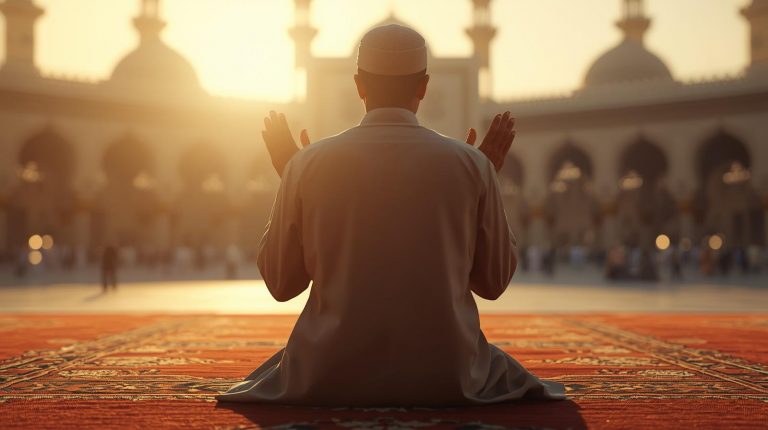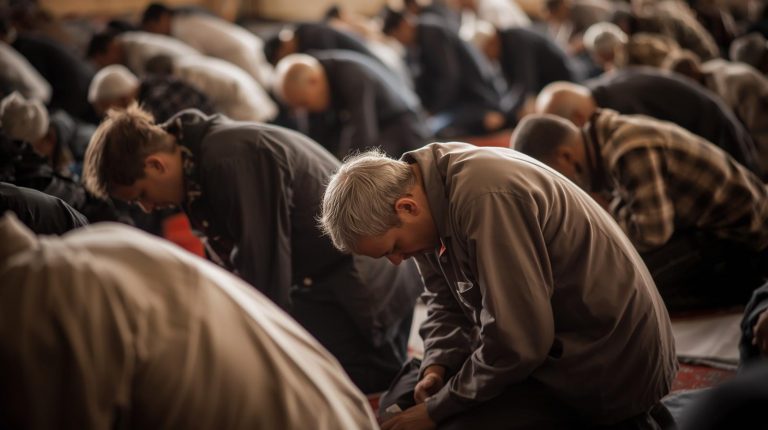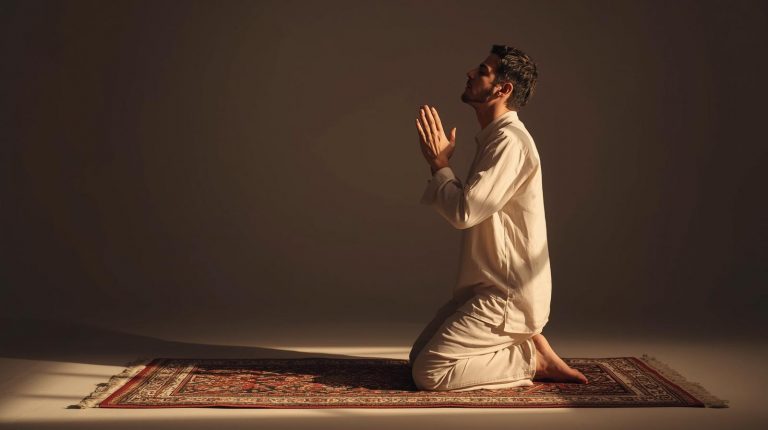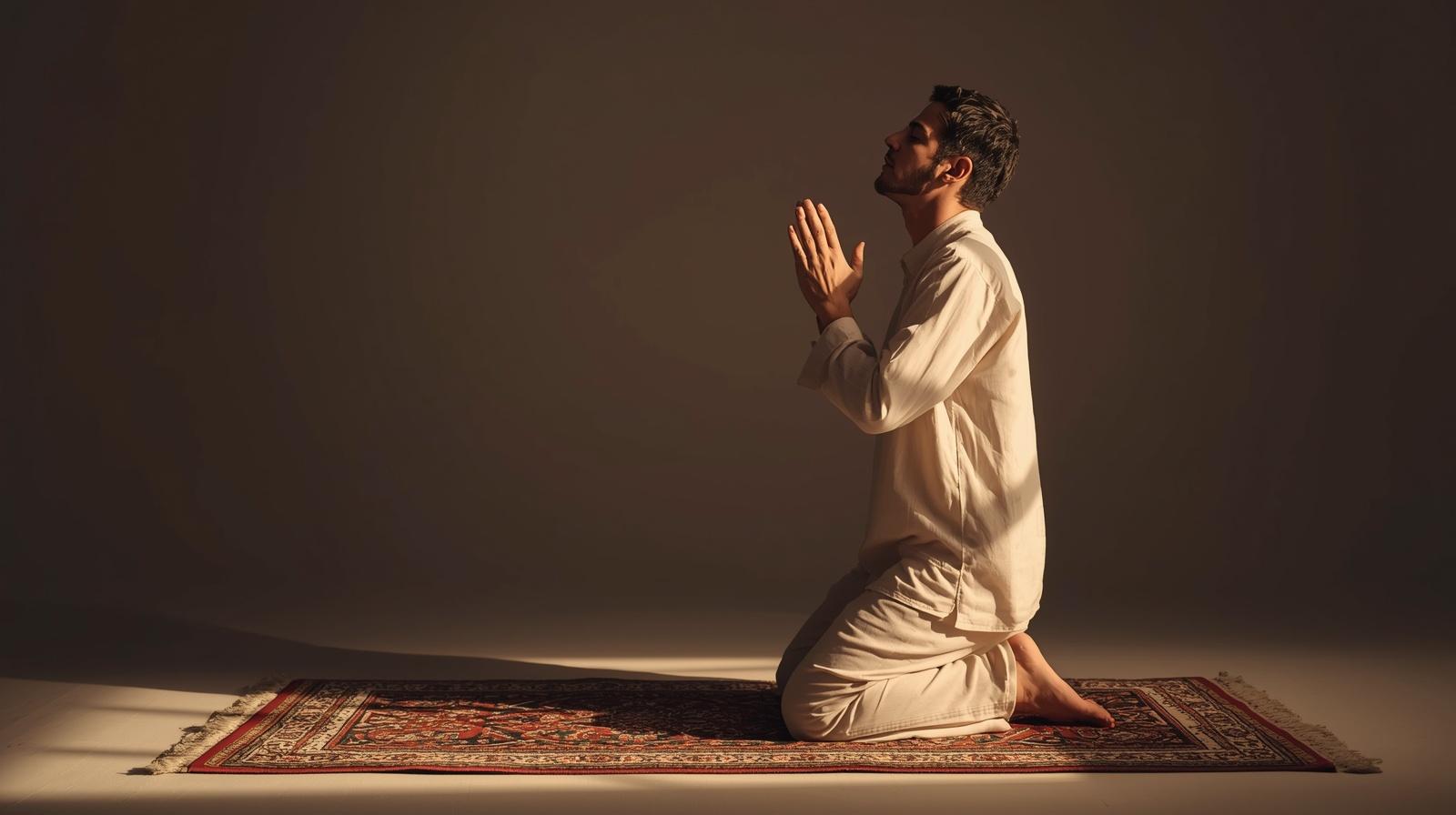
- When standing to pray, you should face the direction of the Kaaba, regardless of whether you are performing obligatory (fard) or supererogatory (nafl) prayers. This is one of the pillars of prayer, and without it, the prayer is not considered valid.
- The requirement to face the direction of prayer does not apply to those engaged in warfare or intense fighting, or to individuals who are sick or traveling by ship, car, or plane, especially if they fear they won’t reach a proper location before prayer time ends.
- Moreover, someone praying nafl or witr while riding an animal does not need to face the Kaaba. However, it is recommended (mustahabb) to face the Qiblah when saying the takbir al-ihram (the opening takbir); after that, they may face any direction.
- Those who can see the Kaaba must face it, while those who cannot see it should face its direction..
- Ruling on not facing the Ka`bah in prayer by mistake
- If a person prays without facing the qiblah due to clouds obstructing their view of the sun’s position or for any other reason, their prayer is considered valid, provided they have made their best effort to determine the correct direction. They do not need to repeat the prayer.
- If someone they trust approaches while they are praying and informs them of the correct direction, the person should quickly turn to face it, and their prayer will still be valid.
Qiyam (standing in prayer)
- Prayer is typically mandatory while standing, but exceptions are made in cases of fear or conflict, allowing individuals to pray while riding. Sick individuals unable to stand should pray sitting or, if necessary, lying on their side.
- For nafl (voluntary) prayers, one may pray while riding or sitting, using head movements for bowing (ruku`) and prostration (sujud). Sick individuals should ensure their prostration is lower than their bowing.
- Additionally, those praying while sitting cannot use an elevated object for prostration; instead, their prostration should be lower than the bowing if they cannot touch the ground with their forehead.
- Prayer on board a ship or airplane
- It is allowed to perform obligatory (fard) prayers while aboard a ship or airplane.
- If one fears that they may fall, it is acceptable to pray while seated.
- If a person is elderly or physically weak, they are permitted to lean on a pillar or stick while standing during prayer.
- Combining standing and sitting in prayer
- It is permissible to pray Qiyam al-Layl standing or sitting, even without an excuse, and one can switch between the two. A person may recite while sitting and then stand just before going into ruku` (bowing), continuing the prayer from that position.
- If praying sitting, one should choose a comfortable position, such as cross-legged or any other that feels suitable.
- Praying wearing shoes
- Is permissible to pray either barefoot or wearing shoes.
- It is preferable to alternate between praying barefoot and with shoes, depending on comfort. One should avoid making it difficult to take shoes on or off. If barefoot, pray without shoes; if wearing shoes, pray with them unless there’s a valid reason otherwise.
- If removing shoes, place them to the left unless someone is there, in which case place them between your feet. Avoid putting them in front of you. Many worshippers overlook this etiquette and are often seen praying while facing their shoes, which is based on authentic teachings from the Prophet (peace and blessings be upon him).
- Praying on the minbar
- It is permissible for the imam to pray on an elevated place such as the minbar, in order to teach the people. So he should stand up on it to pray, then say takbir, recite Quran and do ruku` whilst he is on that place, then he should come down backwards so that he can prostrate on the ground at the base of the minbar, then he may go back to it and do the same in the second rak`ah as he did in the first.
- It is obligatory to pray facing a sutrah and be close to it
- It is mandatory to pray facing a sutrah (a screen or cover), whether in a mosque or elsewhere, regardless of the size of the mosque. This is supported by the hadith of the Prophet (peace and blessings be upon him), which states, “Do not pray except when facing a sutrah, and do not let anyone pass in front of you. If someone insists, confront him, as he has a companion (qarin) with him” (meaning the Shaytan).
- Additionally, it is important to be close to the sutrah, following the Prophet’s (peace and blessings be upon him) command. The distance between the Prophet’s prostration and the wall was sufficient for a sheep to pass. This shows that praying far from the wall or pillars in mosques, as is common in many places, goes against the teachings and practice of the Prophet (peace and blessings be upon him).
- How high should the sutrah be?
- The Sutrah should be approximately a handspan or two above the ground, because the Prophet (peace and blessings of Allah be upon him) said: “When one of you places in front of him something such as the stick on the end of a saddle, he should pray and not worry about anyone who passes in front of that.” This hadith indicates that a line on the ground is not sufficient, and the hadith narrated concerning that is da’if (weak).
- He should face the sutrah directly, because this is the apparent meaning of the command to pray towards the sutrah. Stepping slightly to the right or left so that one is not facing it directly, is not correct.
- It is permissible to pray facing a stick planted in the ground and the like, or a tree, or a pillar, or one’s wife lying down in bed underneath her blanket, or an animal, even if it is a camel.
- Prohibition of praying towards graves
- It is not permitted to pray facing graves at all, whether they are the grave of prophets or of others.
- Prohibition of walking in front of one who is praying even in al-Masjid al-Haram
- IIt is not permissible to walk in front of someone who is praying if there is a sutrah (barrier) in place. This rule applies equally in al-Masjid al-Haram and other mosques. The Prophet Muhammad (peace be upon him) stated that passing in front of a praying person incurs a great burden of sin, as standing for forty years would be preferable to doing so.
- A hadith mentioning the Prophet praying in al-Mataf without a sutrah is not considered authentic. Regardless, it is essential for anyone in prostration to prevent others from walking in front of them, even in Masjid al-Haram.
- It is not allowed for someone praying towards a sutrah to let anyone pass in front of them. The Prophet (peace and blessings of Allah be upon him) stated that if someone attempts to pass, the person should push them in the upper chest to repel them. In another report, it says to stop them twice, but if they insist, they should be fought, as they are considered a devil.
- Stepping forward to prevent someone passing in front of him
- It is permissible for a person to take one or two steps to the front, in order to prevent one who is not responsible from passing in front of him, such as an animal or a small child, and to make them pass behind him.
- What breaks prayer
- The sutrah is so important to prayer that it prevents a person’s prayer from being invalidated, if someone passes in front of him. This is in contrast to the one who does not use a sutrah, whose prayer is broken if an adult woman, a donkey or a black dog passes in front of him.
Niyyah (intention)
- TThe worshipper must hold the intention in their heart to perform the specific prayer, such as the fard (obligatory) prayers of Zuhr or ‘Asr, or their Sunnah. This intention is essential for the prayer. However, verbally stating the intention is considered a bid’ah and contradicts the Sunnah, as it was not endorsed by any of the imams.
Takbir
- To begin the prayer, one should say “Allahu akbar” (Allah is Most Great). This is essential, as the Prophet (peace be upon him) said: “The key to prayer is purification (wudu’), entered by takbir and exited by taslim.” Saying takbir makes certain actions prohibited, and this ends with taslim.
- Voices should not be raised when saying takbir, unless one is the imam.
- The muadhdhin may convey the imam’s takbir if needed, such as if the imam is ill or there are many worshippers.
- Followers should wait to say takbir until the imam has finished.
- Raising the hands – how it is to be done
- He should raise his hands when saying the takbir, either before or after.
- Hands should be raised with fingers stretched out.
- They should be at shoulder level or up to the earlobes.
- Note that touching the earlobes with the thumbs has no basis in the Sunnah and may come from waswas (whispers from Shaytan).
- Placing the hands – how it is to be done
- After the takbir, he should place his right hand on his left. This practice follows the way of the prophets (peace be upon them) and what the Messenger of Allah (peace and blessings be upon him) instructed his Companions to do. It is not permissible to let the arms hang at the sides.
- The right hand should rest on the back of the left hand, including the wrist and forearm.
- Occasionally, the left hand may be grasped with the right. However, the practice of combining placing and grasping, which some later scholars preferred, has no established basis.
- Where they should be placed
- The hands should be placed on the chest, and there is no difference between men and women in this regard. I assert that placing the hands anywhere other than on the chest is either weak (da’if) or lacks a solid basis.
- Additionally, it is not permissible to place the right hand on the waist.
- It’s important to maintain humility and focus on the place of prostration while in prayer.
- A worshipper must approach their prayer with humility and should avoid any distractions that could divert their attention, such as adornments or decorations. They should refrain from praying in areas where food is present that they desire to eat or when they have the urge to urinate or defecate.
- While standing, the worshipper should focus their gaze on the spot where they will prostrate.
- They should not look to the right or left, as turning their gaze in such a manner can lead to distractions that the Shaytan uses to interfere with the slave’s prayer.
- Additionally, it is not permissible for them to look up at the sky during prayer.
- Du`a al-Istiftah (du`a at the start of prayer)
- To begin the prayer, one should start with the Duas narrated from the Prophet (peace and blessings of Allah be upon him). The most well-known is: “Subhanaka Allahumma wa bihamdika, wa tabaraka ismuka wa ta’ala jadduka, wa la ilaha ghayruka” (Glory and praise be to You, O Allah; blessed be Your name; exalted be Your Majesty; and there is no god but You).
- This practice is well-supported, so we should follow it. For additional Duas, refer to “Sifat al-Salah,” pages 91-95, or the English “The Prophet’s Prayer Described” by Shaykh al-Albani, pages 14-19.
- Recitation of Quran
- It is obligatory to seek refuge with Allah; failing to do so is a sin.
- One Sunnah practice is to say, “A’udhu Billahi min al-Shaytan ir-rajim” (I seek refuge with Allah from the accursed Satan).
- Alternatively, one may say, “A’udhu Billah is-Sami’ il-A’lieem min al-Shaytan” (I seek refuge with Allah, the All-Hearing, All-Knowing, from Shaytan).
- Next, whether praying aloud or silently, he should say, “Bismillah ar-Rahman ar-Rahim” (In the Name of Allah, Most Gracious, Most Merciful).
- Reciting al-Fatihah
- Then he should recite Surat al-Fatihah (the first surah of the Quran) in full, including the Basmalah (Bismillahi ar-Rahman ar-Rahim). This is an essential part of the prayer, without which the prayer is not valid. Those who do not speak Arabic must memorize this surah.
- Those who cannot remember the text should say: “Subhan Allah, wa’l-hamdu Lillah, wa la ilaha ill-Allah, wa Allahu akbar, wa la hawla wa la quwwata illa Billah” (Glory be to Allah, praise be to Allah, there is no god but Allah, Allah is Most Great, and there is no strength or power except with Allah).
- It is recommended to recite each verse one at a time, pausing at the beginning of each ayah. Start with: “Bismillah ar-Rahman ar-Rahim” (In the Name of Allah, the Most Gracious, the Most Merciful), pause, then say: “Al-Hamdu Lillahi Rabb il-‘Alamin” (All praises be to Allah, the Lord of all that exists), pause, and continue this pattern until the end of the surah.
This is how the Prophet (peace and blessings of Allah be upon him) used to recite the whole surah, pausing at the end of each ayah and not joining one ayah to the next, even if there is continuity of the meaning.
- It is permissible to read it as Maliki Yawn id-Din or Maaliki Yawm id-Din.
- How the one who is praying behind the imam should recite it
- The one who is praying behind the imam should recite it behind the imam in prayers where Quran in recited silently and in prayers where it is recited aloud, if he cannot hear the imam’s recitation, or if he pauses after completing it so that those who are praying behind him can recite it. We think that this pause was not proven in the Sunnah. I say I have mentioned the evidence of those who think that this pause is permissible and the refutation of that evidence, in Silsilat al-Ahadith al-Da’ifah, no. 546, 547, part 2, p. 24-26, Dar al-Ma’arif edition.
- Recitation after al-Fatihah
- It is sunnah to recite- after al Fatihah, even in Salat al-Janazah (funeral prayer), or some ayahs, in the first two rak`ahs.
- The reciting may be made lengthy sometimes, and shorter sometimes, for reasons of travel, coughing, sickness or the crying of an infant.
- The recitation varies according to the prayers. The recitation in Fajr prayer is longer than it is in all the other prayers. Next longest is Zuhr, then ‘Asr, then ‘Isha, then Maghrib, usually.
- The recitation in the night prayers Qiyam al layl) is longer than all of these.
- The Sunnah is to make the recitation longer in the first rak`ah than in the second.
- He should make the recitation in the last two shorter than in the first two rak`ahs, half the length. If you want more details on this topic, see Sifat al-Salah p. 102 (Arabic original).
- Reciting al-Fatihah in every rak`ah
- It is obligatory to recite al-Fatihah in every rak`ah.
- It is Sunnah to add to it in the last two rak`ahs as well.
- It is not permissible for the imam to make his recitation longer than that which is described in the Sunnah, because that is difficult for those who may be praying behind him, such as the elderly and sick, or nursing mothers, or those who have other things to do.
- Reciting aloud and reciting quietly
- Quran should be recited aloud in Fajr and Jumu’ah prayers, ‘Eid prayers, prayers for rain (istisqa), prayers at the time of an eclipse (kusuf) and in the first two rak`ahs of Maghrib and ‘Isha.
He should recite silently in the first two rak`ahs of Zuhr and ‘Asr, in the third rak`ah of Maghrib and in the last two rak`ahs of ‘Isha.
- It is permissible for the imam occasionally to make an ayah audible in the prayers where recitation is to be done silently.
- In Witr and Qiyam al-Layl, he should recite silently sometimes and aloud sometimes, and he should be moderate in raising his voice.
- Tartil – reciting at a measured pace
- The Sunnah is to recite the Quran at a measured pace, not quickly or hastily. It should be read in a manner that clearly distinguishes each letter, beautifying the Quran with one’s voice. He should observe the well known rulings of the scholars of Tajwid and he should not recite it in the innovated manner of singers or according to the rules of music.
- Prompting the imam
- It is prescribed for the one who is praying behind the imam to prompt the imam if he hesitates in his recitation.
Ruku` (bowing)
- When he has completed the recitation, he should pause briefly, to catch his breath.
- Then he should raise his hands in the manner described for takbirat al-ihram (the takbir at the beginning of prayer).
- And he should say takbir (“Allahu akbar”). This is obligatory.
- Then he should do ruku`, bowing as deeply as his joints will let him, until his joints take the new position and are relaxed in it. This is an essential part of prayer.
- How to do ruku`
- He should put his hands on his knees, firmly, spacing the fingers out, as if he is grasping his knees.
- He should spread his back and make it level so that if water were poured on it, it would stay there (not run off).
- He should not lower or raise his head, but make it level with his back.
- He should keep his elbows away from his sides.
- In ruku`, he should say “Subhana Rabbiy al-‘Azim (Glory be to my Lord, the Almighty) three times or more. There are other kinds of dhikr which may be said in ruku`, some of which are long, some of medium length and some short. See Sifat Salat al-Nabi (peace and blessings of Allah be upon him), p. 132, Maktabat al-Ma’arif edition [The Prophet’s Prayer Described, p. 44].
- Making the essential parts of prayer equal in length
- It is Sunnah to make the essential parts of prayer equal in length, so the ruku`, the standing after ruku`, the prostration and the sitting between the two prostrations should be made approximately the same in length.
- It is not permissible to recite Quran in ruku` or in sujud.
- Straightening up from ruku`
- After completing the ruku`, he should straighten up, which is essential for the prayer.
- While standing up, he must say “Sami’a Allahu liman hamidah” (Allah listens to the one who praises Him), which is obligatory.
- He should raise his hands as he straightens up.
- He must stand straight until every vertebra is aligned, which is also essential.
- While standing, he should say “Rabbana wa laka al-hamd” (Our Lord, to You be all praise). This is obligatory for everyone praying, even when following an imam. Other dhikr can be said at this time, but placing hands one over the other is not prescribed.
- The time spent standing should equal that of the ruku`.
Sujud (prostration)
- Then he should say “Allahu akbar” – this is obligatory.
- He should raise his hands sometimes.
- Going down on the hands
- When performing sujud (prostration), he should lower himself onto his hands before his knees, following the practice of the Messenger of Allah (peace and blessings be upon him), who prohibited the camel-like kneeling.
- During prostration, he should distribute his weight on his palms and spread them out.
- Fingers should remain together and pointed toward the qiblah.
- Palms should be level with the shoulders or ears.
- Forearms must stay off the ground, and he should not spread them like a dog.
- His nose and forehead should touch the ground, along with his knees and toes.
- Keep his feet upright, ensuring toes point toward the qiblah, and heels should remain together.
- Being at ease in sujud
- During sujud (prostration), one should feel at ease and distribute their weight evenly on the parts of the body that touch the ground. These parts include the nose and forehead, the palms, the knees, and the toes.
- A person who feels at ease in their sujud has performed it correctly. This sense of ease is also an essential aspect of the prayer.
- In sujud, it is recommended to say, “Subhana Rabbiy al-‘A’la” (Glory be to my Lord Most High) three times or more. There are other forms of dhikr (remembrance) as well; for more details, refer to “Sifat Salat al-Nabi” (The Prophet’s Prayer Described), p. 145.
- It is encouraged to make ample du`a (supplication) during sujud, as this is a time when prayers are likely to be answered.
- The duration of sujud should be nearly as long as that of the ruku` (bowing), as previously described.
- It is permissible to prostrate on bare ground or on any surface covering the ground, such as a garment, carpet, or mat.
- It is not allowed to recite the Quran while in prostration.
- Iftirash and Iq’a between the two sajdahs
[Iftirash refers to sitting on the left thigh with the right foot upright, its toes pointing towards the qiblah. Iq’a means resting on both heels and feet.
- Then he should raise his head, saying takbir. This is obligatory.
- He should sometimes raise his hands.
- After that, he should sit comfortably until his back is straight, which is obligatory.
- He must spread his left leg and sit on it, also obligatory.
- His right foot should be upright, with toes pointing towards the qiblah.
- He may occasionally sit in iq’a, resting on his heels and feet.
- While in this position, he should say, “Allahumma ighfir li warhamni wajburni, warfa’ni, wa’afini warzuqni.”
- If desired, he can repeat, “Rabbi ighfir li.”
- He should hold this position for nearly as long as his sujud.
- The second sajdah
- Then he should say takbir – this is obligatory,
- He should raise his hands sometimes when saying this takbir.
- He should do the second prostration – this is also an essential part of the prayer.
- He should do in the second prostration what he did in the first.
- The sitting to rest
- When he raises his head from the second prostration and he wants to get up for the second rak`ah, he should say takbir. This is obligatory.
- He should raise his hands sometimes.
- He should sit up straight, sitting on his left foot, until every bone returns to its place.
- The second rak`ah
- Then he should get up for the second rak`ah, supporting himself on his hands with his fists clenched as if kneading dough. This is an essential part of the prayer.
- He should do in the second rak`ah what he did in the first.
- Except that he should not recite the du`a for starting the prayer.
- He should make it shorter than the first rak`ah.
- Sitting for the Tashahhud
- When he completes the second rak`ah, he should sit for the TTashadud. This is obligatory.
- He should sit in iftirash, as described above for the sitting between the two prostrations.
- But it is not permitted to sit in iq’a at this point.
- He should put his right hand on his right thigh and knee, and the end of the right elbow on the thigh, not far from it.
- He should spread his left palm on his left thigh and knee.
- It is not permissible to sit resting on one’s arms, especially the left arm.
- Moving the finger and looking at it
- He should clench all the fingers of his right hand, and put the thumb on the middle finger sometimes.
- Sometimes he should make a circle with them.
- He should point with his index finger towards the qiblah.
- He should look towards it.
- He should move it, making du`a with it, from the beginning of the Tashahhud until the end.
- He should not point with the finger of his left hand.
- He should do all of this in every Tashahhud.
- How to say Tashahhud and the du`a following it
- The Tashahhud is obligatory in prayer. If forgotten, one must perform two prostrations of forgetfulness (sajdat al-sahw).
- It should be recited silently, using the following wording:
- “Al-tahiyyatu Lillahi wa’l-salaawatu wa’l-tayyibat. Al-salamu ‘alayka ayyuha’l-Nabiyyu wa rahmat-Allahi wa barakatuhu. Al-salamu ‘alayna wa ‘ala ‘ibad-Illah il-salihin. Ash-hadu an la ilaha ill-Allah wa ash-hadu anna Muhammadan ‘abduhu wa rasuluhu.”
- This translates to: “All compliments, prayers, and pure words are due to Allah. Peace be upon you, O Prophet, and the mercy and blessings of Allah. Peace be upon us and upon the righteous servants of Allah. I bear witness that there is no god except Allah, and Muhammad is His Messenger.”
- Other variations exist but this is the most accepted version.
Sending Salam to the Prophet (peace and blessings of Allah be upon him): this is what was prescribed after the death of the Prophet (peace and blessings of Allah be upon him), and is narrated in the Tashahhud of Ibn Mas’ud, ‘Aishah and Ibn al-Zubayr (may Allah be pleased with them). For more details see Sifat Salat al-Nabi, p. 161, Maktabat al-Ma’arif, Riyadh, edition/ The Prophet’s Prayer Described, p. 67).
- After that, he should send prayers upon the Prophet (peace and blessings of Allah be upon him) by saying:
- “Allahumma salli ‘ala Muhammad wa ‘ala ali Muhammad kama salayta ‘ala Ibrahim wa ‘ala ali Ibrahim, innaka hamidun majid. Allahumma barik ‘ala Muhammad wa ‘ala ali Muhammad kama barakta ‘ala Ibrahim wa ‘ala ali Ibrahim, innaka hamidun majid.”
- This means: “O Allah, send prayers and blessings upon Muhammad and his family, as You did upon Ibrahim and his family; You are indeed Worthy of Praise, Full of Glory.”
- Alternatively, he may shorten it to:
- “Allahumma salli wa barik ‘ala Muhammad wa ‘ala ali Muhammad kama salayta wa barakta ‘ala Ibrahim wa ‘ala ali Ibrahim, innaka hamidun majid.”
- After this Tashahhud, he may choose any supplication (du‘a) to call upon Allah.
- The third and fourth rak`ahs
- Then he says takbir – which is obligatory. The Sunnah is to say takbir whilst still sitting.
- He should raise his hands sometimes.
- Then he should stand up for the third rak`ah, which is an essential part of prayer, as is the following rak`ah.
- He should do likewise if he wants to get up for the fourth rak`ah.
- But before he gets up, he should sit up straight, by adjusting his left leg, until every bone returns to its place.
- Then he should get up, supporting himself on his hands, as he did when getting up for the second rak`ah.
- Then in the third and fourth rak`ahs, he should recite al-Fatihah. This is obligatory.
- He may add an ayah or more to that occasionally.
- Reciting when calamity strikes
- It is Sunnah to recite Qunut and pray for the Muslims when any disaster befalls them.
- Qunut should be recited after standing up from ruku` and saying “Rabbana wa laka’l-hamd (Our Lord, to You be praise).”
- There is no specific du`a to be recited regularly in Qunut, rather one should recite whatever is appropriate when disaster strikes.
- He should raise his hands when reciting this du`a
- He should recite it aloud if he is acting as an imam.
- Those who are praying behind him should say “Amin” to this du`a.
- When he has finished, he should say takbir and prostrate.
- Qunut al-Wit – when it is to be recited, and what wording it should have
- is prescribed occasionally.
- It should be recited before ruku`, unlike Qunut recited at times of calamity.
- He should recite the following words:
“Allahumma ihdini fiman hadayta, wa ‘afini fiman ‘afayta, wa tawallani fiman tawallayta, wa barik li fima a’tayta, wa qini sharra ma qadayta, fa innaka taqdi wa la yuqda ‘alayk, wa innahu la yadhillu man walayta, wa la ya’izzu man ‘adayta, tabarakta rabbana wa ta’alayta, wa la manja minka illa ilayk
(O Allah, guide me amongst those whom You have guided; pardon me amongst those whom You have pardoned; turn to me in friendship amongst those to whom You have turned in friendship; bless me in what You have bestowed; save me from the evil of what You have decreed; for indeed You decree, and none can influence You; and he is not humiliated whom You have befriended; nor is he honoured whom You take as Your enemy. Blessed are You, O Lord, and exalted. There is no place of safety from You except towards You).”
- This du`a was taught by the Messenger of Allah (peace and blessings of Allah be upon him), so it is permissible, because it was narrated from the Sahabah (may Allah be pleased with them).
- Then he should do ruku`, and the two prostrations, as before.
- The final Tashahhud and placing the left foot under the right leg
- Then he should sit for the final Tashahhud. This is obligatory.
- He should do the same as in the first Tashahhud.
- But he should sit mutawarikan, which means placing the left foot under his right leg.
- He should put his right foot upright.
- It is also permissible to lay the right foot along the ground sometimes.
- He should cover his left knee with his left palm, leaning heavily on it.
- The obligation of sending prayers upon the Prophet (peace and blessings of Allah be upon him) and of seeking refuge with Allah from four things
- In this Tashahhud, it is obligatory for the individual to send prayers upon the Prophet (peace and blessings of Allah be upon him). Some versions of these prayers were discussed earlier when addressing the first Tashahhud.
- Additionally, he should seek refuge with Allah from four things and say: “O Allah, I seek refuge with You from the torment of Hell, from the torment of the grave, from the trials of life and death, and from the evil of the tribulation of the Dajjal.”
The trials of life refer to the temptations of this world and the desires that a person encounters throughout their life. The trials of death involve the torment of the grave and the questioning by the two angels. The tribulation caused by the Dajjal involves the remarkable feats he will perform, which will mislead people into following him and believing his claims of divinity.
Dua before Salam
- Then he may pray for himself as he sees fit, as narrated in the Quran and Sunnah. There are many such good du`as. If he does not know any such du`as then he can say whatever is easy for him, for things that will benefit him in his religion and in his worldly affairs.
- Various kinds of taslim (saying salams)
- Then he should say salams to his right, which is an essential part of the prayer, turning his face so that the whiteness of his right cheek may be seen (from behind).
- Then he should say salams to his left, turning his face so that the whiteness of his left cheek may be seen, even in the funeral prayer
- The imam should raise his voice when saying salam, except in the funeral prayer.
- The salam takes various forms:
- “Al-Salamu ‘alaykum wa rahmat-Allahi wa barakatuhu” to the right, and “Al-salamu ‘alaaykum wa rahmat-Allah” to the left.
- The same, but without saying “wa barakatuhu”.
- “Al-Salamu ‘alaykum wa rahmat-Allahu” to the right, and “Al-salamu ‘alaykum” to the left.
- Saying one salam, tilting the head slightly to the right.
O my Muslim brother, this is what I was able to summarize from Sifat Salat al-Nabi (peace and blessings of Allah be upon him) [The Prophet’s Prayer Described], in an attempt to make it more accessible to you, so that it would be clear to you, as if you could see it with your own eyes. If you pray in the manner described to you of how the Prophet (peace and blessings of Allah be upon him), prayed, then I hope that Allah will accept that from you, because by doing that you will have truly put into practice the words of the Prophet (peace and blessings of Allah be upon him): “Pray as you have seen me pray.”
It is essential to remember the importance of maintaining presence of mind and humility during prayer, as this is the ultimate purpose of standing before Allah. The more you cultivate an attitude of humility and submission in your prayers, as exemplified by the Prophet (peace and blessings of Allah be upon him), the greater the benefits you will receive. This is emphasized by our Lord when He said (interpretation of the meaning):
“Verily, As-Salat (the prayer) prevents from Al-Fahsha (i.e. great sins of every kind, unlawful sexual intercourse) and Al-Munkar (i.e. disbelief, polytheism, and every kind of evil wicked deed).” [Al-‘Ankabut 29:45]
Finally, I ask Allah to accept our prayer and all our good deeds, and to store up their reward until the Day when we meet Him:
“The Day whereon neither wealth nor sons will avail, Except him who brings to Allah a clean heart [clean from Shirk (polytheism) and Nifaq (hypocrisy)].” [Al-Shu’ara 26:88 – interpretation of the meaning]
About the Author