Understanding Self-Care from an Islamic Perspective
Self-care, from an Islamic perspective, transcends the modern understanding of mere indulgence or temporary relief. It is fundamentally defined as the preservation of one’s physical, mental, and spiritual well-being, a practice essential for Muslims to fulfill their duties towards Allah and humanity, thereby living a balanced and meaningful life.1 This approach to self-care is not a selfish pursuit but an integral component of empowering and protecting one’s dignity, honor, and freedom.2 The Prophet Muhammad (peace be upon him) articulated a profound connection between faith and action, noting that “belief is almost always mentioned along with good deeds—like they’re twins”.2 This highlights that caring for oneself is inextricably linked with one’s faith and righteous conduct.
This understanding elevates self-care to an enabling act of worship and stewardship. The consistent framing in Islamic sources positions self-care as a means to a greater end: to empower the individual to better fulfill their ultimate purpose of worshipping Allah and contributing positively to society. When Islamic texts state that self-care allows Muslims to “carry out their duties and live a balanced and meaningful life” 1, it establishes a clear functional relationship. Neglecting self-care directly hinders one’s capacity for devotion and beneficial action, while prioritizing it strengthens spiritual and worldly performance. This approach reflects gratitude for Allah’s blessings, as the body is considered a “trust from Allah” that should be maintained in good condition.3 Thus, self-care is transformed from a personal luxury into a religious obligation, an integral part of one’s devotion, and a demonstration of thankfulness for divine gifts.
Islam views the human being as an integrated whole, emphasizing the interconnectedness of physical, mental, emotional, spiritual, and social dimensions of health.3 This holistic approach aims for harmony in all aspects of life.5 The Quran itself is presented as a source of “healing and mercy for the believers,” containing references to various activities that promote a healthy physical, mental, and spiritual lifestyle.6 To provide a comprehensive overview of this multi-faceted concept, the following table outlines the key dimensions of Islamic self-care:
| Dimension | Core Islamic Principle/Practice | Brief Explanation | Relevant Snippets |
| Physical Self-Care | Honoring the body as an Amanah (trust), cleanliness (Taharah & Nazafah), nutritious halal diet, exercise, adequate sleep. | Caring for the body as a gift from Allah to maintain strength for worship and daily life. | 1 |
| Mental & Emotional Self-Care | Patience (Sabr), Gratitude (Shukr), Trust in Allah (Tawakkul), Dhikr (remembrance), positive thinking, seeking purpose, professional help. | Cultivating inner peace, resilience, and managing emotions through faith-based coping and practical solutions. | 1 |
| Spiritual Self-Care | Salah (prayer), Dua (supplication), Quran recitation, Tawbah (seeking forgiveness), Barakah (blessings), valuing time. | Deepening one’s connection with Allah, purifying the soul, and utilizing time wisely for the Hereafter. | 24 |
| Social Self-Care | Strengthening family bonds, community (Ummah) support, ethical conduct, fostering positive relationships. | Recognizing the interconnectedness of individual well-being with family and community harmony. | 2 |
Physical Self-Care: Honoring the Body as an Amanah (Trust)
The human body is considered an amanah, a trust from Allah, and its care is a fundamental aspect of self-care in Islam. This encompasses various practices aimed at maintaining physical health and vitality.
Hygiene and Cleanliness (Taharah & Nazafah)
Islam places immense value on physical cleanliness, considering it a vital part of faith and a Sunnah (practice) of the Prophet Muhammad (peace be upon him).1 This emphasis extends to both ritual and general hygiene. Ritual cleanliness includes
Wudu (ablution) performed before prayers, which involves washing the hands, face, arms, and feet, as well as rinsing the mouth and nose.4
Ghusl (full body wash) is essential in specific situations, such as after intercourse, menstruation, or childbirth.4 These practices hold profound spiritual significance while simultaneously promoting good physical hygiene.
Beyond rituals, general personal hygiene is strongly advised, including regular bathing and washing, especially after activities that produce sweat or impurities, and maintaining clean and modest dressing.4 Oral hygiene is also highly emphasized, with the Prophet Muhammad (peace be upon him) highlighting the importance of cleaning teeth frequently, particularly before prayer and sleep, often recommending the use of a
miswak.4 Furthermore, Muslims are urged to maintain clean homes, neighborhoods, and public areas, viewing proper waste removal and disposal as acts of religion and civic duty.1 The Quran reinforces this principle, stating, “Indeed, Allah loves those who are constantly repentant and loves those who purify themselves” (Quran 2:222).8 Cleanliness is also linked to gratitude for Allah’s favors (Quran 5:6) and the purification of the self (Quran 2:151).8
This emphasis on cleanliness serves as a gateway to spiritual purity and gratitude. The Islamic sources do not merely present cleanliness as a health recommendation; they link it directly to one’s faith and spiritual state. The Quranic verses highlight that physical purification is a prerequisite for and a reflection of spiritual purity. By engaging in these acts, a Muslim is not only maintaining their physical health but also actively demonstrating devotion and gratitude, preparing themselves for worship, and thereby deepening their connection with Allah. This transforms hygiene into a profound spiritual discipline.
Nutrition and Healthy Eating Habits
Islam promotes the consumption of nutritious, halal (permissible) food and strongly emphasizes moderation in eating.1 The Quran provides clear guidance: “Eat and drink healthy and be not prodigal” (Quran 7:31).3 This verse encourages a balanced diet, discouraging excess and wastefulness. Prohibited foods, such as carrion, blood, pork, and alcohol, are often linked to significant health and fitness concerns.3 However, Islam, being a religion of ease and forgiveness, makes exceptions for consuming prohibited food in emergencies or when facing starvation.3
Nutrition is presented as a foundation for physical and spiritual strength. A Hadith states, “The strong believer is better and more beloved to Allah than the weak believer, while there is good in both”.3 While this Hadith primarily refers to strength of faith and character, its application extends to physical health, underscoring that Muslims are obligated to care for their physical well-being. This establishes a clear functional relationship: proper nutrition contributes to physical strength, which in turn enables a believer to perform acts of worship, such as Hajj or fasting, more effectively.10 The emphasis on
halal foods is not solely about permissibility but also about their inherent health benefits, suggesting a divine design for well-being. Thus, mindful eating becomes a way to honor the body and enhance one’s capacity for devotion.
Exercise and Physical Fitness
Islam actively encourages regular exercise and physical fitness.1 The Prophet Muhammad (peace be upon him) himself engaged in and promoted various physical activities, including swimming, archery, running, and horseback riding.9 The Hadith, “The strong believer is better and more beloved to Allah than the weak believer, while there is good in both,” serves as a foundational principle for maintaining physical health.3 This principle underscores that the body has a right upon an individual, as articulated by Imam Zayn Al-‘Abidin: “wa inna libadanika alayka haqqah” (your body has a right on you).10 Furthermore, Quranic verses encourage movement, such as “walk on earth” (Quran 67:15).10
Physical activity is seen as a means to enhanced worship and resilience. Beyond general health, Islamic teachings highlight specific benefits of exercise directly related to religious practice and personal development. Physical fitness enables a believer to perform religious duties like Hajj, Salat al-Layl (night prayers), and fasting with greater ease and devotion.10 It also contributes to self-defense, cultivating courage to face adversaries, and even strengthening marital intimacy, potentially reducing instances of divorce in communities.10 This reveals a broader implication: exercise is not merely about individual physical health but also about strengthening the
Ummah (community) through capable individuals and enhancing personal relationships, demonstrating a holistic strength encompassing both physical and spiritual dimensions, where one supports the other.
Sleep and Rest: A Sign of Allah’s Mercy
Sleep is regarded as one of the profound signs of Allah’s greatness and mercy.11 The Quran describes sleep as a “repose” or “rest,” emphasizing the natural pattern of night for rest and day for work: “And He it is Who makes the night a covering for you, and the sleep (as) a repose, and makes the day Nushur (i.e. getting up and going about here and there for daily work, after one’s sleep at night or like resurrection after one’s death)” (Quran 25:47).11 Other verses reiterate this divine arrangement for human well-being.11
Islamic guidance on sleep promotes a balanced approach. The Prophet (peace be upon him) advised moderation, discouraging excessive staying up late, and recommending rest when tired, even during prayer.11 This pragmatic approach acknowledges human limitations and the importance of balance. However, excessive sleep, much like excessive eating, is cautioned against, as it can “deadens the heart, makes the body heavy, wastes time, and generates a great deal of carelessness and laziness”.11 This perspective frames sleep as a divine blessing for rejuvenation and spiritual balance. It underscores that while sleep is essential for physical and mental renewal, which in turn supports spiritual vitality, it must be managed to avoid hindering productivity and spiritual growth. The balanced approach ensures that sleep serves its intended purpose of refreshing the individual for their duties and acts of worship.
Mental and Emotional Self-Care: Cultivating Inner Peace and Resilience
Mental and emotional well-being are deeply integrated into the Islamic framework of self-care, with numerous practices and principles designed to foster inner peace, resilience, and a healthy emotional state.
Mindfulness and Positive Thinking
Islam encourages mindfulness and self-reflection through practices such as dhikr (remembrance of Allah) and Quran recitation.5 These practices are instrumental in reducing stress, increasing emotional regulation, and promoting a greater sense of well-being.15 Muslims are encouraged to actively avoid negative thoughts like anger, envy, arrogance, and jealousy, and instead cultivate states of forgiveness, gratitude, and the pursuit of knowledge to support spiritual health, leading to inner peace and tranquility.1
This emphasis on mindfulness serves as a pathway to inner peace and emotional regulation. The consistent message across various texts is that engaging in these spiritual acts helps individuals stay grounded, manage negative thought patterns, and cultivate a positive mental state. It is not merely about wishing for positive thoughts, but about actively engaging in practices that reorient the mind towards Allah, thereby fostering profound inner calm and emotional stability.
Stress Management: Patience (Sabr), Trust (Tawakkul), and Seeking Refuge in Allah
Islamic teachings provide robust frameworks for stress management, rooted in core virtues and practices.
- Patience (Sabr): The Quran and Hadith extensively emphasize patience in the face of challenges and adversity.15 The Quran assures believers, “Indeed, Allah is with those who are patient” (Quran 2:153).7 The Prophet Muhammad (peace be upon him) further highlighted its immense value, stating, “Nobody can be given a blessing better and greater than patience”.16 Practical ways to cultivate patience during times of crisis include engaging in deep breathing exercises to calm the mind, practicing mindfulness to stay present, and recalling past instances of resilience to boost confidence.16
- Trust in Allah (Tawakkul): Believers are encouraged to place their trust in Allah’s divine plan, knowing that He will provide a way out of difficulties: “And whosoever fears Allah… He will make a way for him to get out (from every difficulty). And He will provide him from (sources) he never could imagine” (Quran 65:2-3).16 This reliance on Allah’s will brings inner peace, significantly reduces anxiety, and builds resilience.16
- Seeking Refuge in Allah (Istia’dha): Regularly reciting supplications and verses that invoke Allah’s protection and support, such as Surah Al-Falaq and Surah An-Nas, brings emotional and spiritual relief.16
- Remembrance of Allah (Dhikr): The Quran unequivocally states, “Verily, in the remembrance of Allah do hearts find rest” (Quran 13:28).15Dhikr is recognized as a powerful tool for achieving tranquility during crises.16
- Prayer (Salah): The five daily ritual prayers serve as consistent opportunities for comfort, guidance, and inner peace, effectively helping individuals manage stress and anxiety.5
- Hope (Raja’): Islam instills a profound sense of hope, reminding believers that “For indeed, with hardship [will be] ease. Indeed, with hardship [will be] ease” (Quran 94:5-6).5 It also cautions against despairing of Allah’s mercy (Quran 12:87).16
These faith-based practices are presented as active coping mechanisms for stress and adversity. They are not merely passive forms of acceptance but rather dynamic, faith-driven strategies for managing emotional distress. The guidance on practicing patience, engaging in Dhikr, and relying on Allah provides a cognitive reframing mechanism, allowing individuals to view difficulties as tests or opportunities for growth rather than insurmountable obstacles. This goes beyond mere belief; it involves applying faith as a practical toolkit for emotional resilience and well-being.
Gratitude (Shukr) and its Impact on Well-being
Practicing gratitude (Shukr), particularly during times of crisis, plays a crucial role in shifting one’s focus from what has been lost to what is still present, thereby fostering a more positive outlook.16 The Quran explicitly states that showing gratitude leads to an increase in blessings: “And [remember] when your Lord proclaimed, ‘If you are grateful, I will surely increase you [in favor]; but if you deny, indeed, My punishment is severe.’” (Quran 14:7).16 The Prophet Muhammad (peace be upon him) highlighted the remarkable situation of a believer who is grateful in good times and patient in bad times.16 This practice is shown to improve emotional health by reducing stress and increasing overall happiness.16 Practical methods for cultivating gratitude include daily reflections on blessings, maintaining a gratitude journal, and using positive affirmations.16
Gratitude functions as a catalyst for positive emotional transformation and increased blessings. The Quranic promise of increased favor for the grateful establishes a clear functional link between expressing gratitude and receiving divine blessings. This suggests that gratitude is not just a moral virtue but a powerful psychological tool that actively reshapes one’s emotional landscape and invites divine favor. It enables individuals to transform their perception of circumstances, allowing them to find joy even in adversity, thereby initiating a virtuous cycle of contentment and an expansion of blessings.
Managing Negative Emotions and Setting Healthy Boundaries
Islamic texts acknowledge the validity of negative emotions, such as sadness and grief, and offer guidelines for dealing with them in a healthy and constructive manner.17 Practical steps for managing these emotions include cultivating a good opinion of others (
husn al-dhann), reflecting on the immense difficulties endured by the Prophet (peace be upon him), and reminding oneself that difficulties and suffering often contain hidden blessings and opportunities for growth.17
Furthermore, setting healthy boundaries is encouraged as a vital aspect of self-care. It is affirmed that it is permissible to say ‘no’ when necessary, to cancel plans, to rest, to speak up for oneself, and to remove oneself from uncomfortable or disrespectful situations.2 This practice is presented as an essential part of ensuring one is treated with respect, kindness, and consideration.2 This approach highlights emotional authenticity and self-protection within a faith framework. While Islam promotes positive emotional states, it explicitly acknowledges the reality of negative emotions, dispelling any notion that a believer should suppress feelings of sadness or anxiety. Instead, the emphasis is on managing these emotions constructively. The concept of setting healthy boundaries, often considered a modern self-care practice, is seamlessly integrated into an Islamic context by linking it to the preservation of one’s “dignity, honour and freedom”.2 This demonstrates that Islamic self-care is not about self-negation but about maintaining self-preservation and healthy self-esteem, both of which are necessary for fulfilling one’s purpose. Protecting one’s emotional space is thus viewed as a form of self-respect, which is encouraged in Islam.
Seeking Purpose and Meaning through Divine Connection
The pursuit of meaning is a profound spiritual endeavor in Islam, centering on discovering what makes one’s life worth living.18 This perspective asserts that the temporal nature of this world inevitably leads individuals to an existential crisis if meaning is sought solely in transient worldly affairs.18 The ultimate purpose, therefore, lies in striving for the Hereafter, which is believed to bring enduring happiness in this life and eternity.18 The fundamental role that permeates all human roles is servitude to God, and embracing this role provides profound clarity on how to respond appropriately in any life situation.18 Individuals with a high level of spiritual intelligence are able to abstract positive meaning and significance from the events around them, which in turn fuels positive spiritual states such as inspiration, optimism, gratitude, and perseverance.18
This emphasis on divine purpose constitutes a form of existential self-care. Aligning one’s life with a divine purpose provides a robust framework against existential anxiety and fuels positive spiritual states. This approach offers an enduring source of contentment and resilience, as it anchors an individual’s existence in something eternal and meaningful, transcending the temporary nature of worldly happiness.
The Islamic Stance on Seeking Professional Help
Islam takes a pragmatic and compassionate stance on mental health, encouraging individuals to seek professional help when needed, recognizing mental health issues as legitimate illnesses.5 The Prophet Muhammad (peace be upon him) famously stated, “Make use of medical treatment, for Allah has not made a disease without appointing a remedy for it”.5 This Hadith underscores the permissibility and encouragement to seek assistance from qualified professionals, such as psychologists, psychiatrists, or counselors, as part of a holistic approach to well-being.5 Seeking such help is viewed as an act of honoring the life God has given 17 and is crucial for emotional well-being, which is foundational for physical, professional, and personal functioning.16 There is no shame associated with seeking professional support for mental health challenges.5
This approach highlights the integration of faith and professional support for holistic mental health. It addresses potential misconceptions that faith alone should suffice for mental health challenges. Instead, Islamic teachings explicitly encourage seeking expert human intervention when required, framing mental health issues as tests from Allah for which treatment should be sought. This demonstrates a pragmatic and holistic approach, affirming that while faith provides profound spiritual tools, it does not negate the need for specialized medical or psychological support. This perspective helps remove the stigma often associated with mental health struggles in some communities, asserting that seeking help is an act of honoring Allah’s gift of life and is fully aligned with Islamic principles.
The following table summarizes key spiritual practices and their mental and emotional benefits:
| Practice | Definition/Meaning | Mental/Emotional Benefit | Relevant Snippets |
| Patience (Sabr) | Steadfastness, endurance, perseverance in the face of adversity. | Calms the mind, reduces anxiety, builds resilience, helps reframe setbacks as opportunities for growth. | 5 |
| Gratitude (Shukr) | Acknowledging and appreciating Allah’s blessings, even during hardship. | Shifts focus to positives, reduces stress, increases happiness, fosters positive outlook, improves relationships. | 15 |
| Trust in Allah (Tawakkul) | Relying on Allah’s plan and wisdom, believing He is in control and will provide. | Brings inner peace, reduces anxiety and stress, develops resilience, deepens faith. | 16 |
| Remembrance of Allah (Dhikr) | Conscious remembrance of Allah through phrases, contemplation, or Quran recitation. | Brings tranquility and peace to the heart, reduces stress, increases emotional regulation, grounds in the present. | 1 |
| Prayer (Salah & Dua) | Ritual daily prayers and personal supplication to Allah. | Provides comfort and solace, seeks guidance, instills discipline, reduces worldly stress, fosters connection with Allah. | 5 |
| Seeking Forgiveness (Tawbah) | Sincere repentance and turning back to Allah after wrongdoing. | Purifies the heart and mind, relieves negative thoughts (anger, envy), brings inner peace, fosters self-compassion. | 1 |
IV. Spiritual Self-Care: Deepening Connection with the Divine
Spiritual self-care in Islam is centered on nurturing one’s relationship with Allah, which is considered the ultimate source of peace, purpose, and well-being.
Prayer (Salah) and Supplication (Dua)
The five daily ritual prayers (Salah) are more than mere acts of worship; they are profound moments of mindfulness, discipline, and a structured routine that fosters a deep connection with Allah, helping individuals detach from worldly stress.5 These prayers consistently bring comfort, guidance, and inner peace.15 Through
Dua (personal supplication), Muslims express their worries, seek guidance, and find solace, which significantly alleviates feelings of loneliness and hopelessness.5 Allah promises to answer those who call upon Him.19 Prayer also helps believers gain perspective, cultivate gratitude, and reprioritize life’s concerns, emphasizing the eternal significance of intentions and actions over transient worldly matters.19
Prayer functions as a holistic spiritual and psychological anchor. It is a spiritual obligation that simultaneously serves as a powerful psychological tool for grounding, stress reduction, and emotional regulation. It acts as a constant reminder of the believer’s purpose and reliance on Allah, thereby fostering resilience and an enduring sense of peace.
Quran Recitation and Reflection
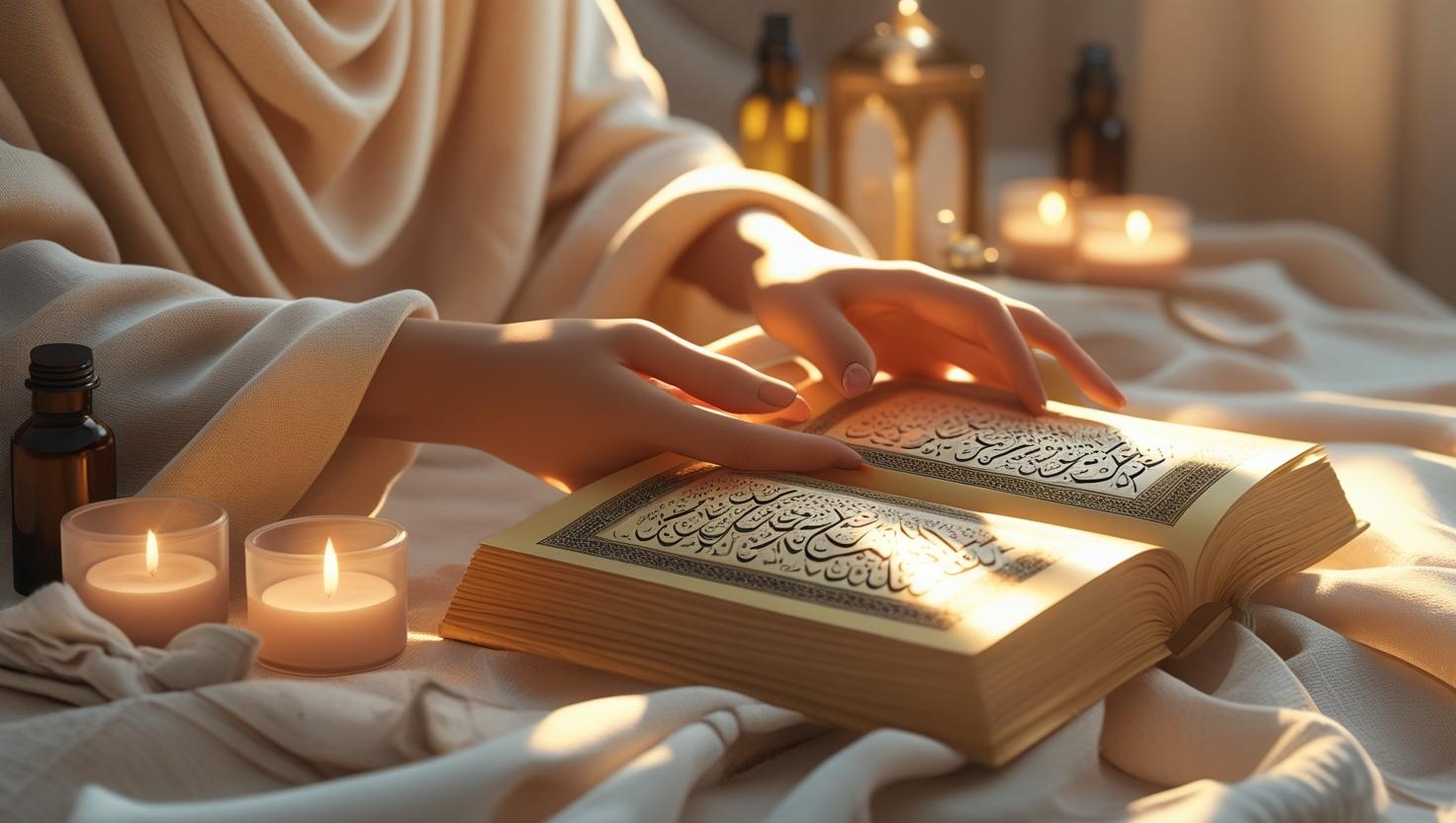
The Quran, the holy book of Islam, is regarded as a profound source of comfort, hope, healing, and mercy for believers.5 The very act of reciting the Quran can be meditative, promoting calmness and reducing anxiety.5 Reading the Quran is strongly encouraged to support mental health, with specific guidance on how to approach it for deeper insights and personal relevance.19 This involves opening one’s heart to unexpected meanings, imagining oneself as various characters within its narratives, and reading as though the verses are being revealed personally.19
The Quran is thus a living source of healing and guidance for the soul. It is not merely a static text but a dynamic wellspring of spiritual and psychological nourishment. Active engagement with the Quran, beyond simple recitation, can lead to profound self-knowledge, emotional regulation, and a clearer sense of purpose, serving as a continuous source of self-care and spiritual growth.
Remembrance of Allah (Dhikr)
Dhikr, the remembrance of Allah, is a powerful tool for finding peace during turbulent times and maintaining serenity when conditions are favorable.19 The Quran explicitly states, “In remembrance of Allah do hearts find rest” (Quran 13:28).16
Dhikr is considered a “medicine for the soul,” capable of healing “broken hearts” and overcoming “depressive states”.19 This practice can be performed anywhere, anytime, and in various forms, including personal supplication (
Dua), during meditation, while observing nature, through music, writing, or by studying Islamic sources in group settings.19
Dhikr serves as a constant source of inner tranquility and divine connection. The direct Quranic affirmation establishes a clear functional link between consistent remembrance of Allah and the attainment of inner peace and tranquility, irrespective of external circumstances. It is portrayed as a continuous, internal practice that keeps the soul nourished and connected to its Creator, providing a robust buffer against life’s stresses and fostering a profound sense of calm.
Seeking Forgiveness (Tawbah) and Purification of the Soul
Seeking forgiveness (Tawbah) is crucial for both mental and spiritual health, as it purifies the heart and mind from the burdens of wrongdoing.1 Allah is described as Most Merciful and All-Forgiving, inviting repentance as a means for individuals to gain immense spiritual benefit.8 The Quran emphasizes this divine mercy: “Indeed, my Lord is Most Merciful and All Loving” (Quran 11:90), and “Whoever repents after his wrongdoing, and makes amends, Allah will relent to him” (Quran 5:39).19 Regret and remorse are viewed as healthy feelings that prompt one to make things right with Allah and others.19 Practical steps for sincere repentance include asking Allah for forgiveness, making amends for errors, setting firm intentions not to repeat mistakes, and importantly, forgiving oneself.19 It is even stated that repentance “counts as a good deed”.19
Forgiveness acts as a cleansing process for emotional and spiritual liberation. The Islamic teachings highlight Tawbah not just as a religious duty but as a profound act of self-care. The emphasis that “the one who gains is you” when Allah asks for repentance, and that it “counts as a good deed,” underscores the direct contribution of seeking forgiveness to mental and emotional relief by releasing guilt, shame, and negative thoughts. This process allows for emotional and spiritual liberation, fostering a healthier relationship with oneself and with Allah, and is viewed as a continuous process of purification and growth.
The Concept of Barakah (Blessings) in Life and Time
Barakah represents divine blessings, abundance, and an increase bestowed by Allah upon individuals, families, and communities.20 It brings about a state of flourishing, contentment, and fulfillment in one’s life and endeavors.20
Barakah is attained through obedience to Allah’s commandments, following the guidance of the Quran and the teachings of Prophet Muhammad (peace be upon him), and engaging in acts of worship such as prayer, fasting, giving charity, and seeking knowledge.20 This divine blessing extends to various aspects of life, including time, wealth, relationships, and provisions.20 Time invested in acts of devotion and beneficial pursuits is particularly blessed with productivity and fulfillment.20
Barakah functions as a spiritual multiplier for productivity and contentment. This concept is presented as a divine mechanism that amplifies the impact of one’s efforts. It is not merely about having more time or wealth, but about the inherent blessing within them, leading to “greater efficiency, creativity and satisfaction” 21 and a profound sense of “contentment and fulfillment”.20 This implies that aligning one’s actions with Islamic principles—through worship, good deeds, and pure intentions—does not just earn spiritual reward but actively invites divine blessings that make one’s limited resources, especially time, feel more expansive and productive. This is a spiritual approach to productivity that directly contributes to a sense of accomplishment and inner peace, which are key aspects of self-care.
Valuing Time: A Precious Resource for the Hereafter
Time is considered the “most precious commodity” in Islam and should not be wasted on trivial matters or pursuits that could harm one’s spiritual journey.22 The Prophet Muhammad (peace be upon him) highlighted its immense value, stating, “There are two blessings which many people do not make the most of and thus lose out: good health and free time”.22 Muslims are encouraged to fill their time with acts of gratitude and obedience towards Allah, moving from one act of worship to another.22 Even permissible pursuits can earn divine reward if undertaken with the correct intention.23 Conversely, wasting time is linked to deep depression, as an individual may feel like an animal living only to eat and sleep, leading to a sense of existential emptiness.23
A significant phenomenon discussed in Islamic eschatology is the “quickening of time” as a sign of the Day of Judgment. Several Hadith narrate that “time will pass quickly,” to the extent that a year will feel like a month, a month like a week, and so on.24 Scholars such as Imam al-Nawawi and Ibn Hajar al-Asqalani interpret this phenomenon not necessarily as a physical acceleration of time, but primarily as a
loss of blessing (barakah) in time.25 This means that despite the passage of hours, little beneficial is accomplished, leading to a subjective feeling that time is slipping away quickly and that one has insufficient time for good deeds.25 The Quran, in Surah Al-Asr (103:1-3), profoundly emphasizes the worth of time as a measure of success or failure: “By time, indeed, mankind is in loss, Except for those who have believed and done righteous deeds and advised each other to truth and advised each other to patience”.25
This perspective frames time management as a spiritual imperative and a defense against existential loss. The interpretation of the “quickening of time” as a loss of barakah highlights a functional relationship: wasting time and neglecting one’s duties leads to a subjective experience of time flying by unproductively, which can cause “deep depression”.23 Conversely, the solution is to “invest time wisely” 28 and fill it with “beneficial things” and worship.22 This implies that conscious, purposeful time management, deeply rooted in Islamic principles, is a critical form of self-care. It combats feelings of regret and loss, actively invites
barakah, and thereby provides a profound sense of fulfillment and prepares the individual for the Hereafter. This approach transforms a potential source of anxiety—the feeling of time slipping away—into an opportunity for spiritual gain and lasting contentment.
The following table provides a summary of the concept of Barakah and its relation to time management:
| Concept | Explanation | Relevant Snippets |
| Definition of Barakah | Divine blessings, abundance, and increase in spiritual, material, and temporal aspects of life. It brings flourishing, contentment, and fulfillment. | 28 |
| “Quickening of Time” (Signs of the Hour) | A prophetic sign where time feels compressed (e.g., a year like a month, a day like an hour). Scholars interpret this as a loss of barakah in time, leading to less accomplishment and feelings of regret. | 24 |
| How to Gain/Restore Barakah in Time | Utilize time for good deeds and worship; get up early (before Fajr) and stay awake after Fajr; pray on time; read more Quran; ask Allah for blessings in time; organize and plan your day; focus on correct intention in permissible pursuits; avoid wasting time on unimportant/unbeneficial actions. | 25 |
V. Social Self-Care: Strengthening Community and Family Bonds
Social connections, particularly within the family and broader community, are fundamental to Islamic self-care. Islam emphasizes that an individual’s well-being is intrinsically linked to the health and harmony of their social environment.
The Centrality of Family in Islam
The family unit is considered the cornerstone of society in Islam, with the cultivation of strong, healthy relationships within it being of utmost importance.29 Values such as love, respect, compassion, and mutual support are central to the Islamic perspective on family life.29 The Prophet Muhammad (peace be upon him) emphasized this by stating, “The best of you are those who are the best to their families”.29 This highlights that kindness and respect within the family directly impact the strength and integrity of the entire community.29 The family is regarded as the primary setting where individuals are nurtured and where moral, spiritual, and social values are imparted.29
Roles and responsibilities within the family unit—such as the father as provider and protector, the mother as nurturer and caregiver, and children’s respect and obedience to parents—all contribute to mutual self-care and overall well-being.29 The Quran instructs believers to “protect yourselves and your families from a Fire whose fuel is people and stones” (Quran 66:6), underscoring the father’s role in safeguarding his family from both physical and spiritual harm.29 Furthermore, good communication, patience, and peaceful conflict resolution are actively encouraged within the family to maintain harmony.29
This emphasis on family positions it as the foundational unit of self-care and societal health. The consistent portrayal of the family as the “cornerstone of society” and the primary unit for nurturing individuals implies a functional relationship: individual self-care is not an isolated endeavor but is deeply intertwined with the health of the family unit. A strong, supportive family provides the initial environment for emotional, spiritual, and social development, all of which are critical aspects of self-care. The Hadith about being “best to their families” suggests that fulfilling one’s duties within the family is not just a personal virtue but also a direct contribution to broader societal well-being, creating a positive ripple effect where individual self-care through strong family ties strengthens the entire community.
Community (Ummah) and Mutual Support
Islam places great emphasis on the collective well-being of the community, known as the Ummah.5 Mutual support, empathy, and acts of kindness are strongly encouraged as ways to uplift and strengthen one another.5 The Prophet Muhammad (peace be upon him) vividly illustrated this interconnectedness by likening believers to “one body. When one of the limbs suffers, the whole body responds to it with wakefulness and fever”.5 This ethos actively combats feelings of isolation and fosters a strong sense of belonging within the community.5 The Quran encourages the formation of a group of people dedicated to inviting to all that is good, enjoining what is right, and forbidding what is wrong, asserting that “they are the ones to attain success” (Quran 3:104).30 This highlights the collective responsibility of Muslims to actively work towards the betterment of society.
This perspective frames communal responsibility as a pillar of individual self-care. It demonstrates the interdependency within the Ummah: when individuals contribute to the community’s well-being by enjoining good, forbidding wrong, and offering support, they in turn benefit from a supportive environment that combats isolation and provides assistance during difficult times. This implies a reciprocal functional relationship: fulfilling communal responsibilities is a form of self-care because it actively creates a healthy ecosystem that nurtures and sustains individual well-being. This represents a shift from a purely individualistic understanding of self-care to a communal approach where personal flourishing is deeply linked to collective harmony and support.
Interpersonal Relations and Ethical Conduct
Islam places significant importance on harmonious interpersonal relations, ethical business conduct, and maintaining social equilibrium within society.30 This involves a wide range of responsibilities, including giving due rights within a family, ensuring impeccable treatment of neighbors, earning income through lawful means, and giving charity to the poor.30 Cultivating virtues such as compassion, humility, and forgiveness contributes significantly to a positive outlook on life and leads to improved relationships.15
Ethical conduct is thus a manifestation of self-care and societal health. This perspective connects individual ethical behavior to both personal well-being and the overall health of society. Engaging in ethical and compassionate conduct towards others is not merely a moral duty but also a profound form of self-care. By fostering positive relationships and contributing to a just and equitable society, individuals experience less conflict, benefit from greater communal support, and cultivate a deeper sense of purpose, all of which are essential for their own mental, emotional, and spiritual well-being.
VI. Conclusion: Integrating Islamic Self-Care for a Fulfilling Life
Islamic self-care is a comprehensive and deeply faith-driven approach that encompasses physical, mental, emotional, spiritual, and social dimensions of well-being. It is fundamentally understood not as a self-indulgent act, but as a vital means to honor the body and soul as trusts from Allah, enabling individuals to fulfill their divine purpose and societal duties. This holistic framework emphasizes the interconnectedness of all aspects of a person’s life, asserting that true well-being is achieved through a balanced and purposeful existence.
The principles discussed throughout this report underscore that self-care in Islam is a continuous journey of growth and refinement, rather than a fixed destination. Every action, from maintaining physical hygiene and consuming nutritious food to engaging in prayer, Quran recitation, remembrance of Allah (Dhikr), and seeking forgiveness (Tawbah), can be transformed into an act of worship through sincere intention (niyyah). This transforms mundane activities into opportunities for spiritual gain and personal development.
Adhering to these Islamic principles for self-care empowers individuals to live balanced, purposeful lives, fulfilling their duties to Allah and humanity with greater capacity and contentment. Faith provides an enduring source of resilience, solace, and a profound sense of meaning, equipping believers to navigate life’s inevitable challenges with strength, patience, and unwavering hope. Ultimately, caring for oneself in Islam is an act of profound worship and gratitude to the Creator, leading to success and fulfillment in both this transient world and the eternal Hereafter.


One thought on “Holistic Self-Care in Islam: Nurturing Body, Mind, and Soul for a Balanced Life”