
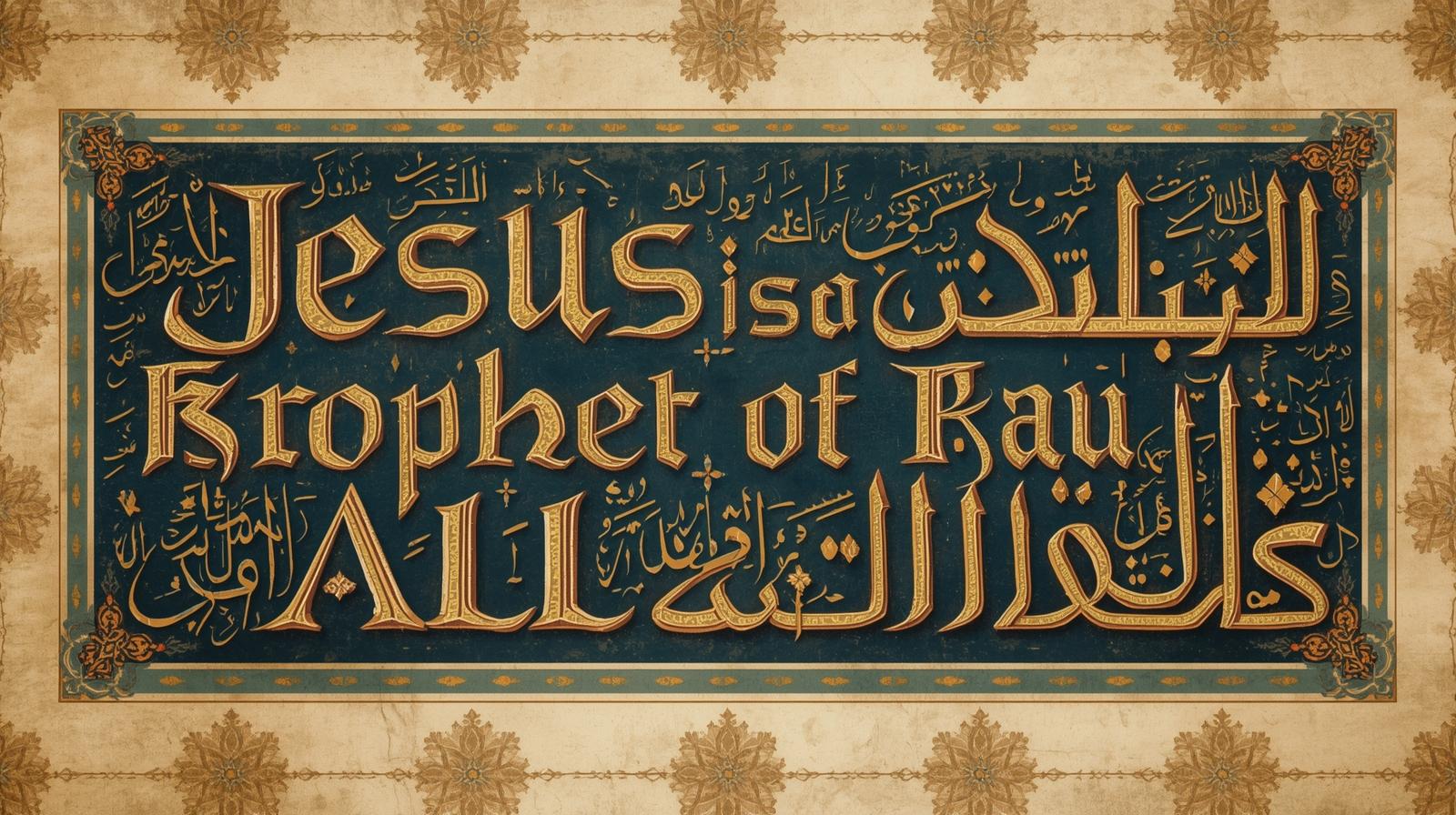
What is the Islamic belief about Jesus Christ? Was he truly the Son of God? The religion of Islam requires belief not only in the Prophethood of Muhammad (sa), but also in all prophets of God, including Jesus (as) (The Holy Quran 2:137). The Holy Qur’an describes the story of Jesus, including his birth, his mission as a Prophet to the Israelites, and his crucifixion.
In Islam, Mary is described as a devout and righteous woman, and affirms the fatherless birth of Jesus. It also outright rejects the opposing claim that his birth was illegitimate. However, although Islam acknowledges the virgin birth of Jesus as a miracle, it does not consider it unnatural. This is because Islamic belief holds that the laws of nature are never broken. Furthermore, the immaculate conception of Jesus is not understood to mean that he was in any way a Divine Being. He was still a human being, (Holy Qur’an 19:31) who believed in the absolute Unity and Indivisibility of God (Qur’an 3:52).
Muslims believe that Jesus was undoubtedly called the son of God, but this title has only been used metaphorically and, in fact, is applied to all the chosen ones of God. Jesus prayed to God like other pious individuals and engaged in spiritual practices such as fasting. Furthermore, he lacked knowledge of the future, as only the Divine Being possesses perfect and complete knowledge. According to Ahmadiyya Muslim beliefs derived from The Holy Quran, Jesus (peace be on him) survived the crucifixion, travelled to preach to the lost tribes of Israel, lived to an old age, and was given a permanent residence in a valley of rivers, which we believe to be Kashmir in India.
Evidence Supporting the Islamic View of Jesus as a Prophet
Emphasis on Monotheism
Islamic teachings strongly emphasize the absolute oneness of God (Tawhid). The Quran explicitly rejects any association of partners with God, including the notion that Jesus is His son. Surah Al-Ikhlas (112:1-4) affirms God’s singularity and uniqueness, making it incompatible with the concept of divine offspring.
The Quranic Declaration
The Quran clearly states in Surah An-Nisa (4:171):
“O People of the Book, do not commit excess in your religion or say about Allah except the truth. The Messiah, Jesus, son of Mary, was but a messenger of Allah and His word which He directed to Mary and a soul from Him.”
This verse emphasizes Jesus’ role as a messenger rather than divine offspring.
Miracles as Signs of Prophethood
The miracles attributed to Jesus—such as healing the sick and raising the dead—are viewed in Islam as signs granted by God to support his prophethood. These miracles are not seen as evidence of divinity but as divine support for his mission.
The Crucifixion Narrative
Islamic tradition holds that Jesus was not crucified but was instead raised to heaven by God. Surah An-Nisa (4:157-158) states:
“And [for] their saying, ‘Indeed, we have killed the Messiah, Jesus, the son of Mary,’ – but they did not kill him, nor did they crucify him; but [another] was made to resemble him to them.”
This belief underscores that Jesus was a prophet who did not undergo death in a manner consistent with divine incarnation.
Theological Consistency
The Islamic view maintains that associating divinity with any human being contradicts the concept of God’s transcendence. The Quran repeatedly warns against attributing children or partners to God (e.g., Surah Al-Isra 17:111), reinforcing that Jesus was a revered prophet and servant of God, not His son.
Historical and Scriptural Context
Islamic scholars argue that the earliest Christian texts do not explicitly describe Jesus as divine but portray him primarily as a prophet and messenger. The later development of doctrines such as the Trinity and Sonship are viewed as deviations from original monotheistic teachings.
In summary, Islamic evidence highlights the strict monotheism central to its theology, explicit Quranic declarations about Jesus’ role solely as a prophet, and theological considerations that oppose attributing divinity or sonship to any human being.