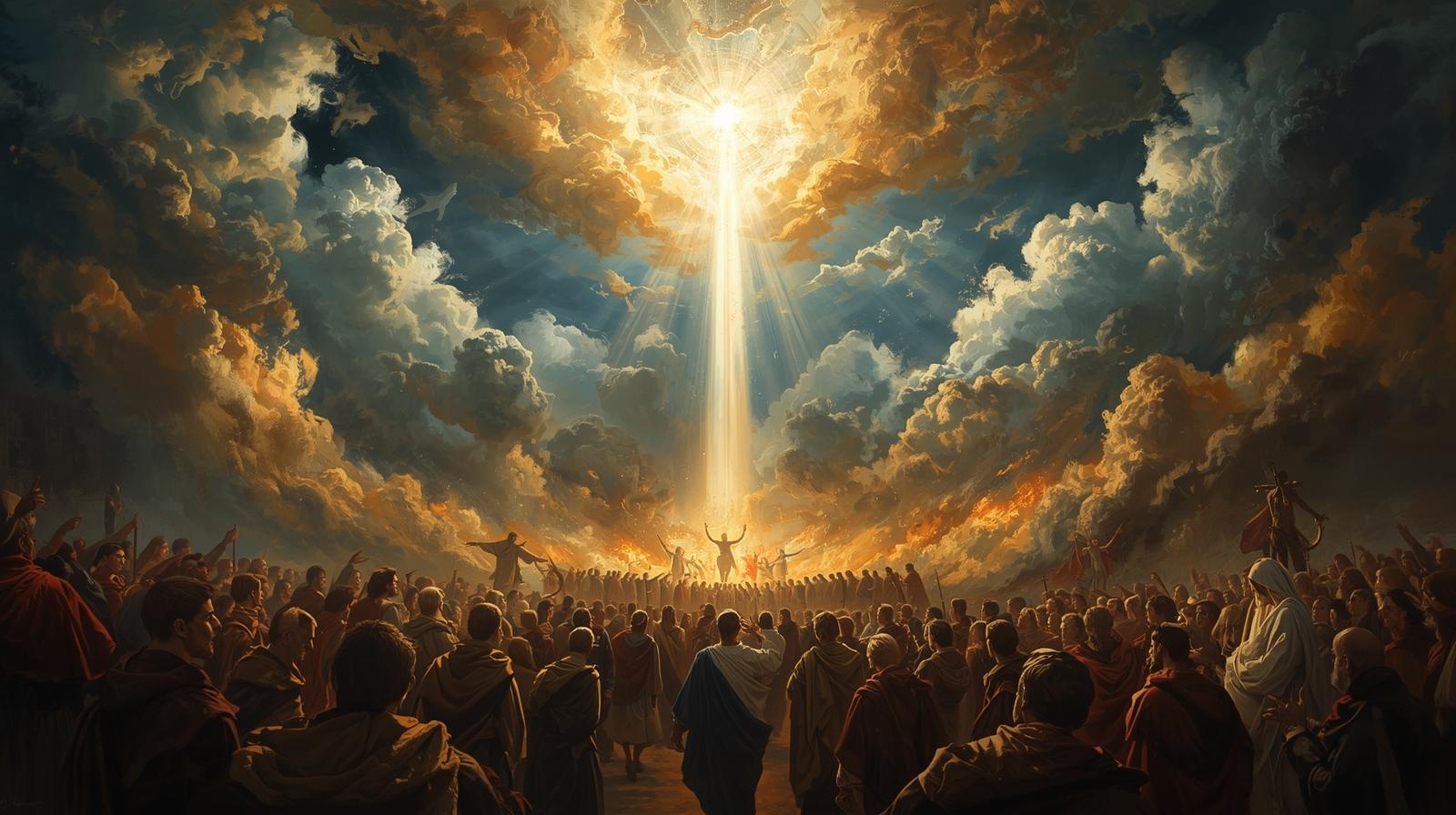
Allah said in Surat al-A`raf, Ayah 187: (يَسْأَلُونَكَ عَنِ السَّاعَةِ أَيَّانَ مُرْسَاهَا قُل إِنَّمَا عِلمُهَا عِندَ رَبِّي). It means: « They ask you (Muhammad) about the final hour, when will be it’s appointed time? Say the knowledge thereof is with my Lord alone. None but He can reveal as to when it will be. » Allah There are signs that indicate the approach of the Day of Judgment, which can be categorised into minor and major signs. The minor signs occur first and will continue to prevail over thousands of years as the time approaches. Eventually, major signs will follow, appearing one after the other in quick succession. It’s important to understand that the chain of minor signs will not happen within a short period; rather, they will unfold gradually over an extended duration leading up to the major signs.
بِسْمِ اللهِ الرَّحْمَنِ الرَّحِيم
Praise be to Allah, the Lord of the worlds. To Him belong all blessings and proper praise. May Allah elevate the status of our Master Muhammad (peace be upon him), along with his noble family and companions, and protect his community from the dangers he fears for it.
Furthermore, Allah says in Surah Ghafir, Ayah 59:
﴿إِنَّ السَّاعَةَ لأَتِيَةٌ لاَّ رَيبَ فِيهَا وَلَكِنَّ أَكثَرَ النَّاسِ لاَ يُؤمِنُون﴾
It means: « The hour will certainly come. There is no doubt ; Yet most men believe not. »
Allâh the Exalted created the worlds. He has made the earth our temporary living place, serving as a passageway to the hereafter rather than a permanent dwelling. The Qur’ân informs us that nothing in this life is eternal; everything we see will eventually perish, taking with it all life on earth.
Life on earth is characterized by constant change. This is evident in our daily circumstances and in the nature of the land we inhabit. Since the beginning of human life on earth, people die while others are born each day. This cycle will continue until a time when all will perish, including humans, Jinn, and animals. This marks the end of life on earth, when Angel Isrâfîl will blow the horn before his own life is taken.
The timing of that day is unknown to all creation. According to the Qur’ân, Allâh the Exalted has concealed this knowledge from the highest-ranking angels and even the prophets and messengers. Allâh states in Surat al-A`raf, Ayah 187:
﴿يَسْأَلُونَكَ عَنِ السَّاعَةِ أَيَّانَ مُرْسَاهَا قُل إِنَّمَا عِلمُهَا عِندَ رَبِّي﴾
This translates to: “They ask you (Muḥammad) about the final hour, when will it be? Say, ‘The knowledge thereof is with my Lord alone. None but He can reveal as to when it will be.'”
However, Allâh has identified signs indicating the approach of the Day of Judgment, which can be divided into minor signs and major signs. The minor signs are those that occur first; as the time approaches, the major signs will follow. The series of minor signs will not happen rapidly; they are expected to prevail over thousands of years leading into a brief period when the major signs appear one after another.
The concealment of the Day of Judgment’s timing was evident when Angel Jibrîl visited the Prophet Muḥammad and his companions. The scholar Imam Muslim relates that Angel Jibrîl approached the Prophet one day in the form of a man and sat among the companions gathered with him. He asked the Prophet several questions to extend knowledge about Islam to the companions. One question was, “Tell me about the Day of Judgment.” The Prophet replied, “I don’t know any more about it than you do.” By this, he meant that both he and Jibrîl were unaware of the destined time of the Day of Judgment. Jibril then asked, “Then tell me about the signs of the Day of Judgment.” The Prophet replied, “The Day of Judgment will arrive after daughters will harm their mothers immensely, treating them as if they were their slaves. Furthermore, those who were once poor and barefoot—like shepherds and peasants—will become wealthy enough to build tall buildings.”
These are among the minor signs that some Islamic scholars believe have already come to pass. Other minor signs include: mountains being demolished from their bases, people falsely claiming prophethood, an increase in earthquakes, a rise in deceivers and misleaders—including corrupt preachers, the spread of unfamiliar diseases, detectable changes in weather conditions, a rise in killings and injustices, and the experience of time passing quickly, where a year feels like a month and a month feels like a week. Additionally, the distances between shopping centers will become shorter. Other nations will take advantage of the fortunes of the Muslim nation, as one would take advantage of a delicious banquet, while surrounding them from all sides. All of these signs are known to have already occurred.
Among the last of the minor signs yet to manifest is the appearance of our Master al-Mahdiyy. This was mentioned by the Prophet in a Hadîth:
«لا تقومُ السّاعَةُ حتى يَملِكَ النَاسَ رجلٌ من أهلِ بيتي يواطىءُ اسمُهُ اسمي واسمُ أبيهِ اسمَ أبي فيملؤها -أي الأرض- قِسطًا وعدلاً»
This translates to: “The Day of Judgment will occur only after a man from my descendants rises. His name is like mine, and his father’s name is like my father’s name. He will fill the earth with peace and justice, as it had been filled with corruption and injustice.”
This Hadîth has been reported by Ibn Hibban in his book as-ṣaḥih, by Abu Dawud in his book as-Sunnan, by at-Tirmidhiyy in his book al-Jami`, and by al-Hâkim in his book called al-Mustadrak, as related by the companion `Abdullâh Ibn Mas`ud, may Allâh raise his rank, who heard it from the Prophet, Salla lLâhu `alayhi wa sallam.
Known as al-Mahdiyy, his full name is Muḥammad Ibn `Abdillâh. He will be a descendant of either al-Hasan or al-Husayn, the sons of Fatimah, the daughter of the Prophet Muḥammad. Initially, in his mission, al-Mahdiyy will be accompanied..
In Islam, the Day of Judgment (known as Yawm al-Qiyamah) is a cornerstone of the faith and one of the six fundamental articles of belief. It represents the final end of the temporal world and the beginning of the eternal afterlife (Akhirah). The Quran describes this event not merely as a terrifying cataclysm, but as the ultimate manifestation of divine justice, where every soul is resurrected and held accountable for their earthly actions. It is known by many names in the Quran, such as Al-Haqqah (The Inevitable Reality) and Yawm ad-Din (The Day of Recompense), emphasizing that this day is an undeniable certainty.
The Signs and the Onset
Islamic eschatology teaches that the Day will not arrive until specific signs have come to pass. These are divided into minor signs, which occur over a long period and involve moral and social decay—such as the loss of trustworthiness, widespread ignorance, and violence—and major signs, which are cosmic events occurring in quick succession. The major signs include the appearance of the False Messiah (Dajjal), the return of Jesus (Isa ibn Maryam) to establish peace, and the sun rising from the West. Once these signs conclude, the Angel Israfil will blow the Trumpet (As-Sur). The first blast will destroy the universe, causing mountains to crumble and all life to cease, while the second blast will herald the Resurrection, where all beings are recreated to stand before their Creator.
The Gathering and the Reckoning
Following the resurrection, humanity will be assembled on a vast, featureless plain for “The Gathering” (Al-Hashr). This period is described as an agonizing wait lasting 50,000 years, where people stand barefoot and naked under a fierce sun. The Quran vividly describes the anxiety of this time, noting that people will be submerged in their own sweat according to the extent of their sins. Eventually, the Great Intercession occurs, leading to the commencement of the Reckoning (Al-Hisab). During this phase, perfect justice is established via “The Scales” (Al-Mizan), which weigh the sincerity and weight of deeds rather than just their quantity.
The Book of Deeds
A central moment of the judgment is the distribution of records. Every individual will receive a book containing a comprehensive record of their life, with nothing omitted. The Quran distinguishes between two groups: the righteous, who will be given their record in their right hand, signifying an easy reckoning and ultimate success; and the wicked or disbelievers, who will receive their record in their left hand or from behind their back, signaling regret and destruction. This moment validates the Quranic promise that not even an atom’s weight of good or evil will go unnoticed.
The Bridge and the Final Abode
The final test involves crossing the Sirat, a bridge that traverses over the Hellfire to reach Paradise. It is described in traditions as thinner than a hair and sharper than a sword. Everyone must attempt to cross it; believers will move across at speeds determined by their faith and deeds—some like lightning, others crawling—while those without the light of faith will fall into the abyss. The ultimate destination is then decided: either Jannah (Paradise), a place of eternal peace and the vision of God, or Jahannam (Hellfire), a place of purification or eternal punishment. The exact timing of this day remains known only to Allah, serving as a constant reminder for believers to live a life of mindfulness and virtue.
The Concept of Al-Mizan (The Scales)
In Islamic theology, Al-Mizan refers to the divine, physical scales set up on the Day of Judgment to measure the deeds of every individual. Unlike worldly scales that measure mass, these scales measure the spiritual “weight” and truth of a person’s life. The Quran establishes this as the ultimate manifestation of justice, stating, “And We place the scales of justice for the Day of Resurrection, so no soul will be treated unjustly at all.” It serves to visually demonstrate to every soul—believer and disbeliever alike—the reality of their actions, ensuring that no one feels wronged by the final judgment.
What Exactly is Weighed?
Scholars have derived three distinct interpretations from the texts regarding what is actually placed on the scales, suggesting that all three may occur. First, the deeds themselves will be weighed; although actions are abstract in this life, Allah will give them physical substance and form in the Hereafter. Good deeds may appear as beautiful, radiant forms, while sins may appear as dark, heavy burdens. Second, the records or scrolls containing the angels’ documentation of one’s life will be weighed. Finally, the person themselves may be placed on the scale. However, a person’s physical size will not matter; a large, powerful tyrant may weigh less than a gnat due to their lack of faith, while a physically frail believer may weigh heavily due to their piety.
The “Heaviest” Deeds
Not all deeds carry equal weight. The weight of an action is determined not just by the action itself, but by the sincerity (Ikhlas) and intention behind it. The single heaviest deed to be placed on the scale is the Testimony of Faith (La ilaha illa Allah). A famous tradition, known as the “Hadith of the Card,” describes a man with 99 scrolls of sins stretching as far as the eye can see. When he thinks he is doomed, a single card bearing the testimony of faith is brought out. It is placed on the other side of the scale, and it outweighs all the scrolls of sin, proving that true, monotheistic faith is heavier than anything else.
Good Character and Remembrance
Beyond faith, the Prophet Muhammad emphasized specific actions that add immense weight to a believer’s scale. He explicitly stated that nothing is heavier in the scales of a believer than good character (Husn al-Khuluq). This elevates kindness, patience, and good manners from mere social niceties to critical spiritual assets. Additionally, specific remembrances of Allah (Dhikr) are described as “light on the tongue but heavy on the scales,” specifically the phrase “SubhanAllahi wa bihamdihi, SubhanAllahil Adheem” (Glory be to Allah and His Praise, Glory be to Allah the Almighty).
The Outcome of the Weighing
The result of this weighing is binary and decisive. The Quran states that those whose scales are heavy with good deeds—meaning their faith and righteousness outweigh their sins—will be the successful ones, destined for a life of bliss in Paradise. Conversely, those whose scales are light—because their good deeds were rejected due to disbelief or hypocrisy, or because their sins overwhelmed their good deeds—will have “lost their souls” and face punishment. This creates a powerful incentive for believers to view every action, no matter how small, as a potential “weight” that could tip the balance in their favor on that critical day.
In Islamic eschatology, the Sirat is a bridge that spans over the Hellfire (Jahannam), connecting the place of Reckoning to Paradise (Jannah). It is described in the Hadith as being “thinner than a hair and sharper than a sword.” This description emphasizes the extreme precariousness of the crossing. The bridge is not merely a physical structure but a manifestation of the “Straight Path” (Sirat al-Mustaqim) that a person tried to follow in their earthly life. It is slippery and shrouded in total darkness, illuminated only by the personal light a believer carries. Along its sides are great hooks and thorns—likened to the thorns of the Sa’dan plant found in the desert—that snatch at people according to their past sins.
The Crossing
Every soul, including the prophets and believers, must pass over this bridge. The speed at which one crosses is directly proportional to their faith (Iman) and righteous deeds. The most righteous will flash across like lightning, completing the journey in an instant. Others will cross like the wind, like swift horses, or like running men. Those with less light will walk, while those struggling with their sins will crawl, dragging themselves forward. During this terrifying transit, the prophets will stand on the other side, pleading to Allah with the words, “Allahumma Sallim, Sallim” (“O Allah, grant safety, grant safety”).
The Concept of Light (Noor)
Success on the Sirat depends entirely on the “light” (Noor) one is granted. This light is generated by acts of worship, such as prayer, charity, and justice performed in this world. In the intense darkness over the Hellfire, this light will shine from the believers’ hands and feet, guiding their way. Hypocrites (Munafiqun), who outwardly practiced Islam but lacked true faith, will initially have light but will find it extinguished just as they step onto the bridge. They will cry out to the believers to wait for them so they can borrow some light, but they will be separated by a wall, leaving them to fall into the abyss.
The Qantarah: The Final Stop
Once the believers have successfully crossed the Sirat and are saved from Hell, they are not immediately admitted into Paradise. They are halted at a second, smaller bridge or archway known as the Qantarah. Here, a final purification takes place where believers settle outstanding grievances between one another. Any grudges, minor injustices, or hard feelings that existed in the worldly life are resolved and removed, ensuring that they enter Paradise with hearts completely free of resentment (Ghill). Only after this final cleansing are they permitted to enter the gates of Jannah.