

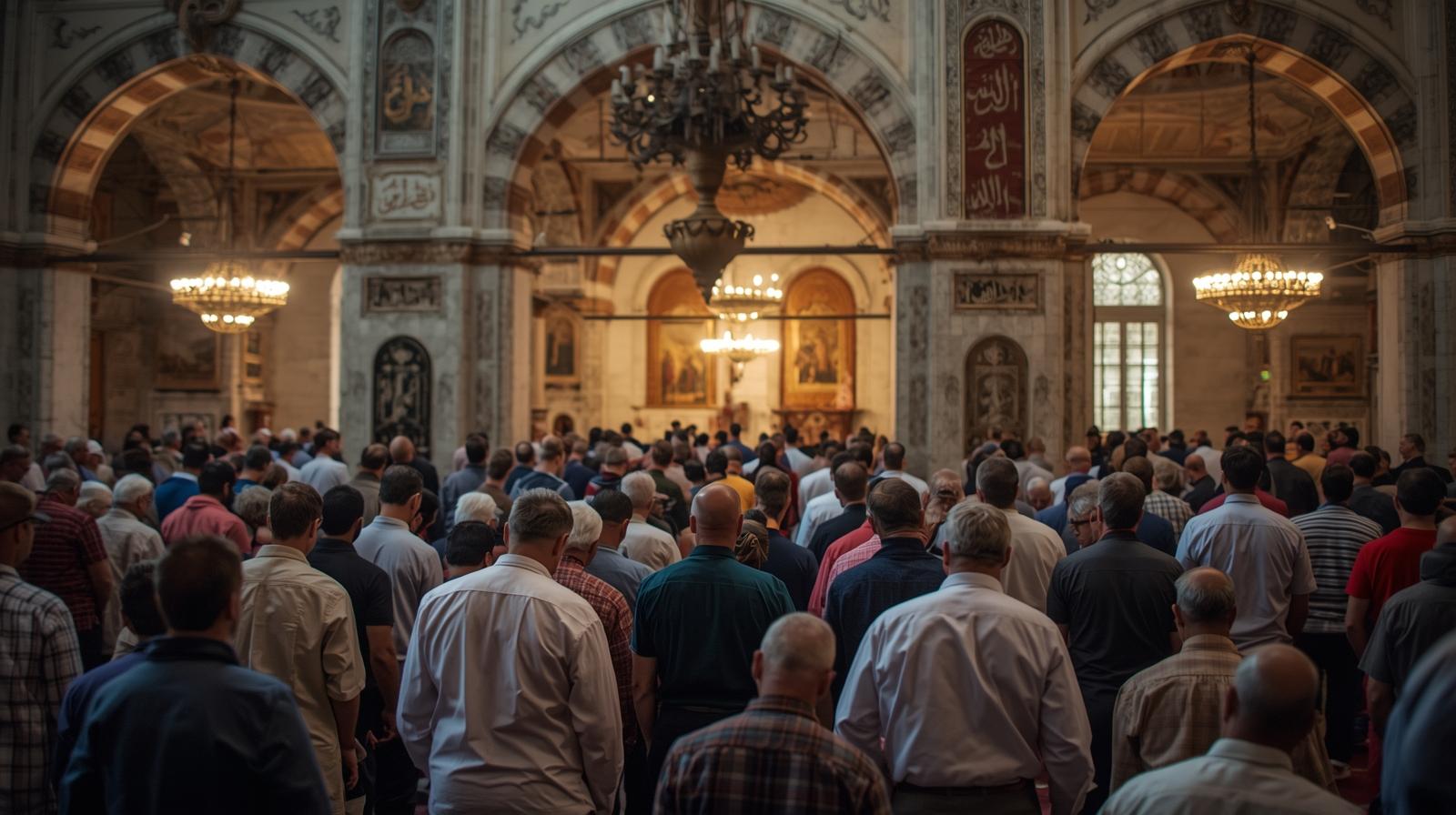
focusing can feel challengingFocusing can feel challenging. Attention is like a muscle; at first, it requires considerable energy and effort to concentrate, which is completely normal! However, with practice, your ability to focus strengthens and becomes easier over time.Attention is much like a muscle—at first, it can feel challenging to focus, requiring considerable energy and effort. This is completely normal! With practice, however, your ability to concentrate strengthens and becomes easier over time.
From the moment you enter the world, your mind is constantly active, working tirelessly every second of the day. While you’re awake, it’s engaged, and even during sleep, it’s still processing. Consequently, your thoughts will naturally flow during your prayers unless you consciously adapt your approach to this important practice. By incorporating more mindfulness techniques, you can cultivate a more profound and meaningful experience. Embracing this journey can deepen your connection and enhance your moments of reflection. Let’s explore this together!
Creating a Sacred Space for Prayer and the Benefits of Incense
Creating a meaningful space for your prayers is a wonderful way to deepen your spiritual connection and enhance your practice. The environment you choose can truly transform your experience, so it’s essential to make it special and sacred. Try to find a room that you don’t often use for everyday activities—this can help establish a sense of separation and significance. Keeping the space clean, organized, and at a comfortably cool temperature can make all the difference, allowing you to fully immerse yourself in your prayers without any discomfort caused by being too hot or too cold.
The lighting in your prayer space can significantly contribute to your experience. A softly lit room creates a serene atmosphere, encouraging feelings of reverence and helping you focus. Strive for minimal visual distractions; bare walls without pictures or personal items can help keep your mind centered on your spiritual intentions.
Finding a quiet, secluded spot is also key to cultivating a distraction-free environment. Make sure to remove any potential interruptions, like the ringing of phones, which can distract you from your connection. It’s equally important to steer clear of kitchen aromas that might lead your thoughts astray—your focus should be solely on your communion with Allah (SWT). Don’t forget to gently close the door behind you; this simple act can foster peace without making you feel confined.
Incorporating incense into your prayer routine can elevate your experience even further. This cherished tradition not only creates a sacred ambiance but is also backed by research showing its calming benefits. Incense promotes relaxation and helps facilitate deep breathing and meditation, paving the way for a greater sense of inner peace.
Aromatherapy has long explored the powerful effects of scents on our emotional and mental well-being. Natural essential oils can work wonders, enhancing your mood and establishing a serene atmosphere ideal for prayer. The unique structure of essential oil molecules interacts with the olfactory receptors in our noses, sending messages to the limbic system—responsible for our emotions and memories. This connection prompts the release of beneficial chemicals, like serotonin to alleviate anxiety and endorphins to reduce pain.
Using essential oils is a truly wonderful way to enhance your emotional balance, bringing remarkable benefits to both your mind and body! By carefully curating your prayer space with these lovely elements, you’ll create a nurturing environment that not only enriches your spiritual practice but also instills a lasting sense of tranquility and connection. This is a fantastic opportunity to transform your prayer experience—your journey is just beginning!
If you’re looking for quick relief from stress or anxiety before your prayers, I highly recommend inhaling a few drops of Chamomile oil on a handkerchief for an instant boost. Alternatively, an aromatherapy lamp can be a stylish addition to your space, gently warming a blend of water and essential oils to fill the air with delightful scents. Calming oils like Chamomile, Rose, or Sandalwood can truly help clear your mind, leading to a more profound and engaging prayer experience.
Lastly, consider incorporating Wudhu (ablution) into your preparation routine. This cleansing ritual not only refreshes your body but also revitalizes your focus and mindset, dramatically enhancing your attentiveness and connection during prayer. Remember, this is all about creating a meaningful and serene space for yourself—embrace the journey ahead!
Ultimately, by setting up a dedicated prayer space, incorporating the soothing power of incense and essential oils, and engaging in the act of Wudhu, you can cultivate a peaceful, focused, and deeply enriching prayer experience. Let’s cherish these moments of connection with Allah (SWT) and embrace the joyful journey of spiritual growth!
Wudhu, or minor ablution, is a powerful and uplifting way to prepare yourself for your daily Prayer. It not only reshapes your thoughts, but it also empowers you to pray with confidence, helping you stay focused and avoid distractions from Shaytan, The Accursed.
Taking your time during wudhu and reflecting on the beautiful invocations recommended at each step can be incredibly transformative. This mindful practice encourages deeper contemplation about life, death, and the Creator you will soon stand before. By using wudhu as a tool to align your thoughts, you can truly enhance your Prayer experience.
It’s essential to maintain a sacred space between wudhu and Prayer, so try to avoid conversations about daily matters during this time. If you find yourself needing a moment, reciting invocations can reinforce your connection between wudhu and Prayer. The more you immerse yourself in meditation and focus solely on your upcoming Prayer, the less likely you are to be distracted. Embrace this enriching practice and discover the blessings that come from being truly present in your spiritual journey!
The Invocation Of Wudhu
الحَمدُ للهِ الَّذي جَعَلَ الماءَ طَهُوراً ولَم يَجعَلْهُ نَجِسا و بِسمِ اللهِ وَبِالله
At the beginning of Wudhu, you start in the Name of Allah (SWT) and praise Him for making the water a pure element
اللّهُمَّ اجعَلْني مِن التَّوّابينَ ، وَاجعَلْني من المُتَطِهّرينَ
At the time of washing your hands, you request Allah (SWT) to place you among those who seek His forgiveness and those who are pure.
اللهُمَّ لَقِّني حُجَّتي يَومَ ألقاكَ وَأطلِقْ لِساني بِذِكرك
At the time of rinsing the mouth, you invoke to Allah (SWT) to teach you the correct way to answer the questions on The Day of Judgment when you shall meet His Divine Presence.
اللّهُمَّ لا تُحَرِّمْ عَلَيَّ رِيحَ الجَنَّةِ، وَاجعَلني مِمَّن يَشمُّ رِيحَها وَرَوحَها وَطيبَها
At the time of rinsing the nose, you request Allah (SWT) not to deprive you from the smell of Paradise and to place you among those who smell its fragrance.
اللهُمَّ بَيِّضْ وَجهي يَومَ تَسْوَدُّ فيه الوجُوهُ، وَلا تُسوِّدْ وَجهي يَوم تَبيَضُّ فيه الوجُوهَُ
At the time of washing the face, you ask Allah (SWT) to brighten your face on that Day when He will disgrace and darken the faces of a great number of people.
اللّهُمَّ أعطِني كِتابي بيَميني، والخُلْدَ في الجِنانِ بِيساري، وحاسِبْني حِساباً يَسيراً
At the time of washing the right forearm, you plead to Allah (SWT) to place the scroll of your deeds in your right hand and the certificate of permanency in Paradise in your left hand, and that He should render your accounts leniently.
اللّهُمَّ لا تُعطِني كِتابي بِشِمالي وَلا مِن وَراءِ ظَهري، ولا تجعَلْها مَغلُولَةً إِلى عُنُقي، وأعُوذُ بِكَ مِن مُقَطِّعاتِ النِّيرانِ
At the time of washing the left arm, you ask Allah (SWT) not to place the scroll of your deeds in your left hand, nor on your back, and He should not hang it around your neck. You also seek refuge from the fierce eternal Fire of Hell.
اللّهُمَّ غَشِّني برَحمَتِكَ وَبَرَكاتِكَ وعفْوِكَ
At the time of wiping the head, you request Allah (SWT) to cover you with His Mercy, Blessings and Pardon.
اللّهُمَّ ثَبِتْني عَلى الصِّراط يَومَ تَزِلُّ فيهِ الأقدامُ، واجعَلْ سَعْيي في ما يُرضيكَ عَنّي ياذا الجَلالِ والإكرامِ
Finally, at the time of wiping the feet, you ask Allah (SWT) to keep you steadfast on His Path on that Day when feet shall slip, and make your efforts like of those that will please Him.
It is reported in authentic traditions that the Infallible Imams (AS) used to tremble and sometimes even the color of their skin changed, demonstrating fear and awe for Allah (SWT) whilst performing the act of wudhu. One should try and create, as well as maintain such fear whilst performing wudhu.
Strategy 1: Understanding And Appreciating Allah (SWT)’s Presence
Taking a moment to reflect on the existence of Allah (SWT) and His incredible power, signs, and divine decisions regarding this world and the next is truly beneficial. Embracing His presence is a profound way to instill humility within your heart, allowing you to approach prayer with genuine attention and concentration. Remember, it is Allah alone who gazes at you with compassion during your prayers, and keeping this in mind can elevate your spiritual experience each time you engage in this sacred act.
Abu Ja’far, the son of Babawayh al-Qummi (RA), beautifully reminds us that Allah (SWT) is Exalted and One-of-a-Kind. There is truly no one like Him. He is timeless, the One who hears and sees all. His attributes are endless—the Omniscient, the Wise, the Living, the Everlasting, the Mighty, the Holy, the Knowing, and the Self-sufficient.
Allah is a Being beyond earthly comparisons. He is our Unique and Eternal Refuge, free from relationships that could confine Him; He begets not, nor is He begotten. In fact, He stands alone without equal or rival. Human eyes cannot fathom His essence, yet He perceives all that we see. Our thoughts may fall short in their comprehension of Him, but He is intimately aware of them. Neither slumber nor sleep overtakes Him; He remains ever-watchful and engaged.
This understanding of Allah as the Gracious and the Knowing One, the Creator of everything, reinforces the notion that there is no deity besides Him. His power of creation and authority is unmatched. Blessed is Allah (SWT), the Lord of All Worlds!
Incorporating piety, perseverance, and a deep appreciation for the Majesty of our Lord can greatly enhance our focus during prayer. This mindful approach enables us to sincerely humble ourselves as we stand before Him.
An inspiring example can be drawn from the life of the Prophet Muhammad (S). He elevated the importance of prayer, treating it with the utmost seriousness and dedication. His relationship with his Creator was characterized by reverence, prompting him to maintain complete concentration when in His presence. Al-Khomeini (RA) recounts that the Prophet prayed standing on his toes for ten years, enduring the pain of swollen feet and a pale face from his devotion, even as he stood through the night. In a moment of divine comfort, Allah consoled him with: “We have not sent down the Qur’an on you to cause you distress” (Qur’an, 20:2).
Additionally, al-Saduq (RA) shares wisdom from al-Sadiq (AS), addressing one of his trusted companions: “O Servant of Allah! When you offer your Prayer, do so as if bidding farewell, fearing you may never return. Concentrate as if this were your final prayer. Fix your gaze upon your place of prostration. If knowing someone is beside you leads you to be more diligent in prayer, understand that you stand before Someone who sees you, even if you cannot see Him.”
Embracing this perspective can transform our prayer experience into something more profound and intentional. Let’s strive to deepen our connection to Allah and approach our prayers with the reverence and concentration they deserve!
Strategy 2: Reminding Yourself Of Allah
The Adhan and Iqamah play a vital role in deepening the connection between the worshipper and their Creator. Before embarking on the sacred journey of Prayer, these calls serve as a beautiful reminder of Allah’s (SWT) presence, preparing your heart and mind for direct communication with the Almighty. Embrace this moment to reflect and feel the divine connection before you begin your Prayer, enhancing your spiritual experience.
Lo! In the creation of the heavens and the earth and (in) the difference of night and day are tokens (of His sovereignty) for men of understanding. (Qur’an, 3:190).
Such as remembering Allah (SWT), standing, sitting, and reclining, considering the creation of the heavens and the earth, (and instinctively lament): Our Lord! You have not created this (world) in vain! Glory be on You! Preserve us from the doom of Fire. (Qur’an, 3:191).
The esteemed scholar al-Mutahhari (RA) beautifully highlights a profound tradition found in the book Light Within Me. The essence of Dhikr (remembrance) of Allah (SWT) is to keep our hearts ever attuned to al-Haqq (The Most Truthful), a name representing Allah (SWT). Engaging in this practice truly banishes inattention and fosters a deeper connection.
Think about how essential liturgies are—they are as vital to our spiritual lives as water is to our bodies’ living cells. Just like the air we breathe, which sustains our existence and that of all living beings, liturgies provide the spiritual nourishment we need. Isn’t it amazing? The gifts bestowed upon us by the Almighty—including sight, hearing, and taste—each offer endless blessings, enriching our lives in so many ways.
Moreover, Allah (SWT) fulfills our needs in this world and the hereafter, entirely independently of our worship. Whether we choose to follow His commands or stray from them does not influence His greatness. His guidance is a wonderful roadmap for our own benefit, urging us to embrace good and avoid harmful actions.
As al-Khomeini (RA) insightfully remarks, reflecting on these truths makes it clear that honoring and obeying such a magnificent Benefactor is crucial for our well-being. He is the Creator and Sovereign of this vast universe, which is beyond our full comprehension.
As human beings, it’s humbling to realize that we inhabit one of the smallest planets in a universe filled with countless galaxies. Our solar system, though significant to us, pales in comparison to the larger systems and wonders that remain hidden from even the most dedicated explorers of our time.
Let’s embrace this incredible journey of remembrance and connection with the Divine, recognizing the profound gifts we’ve been blessed with every day!
We have been advised by the Scholars in Islam to try and remember Allah (SWT) at all times possible. This includes repeating certain phrases of worship and servitude, or it can be in the form of meditation, appreciating this world and the hereafter.
al-Tabataba’i (RA) in his book, al-Mizan Volume Two, discusses the way of living that is happier and the life that is more durable. In this narration, al-Daylami narrates in his al-Irshad that Allah (SWT), at one stage during The Ascension (on The Day of Mi’raj), told The Prophet (S):
As for the happy way of living, it is that in which the person is not tired of remembering Me, does not forget My bounties, and does not ignore My rights (on him). He seeks My pleasure day and night. The ever-lasting life is realized when the person works for his spiritual benefit until the world loses its significance for him, and looks small in his eyes. The hereafter becomes great for him.
He gives preference to My pleasure over his own desire; seeks My pleasures; thinks the right of My bounty great; keeps in mind what I have done for him (i.e. for his benefit); remembers Me day and night whenever he is tempted to commit any wrong or sin; keeps his heart clean from that I dislike; hates Shaytan and his whisperings, and does not let Shaytan establish a hold over, or a passage to his heart.
When he acts like this, then I put (My) love into his heart, until I make his heart, as well as his leisure and engagement, and his thought and speech, a part of (My) favors which I have bestowed on those of (My) Creations who love Me; and I open his heart’s eye and ear, so that he hears with his heart and looks with his heart to My Majesty and Greatness; and I make the world straitened for him and make him hate it with all its pleasures; and I caution him of the world and all that it contains, as a shepherd protects his sheep from dangerous pasture lands.
When this happens, he flees from people and transfers from the house of termination to the abode of eternity, and from the house of Shaytan to The Seat of The Beneficent Allah (SWT). O’ Ahmad! I adorn him with dignity and majesty. So, this is the good way of living and the eternal life, and it is the status of those who are pleased (with Me).
So, whosoever acts for My pleasure, I give him three characteristics: I teach him gratitude, which is not polluted by ignorance, remembrance, that is unadulterated with forgetfulness, and love that takes preference over the love of creatures. Then when he loves Me, I love him and I open the eye of his heart to My Majesty. I do not keep (My) special beings hidden from him. I converse with him secretly in the dark of night and the light of day, until he ceases talking with and sitting with the creatures.
I invite him to hear My words and the messages of My Angels. I reveal My hidden truths, treasures I’ve kept from all creation, empowering him with a spirit of modesty that captivates everyone around him. He walks the earth with a clean slate, his sins forgiven. I open his heart to both sight and sound, ensuring he perceives the full spectrum of existence, including the wonders of The Garden and the consequences of the Fire. I make him aware of the challenges and tribulations that await humanity on The Day of Resurrection, preparing him for the important questions I will pose to both the wealthy and the less fortunate, as well as to the learned and the seekers of knowledge.I make him hear My talk and the speech of My Angels. I make My secret known to him, which I have kept hidden from all (My) creation. I dress him in modesty, until all the creation is awed of him. He walks on the earth (and all his sins are) forgiven. I make his heart hearing and seeing, and I do not hide from him anything of The Garden or the Fire. I make known to him the terror and afflictions awaiting the people on The Day of Resurrection, and about the things I will question the rich and the poor, as well as the learned and the ignorant.
I will make him sleep (in peace) in his grave, and I will send Munkar and Nakeer (AS) to question him. He will not experience the sorrow of death, or the fright of the prelude (of the next world). Then I will erect his weighing scale for him, and will unroll his book (of deeds). I will then put his book in his right hand and he shall read it unfolded. Then I will not keep any interpreter between Me and him.
So these are the attributes of the lovers. O’ Ahmad! Make your concern one concern, make your tongue one tongue, and make your body (i.e. your person) alive that is never oblivious (of Me). Whoever is oblivious of Me, I do not care in which valley he perishes.
Strategy 3: A Relaxed And Alert State Of Mind
A clear and attentive mind is vital for truly meaningful Prayer. If you find yourself feeling tired or drained, that’s completely understandable. It’s perfectly alright to pause for a moment—take some deep breaths or engage in a few relaxation exercises to reset your energy before approaching your Lord. In fact, it’s often more beneficial to pray a little later with full focus and intention rather than rush through the experience. Just keep in mind that any delay should be short; enough time to rejuvenate and gather your thoughts to present your best self before the Almighty.
Imam ‘Ali (AS) offers sage advice here: it’s prudent to avoid praying when you feel drowsy. During Prayer, it’s essential to minimize distractions and immerse yourself in the presence of Allah (SWT). The sincere attention you devote during these moments significantly enhances the acceptance of your Prayer. Let’s cherish these sacred times together, allowing our hearts to engage fully and rise in devotion. Embrace this opportunity to connect deeply and experience the profound impact of your faith!
As you approach Prayer, remember to step forward with intention—not in a lazy or hurried manner. Imagine standing before your glorious and Almighty Lord with respect. The rewards from Prayer reflect your attentiveness; the more engaged your heart, the greater the blessings you receive. Fiqh al-Ridha points out the importance of approaching Prayer mindfully—avoid being sleepy or rushed. Instead, come calmly and solemnly, displaying humility and a spirit of submission to Allah (SWT). Show both awe and hope, standing before Him with sincerity, much like a servant awaiting their master—still and respectful, ever aware that although you may not see Him, He sees you.
Imam (AS) knew how to find comfort in his posture, and it’s just as essential for you. Your posture during Prayer should keep you alert and mindful. There is a meaningful connection between how you hold yourself and your capacity to concentrate. Maintaining good posture fosters balance, protecting your spine and helping to prevent unnecessary strain or injury. Plus, it reduces any discomfort that could distract you from fully engaging in Prayer.
As your focus deepens, you might notice a natural slow down in your body—your heartbeat becomes gentle, your breathing light. This state of heightened concentration allows you to reap the greatest rewards from your worship, unlocking limitless blessings. In this focused moment, you may find that mental fatigue and stress easily fade away.
When you finish your Prayer, you’ll likely feel a sense of renewal—relaxed yet alert, with sharpened senses. Many find themselves embracing a heightened awareness, uplifted confidence, and a positive mindset. The happiness that emerges from this experience is something to aspire to, and it beautifully reflects the inner peace that comes with dedicated Prayer.
Let’s strive towards this state of uplifting tranquility together; it’s an incredible gift to ourselves and a meaningful connection to our faith. Each moment spent in Prayer is an opportunity for growth and serenity, so let’s embrace it wholeheartedly!
Strategy 4: Understanding What You Recite
To truly enhance our experience during Prayer, it’s essential to engage with the meanings of the verses we recite. When we take the time to understand the glorification we express, we significantly increase our ability to maintain focus and concentration. Delving into the meanings of our recitations not only keeps our minds actively involved but also enriches our connection to the divine.
In the Thawab al-A’mal, al-Saduq beautifully relays a saying from al-Sadiq (AS): offering two units of Prayer with understanding ensures that we leave with every sin forgiven—a truly uplifting thought! When we grasp the significance of each word in our Prayer, we nurture a sense of calm that helps us manage any distractions that may arise.
It’s valuable to appreciate the words within our preferred language, reciting them with clarity to keep our minds anchored. While it’s important to connect with their meanings, we should focus our thoughts solely on the phrases we are reciting, using this time to deepen our appreciation rather than analysis.
Moreover, the wisdom of the Prophet of Allah (S) reminds us of the power of contemplation: he said to Abu Dharr that two light units of Prayer offered with mindfulness hold greater value than an entire night of worship. This encourages us to prioritize heartfelt engagement and conscious reflection, helping us to build a truly meaningful Prayer experience. Let’s embrace this journey together, as it makes every moment spent in Prayer not just an obligation, but a fulfilling and rewarding practice.
Takbir
الله أكبر
Allah is Great
Translation of Chapter of al-Hamd
(١) بِسْمِ اللَّهِ الرَّحْمَنِ الرَّحِيمِ
In the name of Allah, the Beneficent, the Merciful (1:1).
(٢) الْحَمْدُ لِلَّهِ رَبِّ الْعَالَمِينَ
All praise is due to Allah, the Lord of the Worlds (1:2).
(٣) الرَّحْمَنِ الرَّحِيمِ
The Beneficent the Merciful (1:3).
(٤) مَالِكِ يَوْمِ الدِّينِ
The Master of the Day of Judgement (1:4).
(٥) إِيَّاكَ نَعْبُدُ وَإِيَّاكَ نَسْتَعِينُ
Thee do we worship and Thee do we beseech for help (1:5).
(٦) اهدِنَا الصِّرَاطَ الْمُسْتَقِيمَ
Guide us to the straight path (1:6),
(٧) صِرَاطَ الَّذِينَ أَنْعَمْتَ عَلَيْهِمْ غَيْرِ الْمَغْضُوبِ عَلَيْهِمْ وَلاَ الضَّالِّينَ
the path of those upon whom Thou hast bestowed favours, not of those inflicted by Thy wrath, nor of those gone astray (1:7).
Translation of Chapter of al-Ikhlas
(١) قُلْ هُوَ اللَّهُ أَحَدٌ
“Say: He, Allah, is One” (112:1).
(٢) اللَّهُ الصَّمَدُ
“Allah is He on Whom all depend” (112:2).
(٣) لَمْ يَلِدْ وَلَمْ يُولَدْ
“He begets not, nor is He begotten” (112:3).
(٤) وَلَمْ يَكُنْ لَهُ كُفُوًا أَحَدٌ
“And none is like Him” (112:4).
Translation of the Dhikr During Ruku (Bending) and Sajdah (Prostration)
سُبْحَانَ رَبِّيَ الْعَظِيمِ وَبِحَمْدِهِ
Glory be to my High Sustainer and I praise Him
سُبْحَانَ رَبِّيَ الأَعْلَى وَبِحَمْدِهِ
Glory be to my Great Sustainer, Most High, and I praise Him
Before Going into Prostration
سَمِعَ اللهُ لمَنْ حَمِدَةُ
Allah hears and accepts the praise of one who praises
Istighfar, Between Two Prostration
أَسْتَغْفِرُ اللٌّهَ رَبِّي وَأَتُوبُ إِلَيْهِ
I seek forgiveness from Allah Who is my Sustainer, and I turn to Him
While Standing
بِحَوْلِ الله وَقُوتِهِ أَقُومُ وَأَقْعُدُ
I stand and sit with the help and strength of Allah
Translation of Tasbihat al-Arba’ah
سبحان الله والحمد لله ولا اله الا الله والله اكبر
Glory be to Allah, and all praise is for Him and there is no one worth worshipping other than Allah, and He is Greater than any description
Translation of Tashahhud and Salam
أشْهَدُ أنْ لا إله إِلاَّ اللَّهُ وَحْدَهُ لا شَرِيك لَهُ
I testify that there is none worth worshipping except the Almighty Allah, Who is One and has no partner
وأشْهَدُ أنَّ مُحَمَّداً عَبْدُهُ وَرَسُولُهُ
And I testify that Muhammad is His servant and Prophet
اَللّهم صَلِّ عَلى مُحَمَّدٍ وَّ الِ مُحَمَّدٍ
O Allah! Send Your blessings on Muhammad and his progeny
السَّلَامُ عَلَيْكَ أَيُّهَا النَّبِيُّ وَرَحْمَةُ اللَّهِ وَبَرَكَاتُهُ
O Prophet! Allah’s peace, blessings and grace be upon you!
السَّلَامُ عَلَيْنَا وَعَلَى عِبَادِ اللَّهِ الصَّالِحِينَ
Allah’s peace be on us, those offering prayers – and upon all pious servants of Allah
السلام عليكم ورحمة الله وبركاته
Allah’s peace, blessings and grace be on you believers!
Strategy 5: Proper Pronunciation
The Arabic language is often celebrated for its beauty and sweetness. When it comes to reciting prayers, focusing on proper Makhaarij (pronunciation) and Tajweed (the rules of recitation) can truly enhance your experience and help you maintain attention more easily. By paying attention to your own tone of voice—and that of others—you can learn how certain tones might sound harsh or blunt, and make small adjustments for a more inviting delivery. Practicing these elements, along with the flow of your recitation, is key. Just think about how the qualities in the voice of the Prophet (S) captivated listeners, pulling them in as he recited the Qur’an.
When you cultivate these qualities in your recitation, you’ll find that long chapters of the Qur’an and extended glorifications during prayer can feel invigorating rather than exhausting. You’ll become so immersed in the recitation that you may even find joy in prolonging your Ruku (bowing) and Sujud (prostration). This engagement can transform the way you experience prayer, allowing you to stretch those moments without discomfort.
For devoted Muslims who may not have Arabic as their mother tongue, it’s especially important to master the mandatory parts of the prayer with correct pronunciation. This ensures that your prayers are valid and accepted. While it’s essential to focus on your recitation, try not to become overly fixated; maintaining a connection to Allah (SWT) is equally important. With dedication, there’s no reason not to learn and practice proper Makhaarij and Tajweed. Embracing this journey not only enriches your spiritual life but also deepens your connection to the divine through each beautiful recitation.
Strategy 6: Confidence
In his inspiring book, Self Building, al-Amini shares valuable insights on deepening our focus during Prayer. He highlights four essential approaches: finding a quiet space, eliminating distractions, strengthening our faith, and reflecting on the transient nature of life. Importantly, he emphasizes the power of persistence. If we face challenges during our initial attempts, rather than feeling disheartened, we should embrace determination and commitment to try again. The journey to mastery over our thoughts is gradual, and it’s crucial to cleanse our minds of distractions while nurturing a heartfelt focus on God Almighty.
It’s essential to remember that achieving this profound attention may take time—whether it’s a day, a few weeks, or even months. We shouldn’t allow setbacks to discourage us; instead, let’s hold onto the belief that dedicated focus in Prayer is attainable. With a resolute intention and faith, we can be assured that we will not falter during our prayers. Trust in the strength granted to us by our loving Lord, The Most High, for as articulated in The Qur’an, we possess a powerful resilience that can overcome any challenges we face. Let’s embark on this journey with hope and enthusiasm!
Indeed! The cunning of Shaytan is feeble. (Qur’an, 20:125).
On The Day of Judgment, only you will be in turmoil when Shaytan exclaims:
… I only invited you to evil, and you accepted on your own volition. Therefore (On this Day of Judgment), do not blame me but blame your own selves. (Qur’an, 14:22).
Self-confidence is truly one of the most valuable qualities we can cultivate in ourselves. It’s a reflection of how we view our own worth and plays a significant role in our ability to focus during Prayer.
Developing self-confidence and overcoming distractions is a rewarding journey that requires both time and dedication. One of the best ways to strengthen your self-belief is through goal setting. By setting clear, achievable goals and celebrating each accomplishment, you demonstrate your capabilities to yourself. Each success reinforces your sense of worth and empowers you to reach for even greater heights.
Strategy 7: Alternating Recitations
To truly elevate your Prayer experience, I invite you to explore the beauty of reciting different chapters from The Qur’an, diverse supplications, and various forms of glorification. This enriching practice can keep your mind engaged and present, steering you away from routine distractions.
Our brains are incredibly adept at processing various thoughts simultaneously, so it’s beneficial to harness this capability while communicating with Allah (SWT). By varying your recitations, you can cultivate mindfulness and enhance your spiritual connection. I wholeheartedly encourage you to learn and memorize new chapters from The Qur’an, as well as to discover different supplications and ways to glorify.
For example, if you usually recite Surah al-Qadr following Surah al-Hamd in your first unit of Prayer, why not consider switching it up with Surah al-Falaq or another chapter? This refreshing change can bring your attention back and help minimize distractions, allowing your focus to deepen during Prayer.
Moreover, if you have a cherished invocation you like to use during your Qunoot, take a moment to explore new ones and incorporate them into your practice. And if you typically recite glorification in your last prostration, challenge yourself to try it in earlier ones as well—it can add a delightful twist to your routine!
While it’s vital to maintain the essential elements of Tashahhud, Salaam, and specific acts of Prayer where substitutions are not permitted, embracing variety in your practice can greatly enrich your experience and foster your spiritual growth. With these thoughtful adjustments, you’re bound to discover even greater joy and fulfillment on your Prayer journey!
Strategy 8: Continued Cleanliness
One of the most beautiful and compelling aspects of Islamic teaching is the emphasis on cleanliness. Being ritually pure, through practices like ablution (wudhu) and ghusl (the major ablution), is essential. For instance, performing ghusl on Fridays is especially encouraged as it refreshes your spirit and wipes away sins. Maintaining cleanliness not only purifies your body but also makes it challenging for Shaytan to disturb your heart and mind during Prayer.
A timeless saying of the Prophet (S) beautifully encapsulates this: “Cleanliness is part of faith, and faith leads a person to Paradise.” Therefore, taking the time to brush your teeth, wear perfume, and don a clean, preferably white outfit when standing before Allah (SWT) is truly worthwhile. Cleanliness empowers a believer and fosters a sense of inner peace.
As you prepare for Prayer, consider incorporating these thoughtful practices: wearing fresh, white attire, applying a pleasant fragrance, burning incense, using a tidy Prayer mat, and ensuring your Prayer space is inviting. Seeking forgiveness before your prayers, along with these rituals, enriches your spiritual journey. All these elements together create a serene and uplifting environment for your connection with Allah, enhancing your overall experience of Prayer and devotion. Embracing cleanliness not only nurtures your faith but also brings a bright spirit into your day.
Strategy 9: Seeking Forgiveness And Accepting Limitations
After each Prayer, take a moment to seek forgiveness. This beautiful practice not only enhances your focus and connection during Prayer but also brings you closer to Him. As you recite your invocation, sincerely express your remorse for any shortcomings in your recent Prayer, asking for forgiveness from our Merciful Lord. Then, return to Him with a heartfelt promise to make your next Prayer even more meaningful. This reflective process serves as a wonderful motivation to strive for improvement, nurturing a desire within you to elevate each experience of standing before the Almighty. Embracing our imperfections can fuel our journey toward greater devotion and excellence!After every Prayer you should seek forgiveness, as this will indirectly increase your attention and concentration during Prayer and bring you nearer to Him. While reciting this invocation, you should sincerely repent to Allah (SWT) that the Prayer you just finished was not up to the required standards and pray to be forgiven for it by The Merciful Lord. Then, you return to Him promising that the next Prayer will be a better one. This process in itself is a motivation to perform better next time you stand before the Almighty. Accepting faults will create in you desire to perform even better.
Strategy 10: Trust
It is said that The Commander of the Faithful, ‘Ali (AS) used to writhe and tremble when it was time for the Prayer. Asked once about his uncommon state, he said:
The time has come for the trust which Allah, The Exalted, offered to the heavens, the earth and the mountains, but they refused to carry it and were afraid of it.6
This is in direct reference to the following verse of The Qur’an:
Verily, We offered the trust to the Heavens, the earth and the mountains, but they refused to bear it, and were afraid thereof, and man undertook it. Verily he was (proved) unjust, ignorant. (Qur’an, 33:72).
Whenever The Infallible (AS) used to stand before Allah (SWT) in Prayer, their limbs trembled, and because of the intensity of fear, even the number of their breaths could be counted. They used to become restless as if bitten by a snake, and Prayer was offered as though there would never be another chance to offer another Prayer.
Muhammad, son of Ya’qub, quoting al-Sadiq (AS) in Furu’ al-Kafi, says:
My father used to say, when ‘Ali, son of al-Husayn (AS) used to stand for the Prayer, he looked like a trunk of a tree, nothing of which would move unless the wind would move it.7
In al-’Ilal, Aban ibn Taghlib, quoting Muhammad, son of ‘Ali ibn al-Husayn:
I said to al-Sadiq (AS): ‘I noticed that when ‘Ali, son of al-Husayn (AS) stood for the Prayer, his color changed.’ He said to me: By Allah (SWT), ‘Ali ibn al-Husayn knew before whom he was standing.8
This is an excellent precedent for us from The Infallible (AS) whose every word and action were in accordance with the pleasure of The Almighty. It is truly meritorious to be able to convince yourself that the Prayer you will be offering may be your last one and that you may not have a chance to say another Prayer. This behavior can be maintained only in pious people, and piety and the fear of Allah (SWT) are the two qualities you should endeavor to possess.
In ‘Uddatud-Da`i, it is stated:
The imploring moaning of Ibrahim (AS) used to be heard from a mile’s distance, such that Allah (SWT) praised him by saying: ‘Ibrahim was mild, imploring, penitent’.
When performing his Prayer, a sound of fizz like that of a boiler was heard coming from his chest. A similar sound was also heard from the chest of our Prophet (S). Fatimah (AS) used to pant in the Prayer because of her fear of Allah (SWT).9
Strategy 11: Stress Management
Of the important cordial disciplines of worship, especially the invoking worship, one is tranquillity, which is not the same tranquillity as demanded by the Scholars of Fiqh (Allah be pleased with them) in the Prayer. It is that the person who prays should perform his worship with quietude of the heart and a tranquillity of the mind. This is because if the worship were performed in a state of anxiety and with shaky heart, the heart would not have any reaction. Thus, no effects of worship would appear in the dominion of the heart, and the reality of the worship would not become an inner image of the heart.10
Your body responds to all kinds of stress by trying to get back to a normal physiological state. Depending on the stress agent, hormones like adrenaline, may surge. Your heartbeat and blood pressure will probably increase. Your blood sugar rises. Besides many health problems related to stress, from high blood pressure to asthma, significant overload is noticed in the brain, and with such a mind, one can hardly say his or her Prayer with concentration.
Less stress will bring much more happiness into your life and more vigilance in your Prayer. The stress you accumulate, as a result of your reaction to everyday events, bred by various anxieties, creates a barrier to your happiness and normal living.
No one can cause you to become stressful. Only those insecurities and deep-seated anxieties can cause you to react irrationally to events in your life and lead to stress. Once this is relieved, your interpersonal relationships will improve, as you emanate warmth from being at peace with yourself.
Once stress has been dissipated through an effective meditation and relaxation exercise, your view of the world becomes much more pleasant. This way the brain is also relieved of the pressure from the overload and you are able to concentrate in your Prayer. It is therefore recommended that you exercise, meditate and relax, employing deep breathing strategies before resting at night and in the early morning hours.
Take time for yourself to relax each day; exercise regularly after getting your doctor’s okay; learn to let go of things which are outside your control; learn to adapt to changes; learn to take action when you can make a difference; avoid excessive caffeine, fats, and sugar; don’t smoke; go away for the weekend, and give your time to something or someone you believe in.
Strategy 12: Senseless Conversations
Let it be known that,
There is no worship superior than silence… Prophet (S)
It has been recorded that,
Silence is part of wisdom. It is a sign of every virtue. It is the way of the devotees of Allah (SWT), because Allah (SWT) likes it. It is the style of The Prophets (AS), and the habit of the chosen people. al-Sadiq (AS)
According to traditions, all the organs in your body are safeguarded when your tongue is protected. However, in many cases, silence is strenuous to practice but very fruitful in the end. By maintaining silence and pondering over every sentence you speak, you would hardly commit yourself to speculation, backbiting, pride, mockery, lying, etc. This way, you have less to think about and less thoughts to interrupt you in your Daily Prayer.
You should try and protect the organs of your body from disobedient actions, as they would invite Allah (SWT)’s displeasure. The scholars have said, ‘One’s speech should always be in remembrance of Allah (SWT), one’s silence should be an effort to think and contemplate, and one’s vision should be for deriving a lesson’.
It will only add to your disadvantage if you involve yourself in careless and purposeless conversations, as you increase the chances of losing the train of your thought in your Prayer. The more careless you are with the tongue, the more defensive you’ll have to be, and Shaytan will not lose this opportunity to remind you of your inaccuracies and feelings of guilt during Prayer. You should be careful of your tongue at all times and employ it in earning only the pleasure of Allah (SWT).
Imam ‘Ali (AS), The Master of Believers, once exclaimed to an individual who was chattering away and admonished him that,
O’ Man! You are dictating to your angel a letter to Allah (SWT), so speak what concerns you and omit that which does not concern you.
The celebrated mystic of our time, the great al-Tabataba’i (RA) concludes the following, after years of struggle in his quest for attaining spiritual perfection:
I have witnessed the most precious effects of silence. Practicing silence for forty days and nights, speaking only when it is absolutely required and remaining occupied in meditation and invocation until attaining purity and enlightenment.
Strategy 13: Moderation In Eating
Eating and drinking is also one of those matters with regard to which people go to extremes and, of course, mostly towards excess. No doubt, you need food to live and it is necessary that food should reach the cells of your body to maintain life. However, the important question is how much food your body needs and whether excessive food is good or harmful.
al-Ridha (AS) says:
You should know that a human body is like fertile land. If moderation is exercised in the matter of its development, i.e. necessary quantity of water is provided to it, which should neither be so excessive as to drown it and change into swamp and bog, nor so scanty that it should remain thirsty and dry, such land yields much produce. However, the land will become barren if not properly looked after.
Therefore, over-eating is a major cause of inattention in Prayer, and one needs to take care of this problem five times a day before every Prayer. Luqman Hakim once said to his beloved son:
Dear son! When the stomach is full your faculty of thinking goes to sleep, and your tongue of wisdom becomes dumb and your limbs fail to worship Allah (SWT).
Strategy 14: Checking And Inspection
Keep track of the level of your attention and concentration in Prayer. If it is the right level, give thanks; if wrong, ask for forgiveness.
Self-conditioning, contemplation and self-examination are essential pre-requisites for a seeker of truth who is battling with his self. Self-conditioning or stipulation means binding oneself with the resolution not to do anything against God’s commands.
al-Khomeini (RA) advises you to specifically be in this state of mind at night, the time for introspection and inner deliberation, and evaluate your deeds of the whole day. This is the time to see whether you have been honest to the Giver of all, to whom everybody is accountable. If you have been faithful to Him, you should be thankful to Him that He has made you successful in your intentions. Furthermore, Shaytan and his accursed legions may magnify the volume of the task in your eyes, but these are the guile played by the cheat. You should always curse, and drive away the devil and evil thoughts from within the depths of your heart and the domain of your mind.
Reviewing your performance on the Daily Prayer should be part of the contemplation you employ every night, to be able to scan through all the problems and suggest possible solutions. Thus, the next Prayer is significantly different from the previous one. Please refer the 30-Day Workbook for more details.
Strategy 15: Putting Thoughts In Writing
Unfortunately, in any relaxed state and in particular the Prayer, it is only human to have numerous creative thoughts, as well as recollections of things you forgot or need to do. These thoughts may haunt your continued meditation if you don’t write them down.
It has been advised by great scholars to write these thoughts down on a piece of paper so you may free your mind to concentrate on the Prayer. You can then more easily continue without clinging to thoughts you fear you might forget. You will be bringing your conscious and subconscious mind closer together and this will yield much useful information and ideas you will want to pursue upon completion of your Prayer. Please refer the 30-Day Workbook for more details.
Strategy 16: Removing Obstacles
Also, before the Prayer, all obstacles in attaining heart’s presence must be removed. As such, you should relieve yourself before starting Prayer, and you should satisfy your hunger or thirst as well. Also, since over-eating creates a lack of attention and concentration, you should observe moderation if you have to eat before Prayer.
Drinking a full glass of water is recommended before Prayer. A campaign has been launched in several schools in the United Kingdom to encourage children to drink more water to increase their concentration. Studies have found that children who are dehydrated do not work as well in the classroom as those who have drunk the recommended eight glasses of water a day. All brain activity is neurological and is a chemical activity which doesn’t function without water
If you are busy investigating something or you are disturbed and agitated about a particular event, you should try within the bounds of possibilities, to eliminate the causes of the worry before Prayer. Think it, and work it out before you stand in front of the Almighty. This way you appear before Allah (SWT) secured and free from insecurities of life.
The cloth you wear during Prayer may also be an obstacle if it is tight, or very loose and uncomfortable. To avoid such instances, proper attire to one’s liking is recommended at all times. The following tradition gives us an idea of what could transpire in Prayer and what one is supposed to do to maintain the concentration in his Prayer.
al-Khomeini (RA) reports from Shaykh Muhammad, son of al-Hasan (al-Tusi – RA) reporting in al-Tahdhib with his trustworthy narrators leading to Abu Hamzah al-Thumali RA), that he said:
I saw ‘Ali, son of al-Husayn, al-Sajjad (AS) offering Prayer, when the cloak slipped from his shoulders. The Imam did not arrange it until he had finished his Prayer. When I questioned him about it, he said:
‘Woe to you, don’t you know before whom I stood? Nothing is accepted of a devotee’s Prayer except what he offers with the proper attention of his heart’.
Thereupon I said to him, ‘May I be ransomed for you, (if that is so) then we (i.e. the like of us) are doomed!’ He replied, ‘No indeed. Verily God compensates for that for the faithful by the means of supererogatory Prayers’.11
Strategy 17: Grief-Stricken, Submission And Sadness
No doubt, sadness brings to your soul many benefits, one of which is a revolution of the soul. It is the time when you are sad and grief-stricken, that you are able to fully organize and empower yourself to be most attentive in Prayer. It is widely accepted that a sad mind is more attuned towards an objective (Allah (SWT), in this case) and more capable of maintaining a high level of attention and concentration.
There shouldn’t be any problem practicing this kind of emotion before Prayer, since you have to warn yourself of the following, ‘You have no way of knowing that your past sins have been forgiven; no way of knowing that you will refrain from committing sins in the future; no way of knowing that your actions win the pleasure of Allah (SWT)…’ al-Sadiq (AS)
The Prophet (S) puts this all clearly by saying to Abu Dharr (RA):
O’ Abu Dharr! Allah (SWT) has not been worshipped with anything like that of length of grief.
O’ Abu Dharr! Whoever is given knowledge which doesn’t cause him to cry simply because he has been given knowledge, it will not benefit him. Allah (SWT) has described the learned and said:
Surely those who were given knowledge before it, when it is recited unto them they fall upon their faces in prostration and they say, ‘Glory be to our Lord! Surely the promise of Allah (SWT) shall take place’. They fall on their faces crying and they become increasingly humble.
At this juncture, it should be made clear that crying and shedding tears for personal reasons during Prayer will make your Prayer null and void.
Strategy 18: Patience, Accepting Fault, And Addressing The Problem To Allah (SWT)
You should be patient with your practice of attention. You do not perform masterfully the first time in any given circumstance. It is the continued practice of meditation, relaxation and attention that reaps benefits. You should not expect specific benefits in a short period of time. Invoking Allah (SWT) and addressing your problem of inattention is a good practice, as He would definitely assist you in this matter.
Patience is vital when we have to perform obedient acts for the love of Allah (SWT), the Great. As He has said:
Indeed, you will not get what I possess, but being patient with those things, which you don’t like (but you still do) in order to seek My pleasure. Patience on My obedience is easier for you than patience in the Fire of Hell. (Hadith al-Qudsi)
Whenever you intend to perform a good deed, Shaytan is there instantly to persuade you not to do it. He may practice tricks on you and convince you not to do the deed, but you have to be careful. You should be able to identify these tricks and discard them. Diagnosing his entrance to your soul is an effective way to solve this issue. And if Shaytan is not successful in convincing you not to do a particular obedient act then he will try his level best to make you do it quickly and with the least of concentration.
What a difference between us and those obedient servants of Allah (SWT) who welcome acts of worship, attend to them with pleasure and fulfill them efficiently. We think that Allah (SWT) Almighty has burdened us with duties, consider them troublesome and view them as a burden. This is surely not so.
al-Khomeini (RA) reports that Patience is of 3 kinds:
Patience at the time of Affliction; Patience in regard to Obedience; Patience in regard to Disobedience.
One who bears patiently with affliction, resisting it with a fair consolation, Allah (SWT) uplifts him 300 degrees, the elevation of one degree over another being like the distance between earth and heavens.
And one who is patient in regard to obedience, Allah (SWT) uplifts him 600 degrees, the elevation of one degree over another being like the distance between the earth’s depths and The Throne.
And one who is patient in regard to disobedience, Allah (SWT) uplifts him 900 degrees, the elevation of one degree over another being like the distance between the earth’s depths and the furthest frontiers of The Throne.
Strategy 19: Fasting
al-Khomeini (RA) reports a tradition that there was once a person who was in great misfortune. He had nothing to eat and neither was he invited for a meal on that strenuous day. He thus decided to visit one of the houses of Allah (SWT) (i.e. a mosque) and declare his poverty in front of his Lord. It is reported that he passed the whole night in hunger and his invocation was not answered. The next day The Prophet (S) was informed of the situation. He (S), at that very moment, was blessed with a revelation from the Almighty that:
Tell our guest that We were his Host last night and wanted to provide him with sumptuous food, but found no better food than hunger!
There is a tradition by Imam ‘Ali (AS) that on The Night of Mi’raj, Allah (SWT) said to The Prophet (S):
O’ Ahmad! How sweet and beautiful are the hunger, silence and seclusion? Wisdom, heart’s tranquillity, nearness to Me, continuous grief, righteous talks, thriftiness, indifference at the time of ease, and hardships, are the characteristics acquired by My servant as a result of hunger, silence, and seclusion.
Fasting has not only been well established and well researched as a primal source of mental alertness, but the act has also been well ignored. Fasting is considered one of the safest therapeutic agents known today in natural as well as conventional medicine. If only we could use fasting, as a way to increase our mental capability to concentrate, not only would we benefit from the fast, we would also achieve the pleasure of Allah (SWT).
It has been reported by researches in Alternative Medicine that during the process of fasting, the body lives on its own substance. In its wisdom, and here lies the secret of the extraordinary effectiveness of fasting as a powerful mode of therapy, the body will decompose and burn those cells and tissues which are diseased, damaged or dead and responsible for accumulating toxins in our body and brain.
During fasting, there also occurs the building of new, healthy cells thus bringing your body to a dynamic state. In this process, the cleansing capacity of the eliminative organs – lungs, liver, kidneys and the skin – is greatly increased, and masses of accumulated metabolic wastes and toxins are quickly expelled.
Fasting also offers physiological rest to all the major organs in the body, including the brain, and there is a stabilizing effect on all the vital physiological, nervous and mental functions. Mental powers are thus improved.
Strategy 20: The World And Its Pleasures
Daylami, in Irshadul Qulub, quoting The Commander of the Faithful (AS), says that The Prophet of Allah (S) said:
On The Night of The Mi’raj (Ascension), Allah, the Exalted, said: ‘0 Ahmad! If a servant performs the Prayer as much as that of the people of the earth and the heaven, and fasts as much as that of the people of the earth and the heaven, and refrains, like the angels, from food, and wears the apparel of a devotee, then I see in his heart a bit of love for this world or for worldly reputation, leadership, celebrity and ornaments, he will not be in an abode in My neighborhood and I will drive My love out of his heart and make it dark until he forgets Me. I will not let him taste the sweetness of My love.’12
According to Ayatullah Ibrahim Amini, one of the greatest obstacle to attaining the state of perfect communion with Allah (SWT) is unwavering attachment to worldly allurements namely, wealth and property, power and position. One’s attraction to these things causes the worshipper’s attention to these transient things. Therefore, you must cut-off these attractions at all cost, and at all times, so that the heart’s presence and attention towards Allah (SWT) becomes easier during Prayer.
There are various interpretations of the term World. What is essential here is to understand the Disapproved World. According to al-Majlisi (RA):
All things that prevent men and women from obeying Allah (SWT) and keep them away from His Love, and from seeking the hereafter, is defined as the Disapproved World.
Let it be known to you that which can be deduced from all the verses of The Qur’an and the traditions in this regard, according to our understanding of them, is that the accursed (disapproved) world is the sum total of all those things that prevent man from obeying Allah (SWT) and keep him away from His love and from seeking the Hereafter.
These attractions may include television and radio and their related illicit pleasures; being part of a group that only backbites people and uses foul language; fill oneself with food at all times; being lazy and wasting time on useless matters, and so forth. This is the world one has to refrain from.
The Prophet (S) had this advice to his companion Abu Dharr (RA) with regards to the Disapproved World, and reads as follows:
O’ Abu Dharr! The (disapproved) world is cursed! Curse is what’s in it except that which seeks Allah’s (SWT) pleasure. And there is nothing more hateful to Allah (SWT) than the (disapproved) world. He created it then left it. He didn’t look at it and will not look at it until the Final Hour (Judgment Day). And there is nothing more pleasurable to Allah (SWT) than faith in Him and abandoning that which He forbids.
O’ Abu Dharr! Blessed are those people who stay far away from this world, and those who await the Hereafter. They take the earth of Allah (SWT) as a carpet, its soil as a pillow and its water as perfume. They read the Book of Allah (SWT) loudly, call Him loudly and they cut themselves off from worldliness.
The Approved World is, The abode of truth for him who appreciates its truthfulness, a place of safety for him who understands it, a mine of treasures for him who collects provisions from it (for the next world), and a house of instructions for him who draws lessons from it. It is the shrine of worship for those who love Allah (SWT), the house of Prayer for His Angels, the place where the revelations of Allah (SWT) descend, and the market place for those devoted to Him. Herein, they earn His Mercy and herein they acquire Paradise by way of profit. Imam ‘Ali (AS).
Worshipping Allah more than the compulsory prayers; using the time in this world to do useful things and help people; taking care of one’s Family and earning lawful income; refraining from the forbidden acts that displease Allah, and so forth, are acts that will plant healthy seeds in this world for the person to enjoy its fruits in the next. This is the Approved World.
Strategy 21: Arresting Thoughts
Because any individual’s mind is filled with thoughts at all times, he is supposed to arrest them, and put a stop on them during Prayer. When a thought comes, a command stop is used subconsciously to arrest and halt that thought and the person does not dwell on it. If this strategy is used on all incoming thoughts, then one will assume command and control over his incoming thoughts during Prayer.
In al-Kafi, on the authority of al-Baqir (AS), it is stated that he has said:
When doubts in the Prayer become too frequent, do not give heed to them, and regard the Prayer to be correct. It is hoped that this state would leave you, as Shaytan causes it.13
In another narrative, al-Baqir (AS) says:
Do not make it Shaytan’s habit to frequent you by breaking your Prayer, as this will stir his greed against you. Shaytan is evil and gets accustomed to what he is habituated to.
Zurarah says that the Imam added:
That malignant (Shaytan, the Accursed) wants to be obeyed. So, if he is disobeyed he will not come back to you.14
Arresting your thoughts can help you overcome nagging worry and doubt, which stands in the way of your attention towards the Almighty. Arresting a thought involves concentrating intensely on the unwanted thought and suddenly stopping and emptying the mind. The command STOP is generally used to interrupt the distracting thought.
One technique is to draw a small dot on a piece of paper and concentrating on it very intensely. Any thought coming to your mind has to be thrown back and ignored. Focusing more on the dot, and freezing your mind will give rise to unwavering meditation. The more time you involve yourself with thinking about NOTHING, the more attentive and focused you become. This way your brain gets habituated to concentrating for longer periods of time without letting distracting thoughts interrupt your goals. (Figure One)
It is also more effective if you explore and list down all the stressful and negative thoughts that interfere with your Prayer. You should then categorize them in the following four sections – No interference, Interferes a little, Interferes moderately and Interferes a great deal. This way, you have a list, and all this needs to be done in writing. It should be understood as an accepted fact that none of these thoughts are productive during Prayer. (Figure One)
Arresting your thoughts requires consistent motivation. You should decide now that you really want to eliminate these negative thoughts during Prayer. Once this is done and the thoughts put in writing and categorized as mentioned above, close your eyes and visualize each thought, starting with the one that interferes a little only, and try and solve the problem in your mind. This way, a thought will be eliminated and will have no place in your Prayer. Together, and after some time, you will eliminate all the thoughts including the ones that interfere a great deal.
This exercise should be performed daily so no thought is misplaced or forgotten. Taking care of every thought and why it should distract you is one way of making sure the thought doesn’t appear in front of you during your Prayer and distract you from your goal. Some thoughts may return again and again, so you will just have to learn to interrupt them. Like the experts say, the main effort is to stifle each thought as it begins, and to concentrate on your Prayer. The thoughts will return less and less readily in most cases, and eventually cease to be a problem.
According to al-Khomeini (RA), in The Disciplines of Prayer:
The principal way of taming it (evil desires) is to act to its contrary. That is, at the time of the Prayer one is to prepare himself to control the imagination during the Prayer and confine it to action, and, as soon as it tries to slip out of his hand, to recapture it. One should carefully watch it in all the actions, recitations, invocations, etc. of the Prayer, observing it so as not to be obstinate.
At the beginning, this seems to be a difficult task. But after a while of strict practice and treatment, it will certainly become tame and obedient. You should not, of course, expect yourself, at the beginning, to be able to control the bird of imagination along the Prayer completely. Actually, this is impossible. Perhaps those who stressed this impossibility had such expectations. The situation requires intention, careful patience and gradual training.
It is possible that you can first control your imagination during only one-tenth of the Prayer or even less than that, in which you can have the presence of heart. Then, if one pays more attention, and if he feels himself in need of that, he can attain a better result, and can gradually overcome the Shaytan of fancy and the bird of imagination, such that they come under his control in most of the Prayer.
Strategy 22: Remembrance Of Death
Great Scholars have advised you to keep busy reminding yourself of death as a way to fear Allah (SWT) and maintain vigilance in your daily Prayer and communication with Allah (SWT). The idea is to develop piety and fear in you and to convince your soul the importance of Prayer.
Allah (SWT) says in Hadith al-Qudsi,
I am surprised at that person who is sure of death and yet laughs (unnecessarily)!
O’ Son of Adam (AS)! Everyday your life is getting shorter but still you do not understand? Each day I send down to you My bounties but you are not thankful to Me about them. You are neither content with My little provision nor are you satisfied with a lot of it.
You can only fear death if you have the knowledge of what will happen to you after death. Indeed, the Infallible Imams (AS) have advised you to constantly think and fear death and that death is a strong weapon for the devout believer to defeat Shaytan and his weak forces. Indeed,
Frequent remembrance of death decreases one’s desires. Imam ‘Ali (AS)
Unlike some people’s belief that the remembrance of death and the Resurrection Day makes one negligent about worldly affairs and material gains, our belief is that the remembrance of death prevents us from heedlessness and chaos. He who is cautious about his performances, big or small, will not commit any wrong act. Apparently, this is one of the most efficient ways to scrutinize your behavior and lead a good and decent life.
This way, you would have a strong and valid reason not to lose your concentration whilst communicating with Allah (SWT).
al-Sadiq (AS) says the following about the effects of remembering death and the Day of Judgment:
Remembering death suppresses inordinate desires. It uproots the very foundation of negligence and apathy. With the reminding of Allah’s promise, it strengthens a man’s heart. It softens the hard mentality of a man. It demolishes the banners of inordinate desires and transgression. It suppresses the evil of greediness and makes the world humble before one’s eyes.
Allamah Tabataba’i (RA) quotes the following long tradition in his Exegesis of The Qur’an, al-Mizan:
Indeed! When the son of Adam comes to his last day in this world and the first of the next, his property, his children and his actions flash before him. He turns to his property and says, ‘By Allah (SWT)! I was covetous of you and avaricious. What have you got for me?’ Then he turns to his children and says, ‘By Allah (SWT)! Surely I was your love and I was your protector. What have you in store for me?’ They will say, ‘We shall convey you to your grave and bury you in it’.
Then he turns to his actions and says, ‘By Allah (SWT)! I was indifferent to you and you were distasteful to me. What do you have for me?’ So it says, ‘I am your companion in your grave as well as on the Day of Gathering when I am presented with you before your Lord’.
After his death, if he is a friend of Allah (SWT) there comes to him a visitor, the most sweet-scented of all people, of most beautiful appearance and wearing the most adorned apparel, and says to him, ‘Rejoice with refreshments from Allah (SWT) and flowers from the Garden of Bounties. You arrived a good arrival’. Thereupon he says, ‘Who are you?’ The visitor then replies, ‘I am your good actions. Proceed from the world to The Garden’. And he recognizes the one who washes his body and earnestly appeals to his carrier to hasten him to the grave.
Then when he enters his grave, two angels come to him and they are the interrogators in the grave, with elegantly dressed hair, writing on earth with their teeth, their voice like roaring thunder and their eyes like streaking lightening. They ask him; ‘Who is your Lord? And who is your Prophet? And what is your Religion?’ And he says, ‘Allah (SWT) is my Lord, Muhammad (S) is my Prophet and Islam is my Religion’. They exclaim, ‘May Allah (SWT) confirm you in what you like and are pleased with’. And this is the meaning of The Word of Allah (SWT):
Allah (SWT) confirms those who believe with the sure word in this worldly life and the Hereafter. (Qur’an, 14:27).
They make his grave spacious for him as far as his eyes can see and they open for him a gate to Heaven and say, ‘Sleep with joy, the sleep of a fine looking bride’. And it is the Word of Allah (SWT):
The dwellers of the Garden shall on that Day be in a better abiding place and a better resting-place. (Qur’an, 25:24).
And if he is an enemy of his Lord, then comes to him a visitor, the ugliest of the creatures of Allah (SWT) in attires and the foulest-smelling. And he tells him, ‘Welcome to the entertainment of boiling water and roasting in Hell’. And he (the dead person) recognizes the one who washes his body and earnestly appeals to his carrier (the bier-bearer) to hold him back.
And when he is buried in his grave, the examiners come to him and remove his shroud from him. Then they ask him, ‘Who is your Lord? What is your Religion? And who is your Prophet?’ And he says, ‘I do not know!’ So they say to him, ‘You did not know, nor were you on the right path’. Then they hit him with an iron-rod, a stroke, which frightens every creature of Allah (SWT) except the Jinn and the men.
Thereafter they open for him a door to the Hell and tell him, ‘Sleep in the worst condition’. So he is squeezed in a narrow space like a shaft in an arrowhead, until his brain comes out from between his nails and flesh. And Allah (SWT) sets on him the serpents of the earth and its scorpions and insects which go on biting him until Allah (SWT) will raise him from his grave, and he will long for the advent of the Hour, because of the trouble in which he finds himself.
It is recommended that a worshipper should think of death before every Prayer. He should imagine that the moment of death has arrived, and that the Prayer is his last one to his Lord and the last few moments to ask for forgiveness and win Divine Mercy. As Imam ‘Ali (AS) says:
Offer compulsory Prayer at its time, like someone who is offering his farewell Prayer, and is afraid that after this he will never have the opportunity to offer the Prayer again. If one realizes someone nearby is watching his Prayer, he becomes more careful in offering his Prayer. Beware! You are standing in front of someone Who sees you but you do not see Him!
However, the important thing in this respect is to feel being in need – a mood, which is little felt by us. Our heart does not believe that the source of the happiness in the Hereafter, and the means of a long-lasting life, is the Prayer. We take the Prayer to be an additional burden on our lives. We think it an imposition and an obligation. The love of a thing understands its consequences. We understood its consequence and the heart believes in it, and therefore, we are not in need of any advice or admonition in acquiring it.
But, if we believe in the Hereafter-life and feel we are in need of that life, and regard worship, especially the Prayer, to be the capital for living there, and the source of happiness in that world, we, naturally, will try to do our best to acquire it, and we will not feel any difficulty and fatigue in ourselves; or rather, we will hurry to acquire it with complete eagerness and craving, and endure every hardship and undergo all circumstances for that purpose.15
Strategy 23: Fixing Your Gaze
The Prophet (S) has said:
While a person is in the standing position during Prayer, he must be looking down fixing his gaze to the point where he places his forehead while in prostration; while in Ruku’ (bending position) the gaze should be between his two feet; while in Qunoot (when he raises his hands reciting the invocation) he should fix the gaze on the palms of his hands, placing them in front of his face; during Sajdah (prostration) his eyes looking at his nose; and while in the final sitting position the gaze to be towards his armpits.
After quoting this tradition, Mir Ahmad Ali (RA) continues:
Man, while praying should totally forget himself and get so much mindful to Allah that he must be practically away from the world around him, and with the constant practice, and with the due concentration, the gradual earning of this state is not difficult.16
Attention and concentration problems are directly related to eye movements. When one stands for Prayer, the less his eyes moves, the better. High level of visual efficiency, and to fix your gaze on a particular item will greatly lessen your distraction and allow you to concentrate on the task at hand. According to researchers, attention is greatly enhanced when the eyes align themselves on a fixed point and focus accurately.
Eye teaming is the term used in Optometry to define the ability to point (fixate), focus and move the eyes to the same place at the same time. These visual skills must be maintained effortlessly for prolonged periods if the person is to maintain his concentration in Prayer. Problems occur when extra effort is necessary to produce and maintain singular vision. Further, a person may become drowsy due to excessive fatigue attempting to maintain focus. Performance will then decrease. Headaches, fatigue, blur, eye rubbing, loss of place when reading, tearing, light sensitivity, eyestrain are all common symptoms. The exercises that are mentioned in later sections should help one eliminate such deficits.
Unfortunately, symptoms of eye-teaming and focusing problems often become worse with time. While struggling to overcome these problems during Prayer, one may find ways to avoid and just stop trying to focus and his whole Prayer is filled with distracting thoughts.
Strategy 24: Avoiding The Whisperings Of Shaytan, The Accursed
‘Abdullah, the son of Sinan, is reported to have said:
I mentioned to al-Sadiq (AS) about a man who was troubled by waswas (whisperings from Shaytan) in his Wudhu and Prayer, adding that he is a man of intelligence. Thereupon al-Sadiq (AS) said: ‘What kind of intelligence has he, when he obeys Shaytan?’ I said: ‘How does he obey Shaytan?’ The Imam replied, ‘Ask him regarding its cause and he will tell you that it is a work of Shaytan’.17
In al-Kafi (al-Kulayni (RA) reports) from Zurarah and Abu Basir that they said:
“We asked him (i.e. al-Baqir or al-Sadiq (AS) about a man who had frequent doubts in his Prayer, to the extent that he wouldn’t know how much he has offered and how much remains to be offered. He said, ‘He should repeat (the Prayer)’. We said to him, ‘That happens to him a lot and wherever he repeats his doubt also recurs.’ The Imam said, ‘(In that case) he should ignore his doubt’. The Imam then added,
‘Do not let the evil one get accustomed to haunting him by tempting him to break the Prayer. For Shaytan is wicked and gets accustomed to that which he gets used to. So when one of you does not pay attention to his doubt and does not break his Prayer frequently, and this is done a number of times, the doubt will not recur to him’.”
Then the Imam added, ‘The evil one wants to be obeyed, and when he is disobeyed he will not return to any of you.’
The assurance from the A’immah (AS) is that if you do not permit Shaytan to enter your souls during Payer, then he has no power to divert your attention during Prayer. He (i.e. The Prophet (S) said, Shaytan lays his snout, which is like the snout of a pig on the heart of the son of Adam, and instigates him to turn towards the world and that which God has not made lawful. But when a person remembers Allah, Shaytan slinks away.18
Further, since Certainty, Conviction, Tranquillity, Steadiness, and Sincerity of the heart are caused by divine inspiration and angelic suggestions, you ought to pray to the Almighty for His divine deliverance and assistance during Prayer.
al-Sadiq (AS) has said:
A man came to The Prophet of Allah (S) and said: ‘O Prophet of Allah, I complain to you concerning the whisperings from Shaytan that so troubles me during Prayer that I don’t know how much of my prayer I have offered.’ The Prophet (S) said to him:
‘When you enter the state of Prayer, strike your left thigh with the forefinger of your right hand, then say: “In the Name of Allah and by Allah, I put my trust in God, I seek refuge in God, the All-hearing, the All-knowing from Shaytan, the Stoned One.” You will exorcise him (Shaytan) and drive him away’.”
Strategy 25: Exercises To Develop Attention, Meditation
Meditation is one effective way to enhance alertness in Prayer. It is popularly known as the practice of uncritically attempting to focus your attention on one thing at a time. It is important to understand that the heart of meditation in Prayer lies not simply in focusing on one entity to the exclusion of all other thoughts, but rather in the attempt to achieve good focus. The nature of our minds is such that it does not want to stay concentrated. Myriad of thoughts will appear and seemingly interfere with your Prayer. Therefore, repeating liturgies, contemplating on the nature of Allah (SWT), His creations, and the natural phenomena are effective ways to reap benefits from this kind of exercise.
Contemplation whilst walking and performing our daily chores is another alternative. al-Sadiq (AS) has said:
If you are intelligent, then you should be of firm resolution and sincere intention before you set out for any place, for surely the self’s nature is to overstep the bounds and encroach on the forbidden. You should reflect when you walk, and take note of the wonders of God’s work wherever you go.
Lower your gaze from whatever is inappropriate to faith, and remember Allah (SWT) frequently. Those places where, and in connection with which, Allah (SWT) is mentioned will testify to that before Allah (SWT) on The Day of Judgment, and will ask forgiveness for those people so that Allah (SWT) will let them enter the Garden.
Gradually this meditation becomes stiffer and higher, and sometimes mean concentration on one’s silence, or on one’s self or on a higher truth, i.e. the names and the attributes of Allah (SWT). The following are the different types of meditation and relaxation exercises that will create in you mental alertness in Prayer.
1. Focused Meditation Exercise
Sit with a pencil and paper. Allow your eyes to rest gently on the blank paper. Pay attention to what you are experiencing. When something comes to mind (a thought, an emotion, a memory, a sensation), follow this direction very carefully:
Write down just enough that, if you wanted to, you could remember that what you just experienced. Then let that experience go, and your eyes rest gently on the paper. This is important: Do not think about what you wrote. Do not analyze it. Do not resist it or fight it or try to change it. Do not connect it with anything. Simply accept it, note it, and let it go. To keep yourself from being drawn into the words on the paper, and the thoughts behind them, rotate the page around 15 degrees after writing, so that as you write more, the words appear on the page as a roughly circular series of jottings.
If a thought recurs, just put a check by it. If it keeps recurring, sit with it a while to make certain you have noted enough about this experience so that you could fully remember it if you wanted to. Then let it go and return to the open-ended focus on your present awareness.
Continue doing this for 10 minutes.
When you have the time, continue the exercise as long as the thoughts keep coming. Then continue the open focus for about 5 minutes after the last thoughts came to you.
(Figure Two)
Another form of this exercise is as follows:
An ancient technique is to use a candle as a visual focus. In that technique, you meditate with your eyes open. The candle is your focus. Whatever you think is OK. Whatever you imagine or feel is OK. Just keep bringing your focus back to the candle.
Do not JUDGE your meditation. Whatever happens is okay. Keep practicing at least ten minutes a day, preferably in the early morning when there are very few distractions. After a while, when you sit down for these two exercises, nothing should come to your mind that can significantly distract you. Your mind will be as blank as ever. Exercise two should be much easier for you – give it a try.
2. Blank Meditation Exercise
A blank form of Meditation equals a frozen mind (not even one thought should be entertained; one should play dead and should not think of anything – a blank mind throughout the exercise) and this act may be practiced for five to ten minutes each day, and within a few weeks, you may notice that your intuition and level of concentration on any given task will begin to increase.
3. Breathing Meditation Exercise
Quoted by al-Mutahhari (RA), The Prophet (S) said:
True worship does not lie in engaging oneself constantly in supererogatory Prayer or in fasting frequently, but in contemplation of the creation and seeking to know the Creator through His works.
Indeed, if one were to lie down, eyes closed, all muscles relaxed, practicing very slow and deep breathing, and contemplate on the Creation and workings of Allah (SWT), this act would be considered not only an effective way to develop one’s attention, but a form of worship. However, one should not entertain any other thought during this 5 – 10 minute exercise, except that which concerns the Creation of Allah (SWT).
During this process, you would learn to breathe slow and deep, provide enough oxygen to furnish and satisfy the brain and other major parts of your body.
A Note On Respiration
To continue with breathing, normal respiration begins with a slow calm exhalation carried out by relaxing the muscles. The chest is depressed by its own weight, expelling air. This exhalation must be as silent as every other action involved in breathing (you should not hear yourself breathe), and because it is silent, it will also be slow. At the end of the expiration the abdominal muscles help the lungs to empty to their fullest extent, by means of a contraction, which expels the last traces of polluted air. The spongy make-up of the lungs does not allow them to be emptied completely, so there is always a residue of impure air in the lungs. We must attempt to minimize this residue because with the fresh air provided by inhalation it makes up the actual air we breathe. The more complete the exhalation, the greater the quantity of fresh air enters the lungs, and the purer the air gets into the lungs.
The Stages of Breathing, Meditation Exercise
This method works best while you are lying on your back. Here is a brief description of the various phases:
1) Empty the lungs entirely by breathing out all the air in your lungs
2) Slowly lower the diaphragm allowing air into the lungs. The abdomen swells filling the bottom of the lungs with air.
3) Expand the ribs without straining.
4) Allow the lungs to completely fill by raising the collarbone.
Throughout this procedure, the air should enter in a continuous flow, without gasping. It is essential to breathe silently! It is of great importance to concentrate the mind entirely upon the action of breathing in the first few minutes before filling your mind with thoughts concerning the Creation of Allah (SWT).
Inhalation, like exhalation, must be silent, slow, continuous and easy. Do not blow yourself up like a balloon! Breathe easily without straining. Remember that the ideal respiration is deep, slow, silent, and easy.
As we all know, Oxygen plays a vital role in the circulatory and respiratory systems. As you breathe, oxygen that is inhaled purifies your blood by removing poisonous waste products circulating throughout your blood. Irregular breathing will hamper this purification process and cause waste products to remain in circulation. Digestion will then become irregular, leaving tissues and organs undernourished. Improper oxygen consumption will thus ultimately lead to fatigue and heightened anxiety states.
Irregular breathing elicited during stressful situations not only makes it hard to cope with them but also contributes to a general deterioration of health. By careful control of your breathing pattern, you not only rejuvenate your system, but you also counter the unhealthy effects of stress. Although this exercise can be practiced in a variety of postures, the following is recommended for beginners, at night before sleeping:
Lie down on a blanket or rug on the floor. Bend your knees and move your feet about eight inches apart, with your toes turned outward slightly. Make sure your back is straight. Place one hand on your abdomen and one hand on your chest. Inhale slowly and deeply through your nose into your abdomen to push up your hand as much as feels comfortable. Your chest should move only a little and only with your abdomen.
Continue until your breathing becomes rhythmic and comfortable. Now, inhale through your nose and exhale through your mouth, making a quiet, breezy sound as you gently breathe out. Your mouth, tongue and jaw will be relaxed. Take long, slow, deep breaths raising and lowering your abdomen. Hear the sound and feel the texture of breathing as you become more and more relaxed.
When you first begin this technique, do it for five minutes. When you become more comfortable with it, you may extend it up to 20 minutes. Upon ending a session, stay still for a few minutes and try to keep the entire body relaxed.
The purpose of this technique is to develop a good, relaxing breathing method and developing and maintaining attention during any given task, in particular the Five Daily Prayer.